

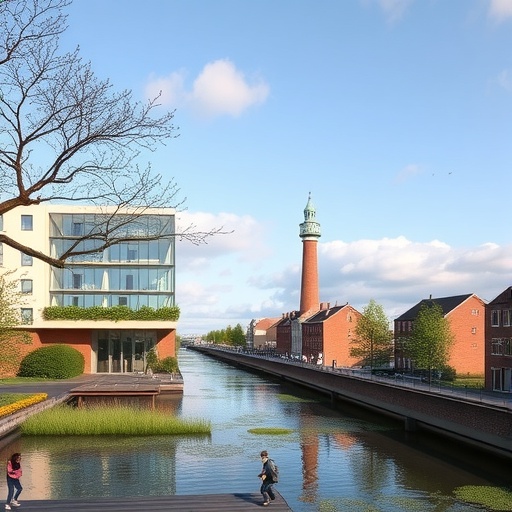
In the face of escalating climate crises, urban centers worldwide confront an urgent imperative: to innovate flood mitigation strategies that are both effective and adaptable. Recent research led by P.T. Schröder, T. Wübbelmann, and N. Kabisch, published in npj Urban Sustainability in 2025, brings a cutting-edge methodology to the fore—scenario-based modeling for implementing nature-based solutions (NBS) specifically tailored for the flood-prone city of Hannover. This novel approach promises a transformative leap in urban resilience planning by merging ecological restoration with advanced computational forecasting.
Flood risk in urban environments traditionally relies on engineered infrastructure such as levees, dams, and drainage systems. However, these structures often lack flexibility and can fall short in the face of extreme weather events exacerbated by climate change. The research in Hannover departs from this paradigm by advocating for nature-based solutions, interventions that work in harmony with natural processes to alleviate flooding impacts. Such interventions include expanding green spaces, restoring wetlands, permeable pavements, and urban reforestation—each serving as a natural barrier or buffer to excess water accumulation.
The crux of Schröder and colleagues’ work lies in the integration of scenario-based modeling—a dynamic analytical framework that evaluates multiple hypothetical futures under varying conditions of urban development, climate projections, and hydrological inputs. By simulating diverse scenarios, the model quantifies the efficacy of different NBS configurations, not simply as static plans but as adaptable strategies capable of responding to changing risk profiles.
Technically, the model harnesses high-resolution spatial data, detailed land-use classifications, and sophisticated hydrodynamic simulations to represent the urban landscape and its interactions with precipitation events. The fusion of Geographic Information Systems (GIS) with hydraulic modeling permits an intricate understanding of water flow paths, retention areas, and critical hotspots vulnerable to flooding. This holistic spatial and temporal analysis unveils the systemic interdependencies often overlooked in traditional flood risk assessments.
Crucially, the scenario-based framework enables stakeholders—from city planners to local communities—to visualize outcomes across a spectrum of interventions. For instance, scenarios comparing extensive vegetated buffer strips versus augmented stormwater retention ponds provide tangible insights into trade-offs between ecological benefits, flood mitigation capacity, and urban land-use constraints. This illuminates paths toward synergistic solutions that maximize co-benefits such as biodiversity enhancement, air quality improvements, and urban heat island mitigation.
In the case study of Hannover, the cityscape’s topography and hydrological network were meticulously characterized. Historical flood data, coupled with climate model projections for increased precipitation intensity and frequency, framed the baseline conditions. From there, the research progressed to layer NBS strategies incrementally—examining how each addition altered flood dynamics. The resulting simulations exposed the spatial variability of impact, revealing that targeted retrofitting in critical flood corridors yielded disproportionately high mitigation effects.
The potential scalability of this scenario-based modeling approach holds significant promise beyond Hannover. Urban areas worldwide grappling with similar climatic threats can adopt and customize this methodology, leveraging local data to craft bespoke NBS portfolios. By embedding adaptability through scenario planning, cities can better prepare for uncertainties inherent in climate change, avoiding the rigidity that has historically plagued traditional flood defenses.
Scientifically, the study advances the dialogue between environmental science, urban planning, and computational modeling. It argues convincingly for a paradigm shift where flood risk mitigation is not a one-dimensional engineering challenge but a multi-disciplinary endeavor intricately linked to ecology and social dynamics. The inclusion of community feedback in scenario development further enriches the approach, ensuring socially equitable solutions that resonate with local realities.
Moreover, this research underscores the vital role of ecosystem services, quantifying how natural landscapes function as critical infrastructure. Wetlands, for example, do more than just absorb water; they filter pollutants, provide habitat, and regulate microclimate. As the model demonstrates, preserving and enhancing these systems offers a multifaceted defense mechanism, reducing reliance on costly gray infrastructure investments.
The computational rigor underpinning the model sets a new benchmark in urban flood risk assessment. By employing Monte Carlo methods and sensitivity analyses, the researchers ensure robustness against data uncertainties and parameter variability. This statistical confidence bolsters the credibility of policy recommendations derived from the modeling outcomes, facilitating evidence-based decision-making at municipal levels.
Implementation pathways recommended within the study emphasize phased deployment aligned with urban development cycles, ensuring minimal disruption and maximizing stakeholder engagement. Flexibility provisions allow revisions as new data emerge or as climate scenarios evolve, reflecting a living strategy rather than a fixed blueprint. Such agility is essential in maintaining long-term efficacy amid the dynamic challenges of ecological and urban changes.
From an innovation standpoint, the research integrates emerging technologies such as remote sensing and real-time monitoring to refine model inputs continuously. This convergence of data streams enables proactive management and rapid response capabilities, turning theoretical models into actionable urban resilience tools. Coupling this with citizen science platforms fosters transparency and empowers communities to participate actively in safeguarding their environment.
The broader implications of this work resonate with global initiatives seeking sustainable urban futures aligned with the United Nations Sustainable Development Goals (SDGs). By prioritizing nature-based solutions, the approach mitigates flood risks while simultaneously enhancing urban livability and promoting climate adaptation, fulfilling multiple targets under SDG 11—Sustainable Cities and Communities.
In conclusion, Schröder, Wübbelmann, and Kabisch’s scenario-based modeling approach for implementing nature-based solutions represents a paradigm shift in urban flood risk management. It leverages advanced computational tools to integrate ecological restoration directly into urban planning, offering scalable, flexible, and socially conscious strategies that address the multifaceted challenges of contemporary cities. As extreme weather becomes the new norm, such innovative frameworks will be indispensable in crafting resilient urban landscapes capable of thriving amid uncertainty.
Subject of Research: Implementation of nature-based solutions for urban flood risk mitigation through scenario-based modeling, case study of Hannover, Germany.
Article Title: A scenario-based modelling approach to implementing nature-based solutions for flood risk mitigation in Hannover.
Article References:
Schröder, P.T., Wübbelmann, T. & Kabisch, N. A scenario-based modelling approach to implementing nature-based solutions for flood risk mitigation in Hannover. npj Urban Sustain (2025). https://doi.org/10.1038/s42949-025-00326-5
Image Credits: AI Generated


