

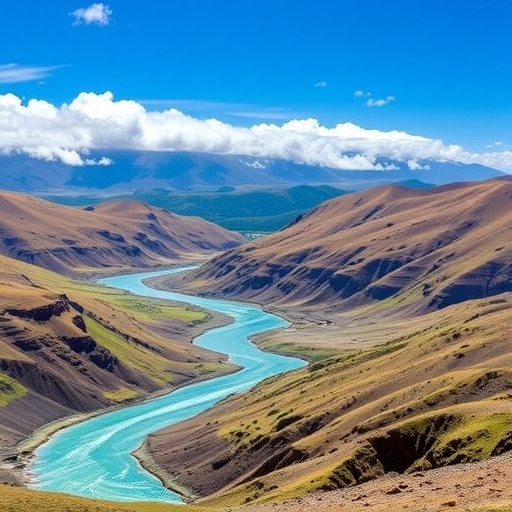
A groundbreaking study has recently illuminated the intricate and scale-dependent flood responses to the escalating climate extremes on the Tibetan Plateau, a region critical not only for its unique geography but also for its role in the hydrological dynamics of Asia. With climate change intensifying the frequency and magnitude of extreme weather events globally, understanding how floods respond differently across spatial scales on this vast plateau has become an urgent scientific endeavor. This research, published in Communications Earth & Environment, dissects the complexities of flood behaviors shaped by diverse climatic drivers and varying topographic and hydrological conditions.
The Tibetan Plateau, often referred to as the “Third Pole,” is sensitive to climate variability and change, housing some of the planet’s largest glacier reserves and acting as the source region for major Asian rivers. Flooding in this region impacts millions of residents downstream but has remained poorly understood in terms of how these events propagate at multiple scales—ranging from localized catchments to regional basins. The researchers employed an innovative analytical framework to unravel how flood dynamics are modulated by climate extremes differently depending on the geographical scale of observation, bridging critical knowledge gaps that hinder effective water resource management and disaster mitigation.
In their approach, the team integrated high-resolution climate data obtained from advanced remote sensing platforms alongside hydrological models calibrated to the Tibetan Plateau’s unique uplifted terrain and climatic heterogeneity. This allowed them to quantify the influence of atmospheric extremes such as intense precipitation, snowmelt pulses, and glacier melt on flood generation. Crucially, they revealed that the flood response exhibits pronounced scale dependency: small-scale basins are more sensitive to intense localized rainfall events, whereas large-scale river systems predominantly respond to gradual climatological trends including sustained warming and glacier retreat.
One of the pivotal discoveries is the contrasting flood regime shifts at different scales due to climate change. Smaller catchments are experiencing an increase in flash flood frequency and intensity, spurred by more extreme short-duration rainfall events. Conversely, at macro scales, flood peaks are increasingly influenced by heightened glacier meltwater contributions, leading to prolonged flood episodes that can last days to weeks. This duality underscores the necessity for tailored risk assessments and adaptive infrastructure planning that accounts for both immediate, rapid flood onset and sustained high river flows engendered by longer-term climatic alterations.
The authors also underscored the interconnectedness between cryospheric changes and flood hazards. As glaciers recede under warming conditions, the partitioning of water between runoff and storage shifts, altering downstream hydrological regimes. The shift is markedly non-linear and intertwined with precipitation patterns, making it challenging to predict flood scenarios without acknowledging the coupling of temperature, ice loss, and hydrological responses. Their findings illustrate that neglecting the scale-dependent nature of these interactions risks oversimplifying flood risk models, which could lead to underestimation or overestimation of hazards in different subregions.
To accomplish this integration, the research leveraged cutting-edge statistical tools capable of disentangling the relative contributions of different climatic forcing mechanisms on flood generation at various scales. These tools, including multi-scale wavelet analyses and spatially distributed hydrological simulations, allowed the team to discern patterns that traditional single-scale studies fail to capture. Moreover, the study’s methodology offers a potential blueprint for examining similar mountainous and glaciated regions experiencing rapid climate change, such as the Andes or Alps, thus contributing broadly to the field of climate impact assessment.
Implications from this study reach far beyond academic interest. The scale-dependent flood responses have direct ramifications for regional flood forecasting, infrastructure design, and policy-making. Emergency preparedness systems and flood mitigation strategies must account for spatial variability in flood characteristics imposed by climatic extremes. Regions relying on large rivers sourced from the plateau must anticipate prolonged high-flow conditions, while local communities in smaller catchments need enhanced early warning systems for flash floods. This calls for a paradigm shift in disaster management that incorporates multi-scale climate-hydrology interactions comprehensively.
Additionally, the research highlights the critical role of interdisciplinary collaboration. Understanding flood responses required not only climatological and hydrological expertise but also insights from geomorphology and glaciology. The complex feedback loops between climate drivers, landscape attributes, and hydrological processes demand integrated frameworks to project future hydroclimatic risks accurately. Such integrative science is vital as the Tibetan Plateau yet remains a data-sparse and logistically challenging environment for continuous monitoring.
In terms of future directions, the study advocates for expanding observational networks across the plateau to capture fine-scale hydrometeorological variability and glacier dynamics. Enhanced satellite missions combined with ground-based sensor arrays could improve the accuracy and temporal resolution of data inputs critical for refining flood prediction models. Incorporating climate model projections into hydrological simulations under different emission scenarios can further elucidate potential shifts in flood regimes, aiding stakeholders in adaptive water management planning under uncertainty.
Furthermore, this research underscores the importance of considering non-stationarity in flood frequency analyses induced by climate change. Traditional flood risk assessments often assume stable historical hydrological conditions, an assumption increasingly invalid in the face of rapid cryospheric and atmospheric transformations. The Tibetan Plateau exemplifies how evolving climatic extremes can disrupt past patterns, necessitating dynamic flood risk models that evolve with changing environmental baselines.
The nuanced understanding of scale-dependent flood responses presented by this study serves as a clarion call for both the scientific community and policy-makers. High-altitude regions worldwide, acting as Earth’s water towers, are undergoing profound hydrological shifts that complicate water resource management and disaster mitigation. Unpacking these complexities, as done here, is indispensable for crafting resilient strategies that safeguard vulnerable populations and ecosystems both regionally and downstream.
To summarize, this transformative research elucidates the multi-faceted ways in which climate extremes modulate flood risk on the Tibetan Plateau across spatial scales. By employing integrated data-driven approaches, it highlights the interplay between meteorological extremes, glacier melt, and hydrological responses that drive differential flood behaviors. These insights mark a significant advance in understanding mountain flood regimes under climate change, setting a new benchmark for global water hazard assessment in sensitive cryospheric regions.
As climate change continues to intensify, the study’s findings emphasize the urgency of developing adaptive, scale-aware flood management frameworks. Recognizing spatial heterogeneity in flood responses enables more precise forecasting and targeted interventions, which are vital for reducing flood impacts and securing sustainable livelihoods. The Tibetan Plateau stands at the nexus of these pivotal environmental transitions, symbolizing both the challenges and opportunities in confronting future hydroclimatic extremes.
The unprecedented rigor and scope of this research, published in the forefront journal Communications Earth & Environment, underscore its seminal contribution to climate science and hydrology. It paves the way for a paradigm shift in how flood risk is conceptualized in the world’s major mountain water towers, reaffirming the critical importance of scale-aware investigations in the Anthropocene. Through this lens, the findings deliver crucial knowledge for shaping climate adaptation strategies amidst accelerating global change.
Subject of Research: Scale-dependent flood responses to climate extremes over the Tibetan Plateau.
Article Title: Unraveling scale-dependent flood responses to changing climate extremes over the Tibetan Plateau.
Article References:
Li, X., Cui, P., Shen, P. et al. Unraveling scale-dependent flood responses to changing climate extremes over the Tibetan Plateau. Commun Earth Environ 7, 252 (2026). https://doi.org/10.1038/s43247-026-03413-2
Image Credits: AI Generated


