

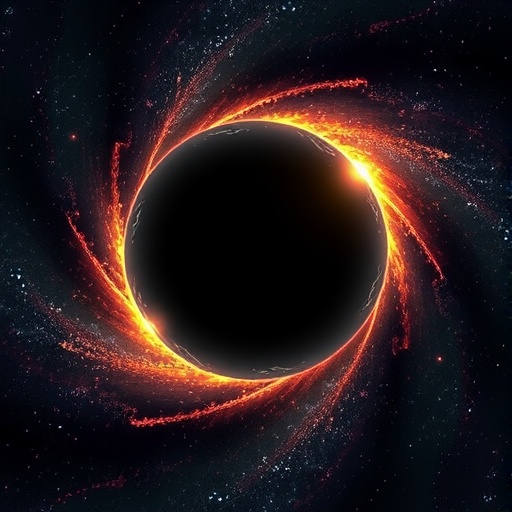
Black Holes Just Got Weirder: Scientists Uncover Spontaneous Scalarization and Dynamic Evolution in Scalar-Gauss-Bonnet Gravity
Prepare to have your understanding of the universe’s most enigmatic objects thoroughly shaken. Recent groundbreaking research published in the European Physical Journal C, “Spontaneous scalarization and dynamical evolution of black holes in scalar-Gauss-Bonnet gravity” by X. Ye, Y. Liu, and C.Y. Zhang, delves into the profound implications of a modified theory of gravity, revealing that black holes might possess a hidden dynamic personality, capable of spontaneously transforming and evolving in ways we never previously imagined. This isn’t just another theoretical curiosity; it’s a glimpse into a universe far richer and stranger than our current models allow, potentially reshaping our cosmic perspective and opening new avenues for astrophysical observation. The study’s findings suggest that black holes, far from being static, unchanging entities, can undergo dramatic transformations driven by a phenomenon termed “spontaneous scalarization,” a concept rooted in the intricate interplay between matter, spacetime, and exotic scalar fields.
The core of this revolutionary paper lies in the exploration of scalar-Gauss-Bonnet gravity, a theoretical framework that extends Einstein’s general relativity by introducing an additional scalar field coupled to the Gauss-Bonnet invariant. This invariant, a fundamental geometrical quantity in higher-dimensional spacetime, acts as a powerful modulator of gravitational interactions. In essence, this modified gravitational theory predicts that the presence of certain physical conditions, particularly those found in the extreme environments around black holes, can trigger the emergence of a scalar field. This field, unlike the graviton which mediates gravity, carries additional fundamental information and can influence the very structure and behavior of spacetime, leading black holes away from their simplistic, prediction-consistent-with-general-relativity existence.
What makes this research particularly electrifying is the concept of “spontaneous scalarization.” This phenomenon posits that under specific circumstances, black holes can transition from a familiar general relativistic state to a configuration endowed with a non-trivial scalar field. This transition is not initiated by external forces but arises intrinsically from the black hole itself, a self-generated transformation that effectively “activates” the scalar field. Imagine a black hole that, under its own immense gravitational influence, decides to sprout an extra dimension or characteristic, fundamentally altering its nature. This spontaneous emergence of scalar hair is a radical departure from the no-hair theorem, a cornerstone of black hole physics that suggests black holes are characterized only by their mass, charge, and angular momentum.
The dynamical evolution aspect of the research is equally compelling. Once spontaneously scalarized, these black holes are not static. The paper details how they can undergo continuous changes and transformations dictated by the dynamics of the scalar field and its interaction with the black hole’s spacetime. This implies that the appearance and properties of a black hole can evolve over time, making them dynamic entities rather than unchanging cosmic relics. This dynamic nature could lead to observable phenomena, such as varying gravitational wave signals or altered accretion disk behaviors, providing potential observational footprints for these exotic objects. The implications for understanding black hole mergers and their subsequent evolution are immense, suggesting a much more complex post-merger scenario than currently modeled.
The mathematical framework employed in this study is sophisticated, involving numerical simulations that grapple with the complex non-linear equations governing scalar-Gauss-Bonnet gravity. The researchers meticulously construct and evolve black hole solutions within this modified gravitational theory, carefully tracking how the scalar field behaves and influences the spacetime geometry. This rigorous computational approach allows them to visualize and quantify the spontaneous scalarization process and the subsequent dynamical evolution, providing concrete evidence for these unexpected black hole behaviors. The intricate dance between the scalar field, the black hole’s event horizon, and the surrounding spacetime is mapped out with remarkable detail.
One of the most profound implications of spontaneous scalarization is its potential to reconcile astrophysical observations with theoretical predictions. For decades, physicists have been searching for deviations from general relativity in strong gravitational fields. The existence of scalarized black holes could provide such a deviation, offering a natural explanation for anomalies observed in some black hole systems that current general relativity struggles to fully account for. This could lead to a re-evaluation of our understanding of gravity itself, especially in the extreme conditions where Einstein’s elegantly simple equations might reach their limit, hinting at a deeper, more intricate reality.
The term “scalar hair” is crucial here. In traditional general relativity, black holes are remarkably simple objects—bald, in a sense, as they lack any additional fields or complexities beyond their fundamental properties. Scalarization, however, implies that scalar-Gauss-Bonnet gravity can endow black holes with “scalar hair,” a scalar field that permeates the spacetime around them. This hair is not just a decorative addition; it fundamentally alters the gravitational influence and structure of the black hole, making it distinct from its general relativistic counterpart. The presence or absence of this scalar hair could be a critical observational discriminant between standard gravity and its scalar-Gauss-Bonnet variant.
Furthermore, the study explores the possibility of these scalarized black holes interacting with their environment in novel ways. The presence of the scalar field could influence the accretion of matter onto the black hole, the emission of jets, and the gravitational wave signatures produced during mergers. This opens up a rich landscape for observational cosmology and astrophysics. Telescopes like the Event Horizon Telescope, capable of imaging black hole shadows, and gravitational wave observatories like LIGO and Virgo, could potentially detect the subtle, yet significant, differences brought about by scalar hair and dynamical evolution. The cosmic symphony of gravitational waves might carry new notes unknown to us until now.
The paper also touches upon the stability of these scalarized black holes. Are they transient phenomena, or can they persist on cosmological timescales? The research suggests that under certain parameter regimes of scalar-Gauss-Bonnet gravity, scalarized black hole solutions can be stable, implying their potential ubiquity in the universe. The stability of these configurations is paramount for them to be considered plausible astrophysical objects rather than fleeting theoretical artifacts. The enduring presence of such objects would necessitate a significant revision of our galactic census and understanding of compact object populations.
The dynamical evolution aspect is where the story truly unfolds. The paper demonstrates that scalarized black holes can undergo phase transitions, merge with other black holes, and interact with surrounding matter in ways that are distinct from standard black holes. These dynamic processes could lead to observable signatures, such as unique gravitational wave chirps during mergers or peculiar patterns in the X-ray emissions from accreting matter. This dynamic nature suggests that black holes are not mere gravitational wells but rather evolving structures that actively participate in the cosmic drama, their very forms changing and adapting over vast cosmic epochs.
This research is a testament to the power of theoretical physics to push the boundaries of our cosmic knowledge. By venturing beyond the confines of established theories, scientists like Ye, Liu, and Zhang are uncovering new possibilities for how the universe operates at its most fundamental levels. The implications of spontaneous scalarization and dynamical evolution in black holes are far-reaching, potentially impacting our understanding of dark matter, dark energy, and the very fabric of spacetime. It underscores the idea that the universe is perpetually revealing new layers of complexity, challenging our preconceptions and inspiring further exploration.
The discovery that black holes can spontaneously change their fundamental properties challenges the long-held notion of their unchanging nature. The idea of them evolving dynamically suggests a universe in constant flux, where even the seemingly immutable can transform. This is a profound philosophical as well as scientific shift, prompting us to reconsider the very essence of permanence in the cosmos. The universe whispers secrets, and with each new discovery, we learn to listen closer, appreciating the subtle nuances that characterize its grand design.
The gravitational wave astronomy community, in particular, will be poring over these findings. The prospect of detecting unique gravitational wave signals from scalarized black hole mergers or other dynamic events offers incredible opportunities for future observations. Distinguishing these signals from those predicted by general relativity will be a major challenge, but also an exciting frontier for signal processing and data analysis in astrophysics. The quest to find these subtle but telling deviations from the norm is a testament to the ingenuity and persistence of scientific inquiry.
In conclusion, the work presented in the European Physical Journal C is a beacon of innovation in theoretical astrophysics. It presents a compelling case for the existence of black holes with “scalar hair” that can spontaneously emerge and dynamically evolve. This research not only enriches our theoretical understanding of gravity and black holes but also provides a tangible roadmap for future observational searches, potentially leading to paradigm shifts in our comprehension of the universe’s most extreme phenomena. The cosmos, it seems, is still full of surprises, and black holes are at the forefront of its most captivating mysteries.
Subject of Research: Spontaneous scalarization and dynamical evolution of black holes in scalar-Gauss-Bonnet gravity.
Article Title: Spontaneous scalarization and dynamical evolution of black holes in scalar-Gauss-Bonnet gravity.
Article References: Ye, X., Liu, Y. & Zhang, CY. Spontaneous scalarization and dynamical evolution of black holes in scalar-Gauss-Bonnet gravity.
Eur. Phys. J. C 86, 71 (2026). https://doi.org/10.1140/epjc/s10052-025-15272-w
Image Credits: AI Generated
DOI: https://doi.org/10.1140/epjc/s10052-025-15272-w
Keywords: Black holes, scalar-Gauss-Bonnet gravity, spontaneous scalarization, dynamical evolution, general relativity, scalar hair, modified gravity, astrophysics, cosmology, gravitational waves.


