

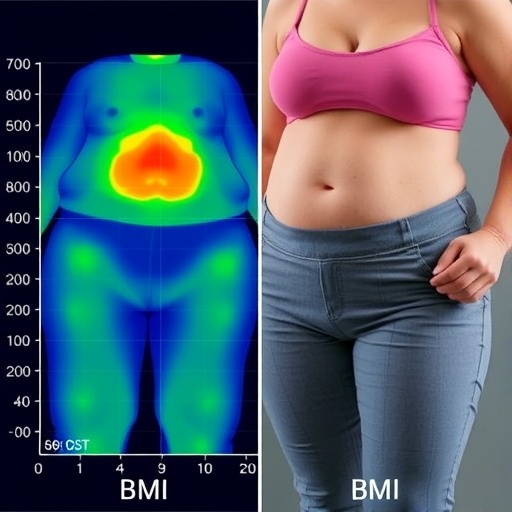
In the swiftly evolving landscape of geriatric health research, the complex interplay between physical and cognitive well-being continues to be a foremost concern among scientists and healthcare professionals. A recently published study in BMC Geriatrics by Dong, Wu, Chai, and colleagues offers a pioneering comparative analysis that delves into the nuances of sarcopenic obesity detection and its mental-cognitive implications among community-dwelling older adults. This investigation places particular emphasis on the methodological contrast between utilizing Body Mass Index (BMI) and waist circumference as diagnostic criteria, igniting important discussions surrounding the optimization of screening tools in this vulnerable population.
Sarcopenic obesity, a dual condition characterized by the coexistence of excess adiposity and diminished skeletal muscle mass coupled with impaired function, represents a burgeoning public health challenge. The condition is notoriously underdiagnosed due to the complexity of its physiological presentation, which can be masked by conventional obesity measures. The study under review critically examines how different anthropometric measures—namely BMI versus waist circumference—affect the accuracy and utility of sarcopenic obesity detection, highlighting the ramifications this has for identifying associated cognitive decline and mental health shifts in older adults.
Body Mass Index, a long-standing staple in clinical and epidemiological assessments, calculates an individual’s weight relative to the square of their height. Its widespread use is attributed to its simplicity and cost-effectiveness; however, it notoriously fails to discriminate between fat mass and muscle mass, potentially misclassifying individuals with sarcopenic obesity. This is notably problematic in aging populations, where muscle atrophy and fat redistribution occur concurrently. Conversely, waist circumference offers a more direct measurement of central adiposity, which recent evidence suggests may be more closely linked to metabolic dysfunction and neurodegenerative processes.
Dong et al.’s study systematically compares these two anthropometric metrics in a cohort of community-dwelling elders, analyzing not only their efficacy in detecting sarcopenic obesity but also their predictive power regarding mental and cognitive health outcomes. The researchers employed comprehensive assessments, including dual energy X-ray absorptiometry (DXA) for body composition and a battery of standardized cognitive tests to evaluate domains such as memory, executive function, and attention.
The findings reveal a significant disparity in sarcopenic obesity detection rates depending on the measurement method used. Waist circumference emerged as a superior indicator for central adiposity and correlated more robustly with declining muscle strength and physical performance metrics. It also demonstrated a stronger association with cognitive impairment and depressive symptomatology, phenomena increasingly recognized as linked to metabolic health. This challenges the prevailing reliance on BMI and underscores the critical importance of precise phenotyping in geriatric populations.
From a mechanistic perspective, the study emphasizes how central obesity contributes to systemic inflammation, insulin resistance, and subsequent neuroinflammation, pathways that have been implicated in the pathogenesis of cognitive decline and depression. Sarcopenic obesity creates a metabolic milieu that exacerbates these processes, suggesting that the physical manifestation of fat and muscle loss is intertwined with neurocognitive deterioration. By favoring waist circumference as a screening tool, clinicians may better target individuals experiencing these compounded pathologies early on.
The study also addresses the socio-demographic nuances influencing sarcopenic obesity prevalence and its cognitive consequences. Factors such as sex, socioeconomic status, and lifestyle behaviors modulate the risk profile and disease trajectory, highlighting that a one-size-fits-all approach to evaluation and intervention is inadequate. The utilization of waist circumference allows for more tailored risk stratification, promoting personalized healthcare strategies that may mitigate cognitive decline through targeted physical and nutritional interventions.
Mental health outcomes, particularly depressive symptoms, were found to be intricately linked with the presence of sarcopenic obesity when defined using waist circumference criteria. This supports accumulating evidence that physical health deterioration in the elderly often precipitates or exacerbates mental health disorders, feeding into a vicious cycle that undermines functional independence and quality of life. The study’s integrative approach, incorporating both physical and psychological dimensions, advocates for a holistic appraisal of aging adults in clinical settings.
Comparative evidence from this work also sheds light on the limitations and potential pitfalls of BMI-centric protocols in gerontological research and practice. While BMI remains an important epidemiological tool, its insensitivity to body composition changes undermines its value in predicting adverse outcomes that extend beyond cardiovascular and metabolic diseases to encompass cognitive and affective disorders. The study’s robust dataset and longitudinal design offer compelling arguments for revisiting clinical guidelines to incorporate waist circumference more systematically.
Importantly, this research advances the understanding of sarcopenic obesity as a multifaceted entity with widespread implications. It invites future investigations to explore underlying biological mechanisms that tie adiposity, muscle degeneration, and brain health into a singular trajectory of decline. It also prompts innovation in diagnostic technology and community health screening programs, emphasizing accessibility and accuracy in vulnerable aging populations.
Clinicians and public health strategists stand to benefit immensely from these insights, as early detection and intervention are paramount for ameliorating the burden of sarcopenic obesity and its neuropsychological sequelae. Multidisciplinary approaches, incorporating geriatricians, neurologists, nutritionists, and mental health professionals, are necessary to navigate the complex clinical presentations and optimize treatment outcomes.
While the study elucidates many aspects, it also raises critical questions about the standardization of diagnostic criteria and the integration of novel biomarkers in sarcopenic obesity evaluation. Future research directions may include longitudinal tracking of cognitive trajectories relative to changes in body composition and the efficacy of targeted lifestyle modifications or pharmacological therapies.
This work by Dong and colleagues undeniably preserves an innovative space in aging research by simultaneously addressing the physical and cognitive domains through a refined lens of anthropometric measurement. It galvanizes the scientific community to reconsider entrenched practices, urging the adoption of methodologies that better capture the intricate realities of aging physiology and neuropsychology.
The societal implications of this study resonate deeply, especially as global populations age and the prevalence of chronic diseases escalates. Effective public health responses rely on evidence-based protocols that marry cost-efficiency with diagnostic precision, and this study compellingly advocates for such an evolution in practice.
In conclusion, the comparative analysis of sarcopenic obesity detection via BMI versus waist circumference substantially advances the field’s grasp of how best to identify at-risk older adults and predict related cognitive and mental health outcomes. It is a clarion call for refined strategies in research, clinical practice, and health policy to better serve an aging world prone to complex interrelated morbidities.
Subject of Research: Sarcopenic obesity detection and mental-cognitive outcomes in older adults
Article Title: Comparative analysis of sarcopenic obesity detection and associated mental–cognitive outcomes in community-dwelling older adults: impact of using body mass index versus waist circumference
Article References:
Dong, P., Wu, H., Chai, Y. et al. Comparative analysis of sarcopenic obesity detection and associated mental–cognitive outcomes in community-dwelling older adults: impact of using body mass index versus waist circumference. BMC Geriatr (2026). https://doi.org/10.1186/s12877-026-07145-y
Image Credits: AI Generated


