
Sunday, April 5, 2026
Science
No Result
View All Result
  • Login
  • HOME
  • SCIENCE NEWS
  • CONTACT US
  • HOME
  • SCIENCE NEWS
  • CONTACT US
No Result
View All Result
Scienmag
No Result
View All Result
Home Science News Biology

Ruptured Achilles tendon shows faster repair amid plasma irradiation treatment

May 21, 2024
in Biology
Reading Time: 3 mins read
0
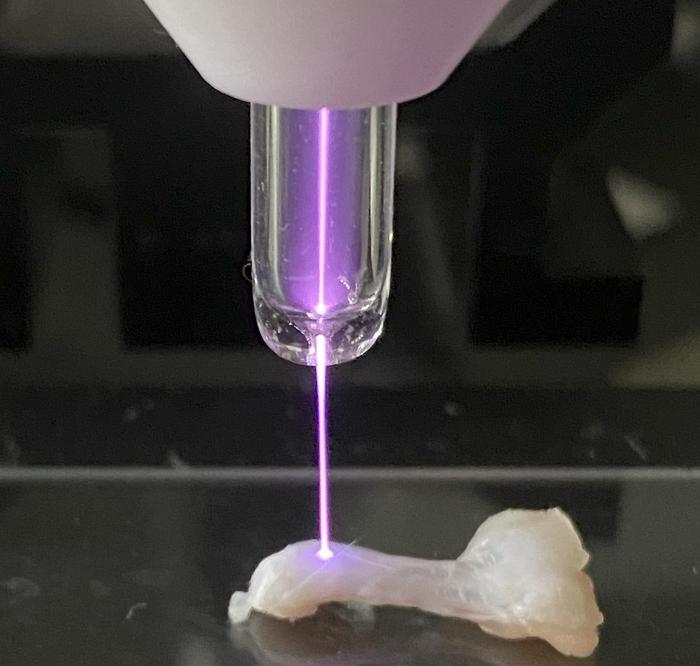
Plasma irradiation treatment
66
SHARES
602
VIEWS
Share on FacebookShare on Twitter
ADVERTISEMENT

What is the largest ligament in the human body? It might surprise some people that it is the Achilles tendon. Even though it is also considered the toughest ligament, the Achilles tendon can rupture, with many such injuries involving sports enthusiasts in their 30s or 40s. Surgery might be required, and a prolonged period of rest, immobilization, and treatment can be difficult to endure.

Plasma irradiation treatment

Credit: Osaka Metropolitan University

What is the largest ligament in the human body? It might surprise some people that it is the Achilles tendon. Even though it is also considered the toughest ligament, the Achilles tendon can rupture, with many such injuries involving sports enthusiasts in their 30s or 40s. Surgery might be required, and a prolonged period of rest, immobilization, and treatment can be difficult to endure.

Seeking to shorten the recovery time, a research team led by Osaka Metropolitan University Graduate School of Medicine’s Katsumasa Nakazawa, a graduate student in the Department of Orthopedic Surgery, Associate Professor Hiromitsu Toyoda, and Professor Hiroaki Nakamura, and Graduate School of Engineering Professor Jun-Seok Oh has focused on non-thermal atmospheric-pressure plasma as a treatment method.

This study is the first to show that such plasma irradiation can accelerate tendon repair. The team ruptured then sutured the Achilles tendon of lab rats. For one group of rats, the sutured area was irradiated with a helium plasma jet. The plasma-irradiated group exhibited faster tendon regeneration and increased strength at two, four, and six weeks after surgery compared to the untreated group.

“We have previously discovered that irradiation of non-thermal atmospheric-pressure plasma has the effect of promoting bone regeneration. In this study, we discovered that the technology also promotes tendon regeneration and healing, showing that it has applications for a wide range of fields,” Professor Toyoda declared. “Combined with current tendon treatments, it is expected to contribute to more reliable tendon regeneration and shorter treatment time.”

The results were published in PLOS ONE.

###

About OMU 

Established in Osaka as one of the largest public universities in Japan, Osaka Metropolitan University is committed to shaping the future of society through “Convergence of Knowledge” and the promotion of world-class research. For more research news, visit and follow us on social media: X, Facebook, Instagram, LinkedIn.


Journal

PLoS ONE

DOI

10.1371/journal.pone.0301216

Method of Research

Experimental study

Subject of Research

Animals

Article Title

In vivo study on the repair of Rat Achilles tendon injury treated with non-thermal atmospheric-pressure helium microplasma jet

Article Publication Date

14-May-2024

COI Statement

The authors have declared that no competing interests exist.

Share26Tweet17
Previous Post

One in 5 adults in Canada without access to primary care

Next Post

‘Silent demise’ of vast rangelands threatens climate, food, wellbeing of billions: UN Convention to Combat Desertification

Related Posts

blank
Biology

Damselfly Mating Strategies Shed Light on Reproductive Barriers

April 4, 2026
blank
Biology

Custom Biochar Approaches Enhance Alfalfa Growth and Stress Tolerance in Saline Soils

April 3, 2026
blank
Biology

Mutant Clownfish Sheds Light on How Nature Defines Boundaries

April 3, 2026
blank
Biology

Scientists Discover How Bacterial Enzyme Breaks Down Sturdy Collagen

April 3, 2026
blank
Biology

Lipid Build-Up Blocks Immune Response in Tuberculosis

April 3, 2026
blank
Biology

How the Human Brain Constructs Our Sense of Time

April 3, 2026
Next Post
Cover of the new UN CCD report

‘Silent demise’ of vast rangelands threatens climate, food, wellbeing of billions: UN Convention to Combat Desertification

  • Mothers who receive childcare support from maternal grandparents show more parental warmth, finds NTU Singapore study

    Mothers who receive childcare support from maternal grandparents show more parental warmth, finds NTU Singapore study

    27632 shares
    Share 11049 Tweet 6906
  • University of Seville Breaks 120-Year-Old Mystery, Revises a Key Einstein Concept

    1034 shares
    Share 414 Tweet 259
  • Bee body mass, pathogens and local climate influence heat tolerance

    674 shares
    Share 270 Tweet 169
  • Researchers record first-ever images and data of a shark experiencing a boat strike

    537 shares
    Share 215 Tweet 134
  • Groundbreaking Clinical Trial Reveals Lubiprostone Enhances Kidney Function

    523 shares
    Share 209 Tweet 131
Science

Embark on a thrilling journey of discovery with Scienmag.com—your ultimate source for cutting-edge breakthroughs. Immerse yourself in a world where curiosity knows no limits and tomorrow’s possibilities become today’s reality!

RECENT NEWS

  • Clinical Outcomes and Risks in Post-Ibrutinib Transplant
  • Whole-Body MRI Predicts Ovarian Cancer Treatment Outcomes
  • Distributed Fusion Framework Predicts Breast Cancer Recurrence
  • Inside TCF3::HLF-Positive B-ALL: Clinical and Molecular Insights

Categories

  • Agriculture
  • Anthropology
  • Archaeology
  • Athmospheric
  • Biology
  • Biotechnology
  • Blog
  • Bussines
  • Cancer
  • Chemistry
  • Climate
  • Earth Science
  • Editorial Policy
  • Marine
  • Mathematics
  • Medicine
  • Pediatry
  • Policy
  • Psychology & Psychiatry
  • Science Education
  • Social Science
  • Space
  • Technology and Engineering

Subscribe to Blog via Email

Success! An email was just sent to confirm your subscription. Please find the email now and click 'Confirm Follow' to start subscribing.

Join 5,146 other subscribers

© 2025 Scienmag - Science Magazine

Welcome Back!

Login to your account below

Forgotten Password?

Retrieve your password

Please enter your username or email address to reset your password.

Log In
No Result
View All Result
  • HOME
  • SCIENCE NEWS
  • CONTACT US

© 2025 Scienmag - Science Magazine