

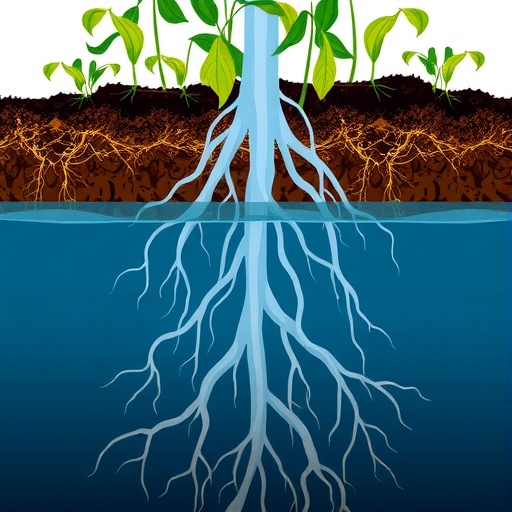
In recent years, the field of environmental science has drawn significant attention to the intricate relationship between root systems and soil water dynamics. A groundbreaking study led by a team of researchers comprising Tang, Ba, and Zhang, among others, has unveiled the dual functions of root systems in balancing soil water flow behavior. Their findings, which will be published in the journal Commun Earth Environ in 2025, have the potential to revolutionize our understanding of plant-soil interactions and their implications for ecosystem management, agriculture, and climate resilience.
The roots of plants serve not only as anchors in the soil but also perform vital physiological functions that significantly affect how water is distributed within the soil. This balancing act is crucial because the way water flows through the soil can influence everything from crop yields to the health of entire ecosystems. The team’s research offers new insights into how root systems facilitate both the retention and drainage of water, effectively balancing these opposing forces to enhance soil moisture levels.
In their investigation, the researchers employed a comprehensive methodology that combined field experiments with advanced computational modeling. They meticulously measured soil water content and analyzed the corresponding growth patterns and root development of various plant species in differing environmental conditions. This approach allowed them to evaluate how different root architectures adapt to maintain optimal water levels in the soil. The implications of such adaptations are profound, considering the increasing challenges posed by climate variability and extreme weather events.
At the heart of this study lies the concept of root morphology, which refers to the form and structure of root systems. The research demonstrates that plants with certain root configurations can significantly enhance soil water retention. For example, fibrous root systems with extensive lateral branching are shown to create greater soil porosity, facilitating better water infiltration. On the other hand, taproot systems can effectively access deeper water reserves, essential during prolonged dry spells. The dual functionality of these root types suggests a sophisticated evolutionary response to environmental stresses, enabling plants to thrive despite fluctuating water availability.
Over the course of their research, the team also investigated the role of root exudates—organic compounds secreted by roots that affect the surrounding soil environment. These exudates stimulate microbial activity, enhancing soil health and improving structure, thereby contributing to water retention capabilities. Such interactions highlight the importance of biological processes in soil systems, indicating that healthy root systems not only provide direct benefits to plants but also contribute to broader ecosystem stability.
Moreover, the researchers emphasized the significance of understanding water flow behavior in the context of hydrological cycles. The balance achieved by root systems in managing soil water dynamics ultimately has implications for groundwater recharge and surface runoff, crucial components in maintaining the hydrological equilibrium of natural and agricultural landscapes. Their findings suggest that optimizing plant root systems—not merely for maximum growth, but for efficient water management—should be a priority in both agricultural practices and reforestation efforts.
The implications of Tang et al.’s research extend to agricultural strategies, especially in regions prone to drought. By selecting plant varieties with root systems adept at balancing soil water flow, farmers can potentially increase yields while reducing dependency on irrigation. This finding presents a compelling case for the incorporation of root system characteristics as selection criteria in crop breeding programs. As global climate patterns become increasingly unpredictable, the ability to maintain soil moisture is paramount for sustainable food production.
Additionally, the study’s insights regarding soil water behavior can inform policies related to land management and environmental conservation. Understanding how different plant species interact with soil moisture dynamics provides critical information for restoring degraded lands, enhancing biodiversity, and promoting resilience against climate change impacts. The incorporation of these ecological principles into land management frameworks could lead to better outcomes for both agricultural productivity and environmental sustainability.
Furthermore, this research aligns with global initiatives aimed at promoting sustainable practices in agriculture and forestry. With increasing population pressures and heightened demands for food production, conventional farming practices often lead to soil degradation and water scarcity. By harnessing the insights gleaned from this study, policymakers and farmers can work together to implement innovative strategies that prioritize ecological health while meeting the needs of a growing populace.
In conclusion, the research conducted by Tang and colleagues illuminates the critical role of root systems in balancing soil water flow behavior, emphasizing a dual function that has been underexplored until now. As we advance toward a future marked by climate uncertainty, understanding the complexities of plant-soil interactions will be essential in developing sustainable approaches to resource management. The findings from this study provide a foundational basis for further exploration into the relationship between plants and their environment, ultimately guiding efforts to mitigate the effects of climate change on agricultural landscapes.
The journey of discovery in understanding plant root systems and their hydraulic functions is just beginning. Ongoing research is likely to uncover even more intricate relationships and mechanisms that govern water dynamics in soil, allowing us to harness these insights for the betterment of agricultural practices and environmental resilience.
Such advancements promise to enrich not only scientific discourse but also practical applications that can shape the future of food security and ecological sustainability. As experts continue to dissect these complex interactions, the lessons derived from root system dynamics will undeniably play a pivotal role in revolutionizing our approach to environmental stewardship and agricultural innovation.
In summary, the dual functionality of root systems in maintaining soil water flow behavior presents an exciting frontier in ecological research, with wide-ranging implications for agriculture, climate resilience, and ecosystem health. The ongoing dialogue between researchers, policymakers, and farmers will be crucial in translating these scientific insights into actionable strategies for a more sustainable future.
Subject of Research: Dual function of root systems in balancing soil water flow behavior
Article Title: Dual function of root systems in balancing soil water flow behavior
Article References:
Tang, Z., Ba, H., Zhang, W. et al. Dual function of root systems in balancing soil water flow behavior. Commun Earth Environ (2025). https://doi.org/10.1038/s43247-025-03062-x
Image Credits: AI Generated
DOI:
Keywords: Root systems, soil water dynamics, crop yields, environmental science, sustainable agriculture, climate resilience.


