

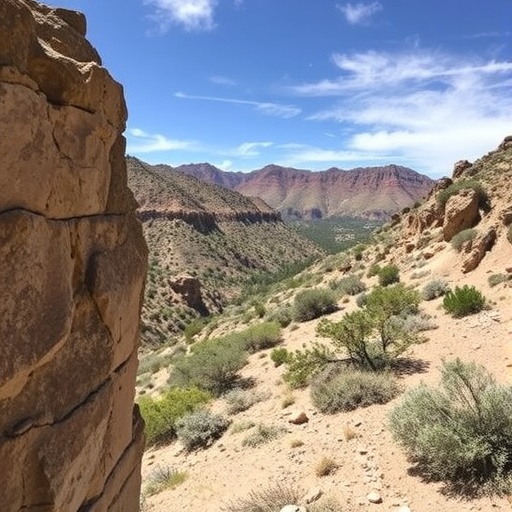
In a groundbreaking study, researchers led by W. Liao and colleagues have unveiled significant findings regarding the phenological shifts in vegetation resulting from the governance of rocky desertification. This issue has emerged as a critical environmental challenge, particularly in arid and semi-arid regions where land degradation hampers agricultural productivity and threatens biodiversity. The implications of this research are vast, as the study meticulously structures the narrative around both the spatiotemporal characteristics of vegetation changes and the underlying driving mechanisms at play.
The study highlights that rocky desertification is not merely a backdrop to biological shifts but a catalyst that can alter the timing of biological events, such as flowering and leafing, which can significantly impact ecological interactions and agricultural yields. The researchers employed advanced remote sensing technology and rigorous data analysis to observe and depict these changes over time, ensuring that their findings are grounded in empirical evidence.
Throughout the study, a myriad of factors driving these phenological shifts was identified. Climate change was recognized as a central player, exacerbating existing environmental conditions and influencing plant growth patterns. The interplay of temperature, precipitation, and land use changes lighted pathways for understanding how human actions intersect with natural phenomena, crafting a narrative of interaction where governance strategies can lead to notable vegetation recovery or decline.
The research articulates the concept that effective governance of rocky desertification involves not only immediate remedial measures but also requires foresight in managing ecosystems sustainably. By reinforcing the importance of policy frameworks, the study indicates that successful interventions have the power to reverse adverse ecological trends, facilitate biodiversity, and enhance ecosystem services. Policymakers are therefore called upon to amplify these findings into actionable strategies that can mitigate the effects of desertification while promoting vegetation health.
Further emphasizing the implications of their findings, the researchers illustrate how altered vegetation phenology can lead to cascading effects within ecosystems. Changes in flowering times, for example, can misalign the life cycles of pollinators, thus threatening food production and ecological balance. Furthermore, these misalignments can affect local fauna that depend on specific flora for food and habitat, leading to potential biodiversity loss and ecosystem destabilization.
The researchers highlight that traditional models of desertification often overlook the dynamic nature of ecological responses. This study integrates a multifaceted view, demonstrating that vegetation recovery is not linear. Rather, it can lead to sudden changes in growth patterns that reflect the resilience of ecosystems or their vulnerability under stress. Such revelations prompt a reevaluation of how we approach conservation efforts and restoration initiatives on landscapes affected by rocky desertification.
One of the compelling case studies presented involved a region significantly impacted by desiccation, where governance strategies have been employed successfully. The data revealed notable advancements in vegetation recovery during the post-intervention phase, underscoring the potential for policy to foster positive ecological outcomes. These findings serve as a beacon of hope for policymakers who are grappling with desertification and its effects on local ecosystems and economies.
The study further delves into the technological innovations that are redefining how we monitor and assess these environmental changes. By employing remote sensing technologies, the researchers developed a sophisticated array of analytical tools capable of tracking minute changes in vegetation patterns over vast geographical areas. This approach not only enhances our understanding of how governance impacts ecological health but also sets a precedent for future research methodologies in environmental sciences.
Moreover, the research team discusses the broader implications of their findings for climate change initiatives. Understanding the relationship between desertification governance and vegetation phenology offers critical insights for global climate strategies. As nations strive to meet their climate goals, integrating these insights can be pivotal in developing holistic approaches that align environmental restoration with climate resilience.
The study by Liao and colleagues signifies a paradigm shift in our understanding of vegetation dynamics in the face of rocky desertification. By connecting the dots between governance, climate factors, and ecological responses, the research lays the groundwork for more integrated management practices. As scientists and policymakers grapple with the challenges of sustainability in an era of rapid environmental change, this study offers a pathway that not only addresses immediate ecological concerns but also promotes long-term ecosystem health.
Ultimately, the evidence presented in this study asserts the necessity of adopting a systems-thinking approach to governance and management strategies concerning desertification. The research outlines that successful interventions should be multifaceted, incorporating community engagement, technological advancements, and policy reform to achieve meaningful and lasting change. This comprehensive perspective is crucial for fostering resilience in ecosystems that face the relentless pressures of climate change and human activity.
As the topic of rocky desertification governance gains traction, continued research will be essential in uncovering additional layers of complexity within these ecosystems. The quest for knowledge continues, with the hope that such studies will empower stakeholders to make informed, responsible decisions that benefit both the environment and society. This work not only positions itself at the forefront of environmental research but also serves as a clarion call to action to protect the planet’s fragile ecosystems.
Moving forward, the outcomes of this study have the potential to influence policy at multiple levels, from local governance to international frameworks. As nations worldwide confront the impending crises of biodiversity loss and climate change, understanding the consequences of governance on phenological patterns becomes paramount. The importance of this research cannot be overstated; it represents a critical intersection of ecology, governance, climate policy, and community action that could pave the way for more sustainable environmental futures.
This exploration of rocky desertification governance signifies a vital addition to the conversation around climate resilience and sustainable ecological management. The findings set the stage for deeper inquiry into how we might live harmoniously with nature while actively working to restore and rejuvenate the ecosystems that sustain us. By embracing innovation and a multidisciplinary approach, society can move closer toward a sustainable future where nature and governance coalesce to foster thriving ecosystems.
In conclusion, Liao et al.’s investigation into the phenological shifts caused by rocky desertification governance is a call to arms for scientists, policymakers, and communities alike. It serves as a foundational pillar for future explorations into the complexities of our natural world and reminds us of the profound connections that exist between human actions and ecological realities.
Subject of Research: The impact of rocky desertification governance on vegetation phenology, examining spatiotemporal characteristics and driving mechanisms.
Article Title: Vegetation phenological shift induced by rocky desertification governance: spatiotemporal characteristics and driving mechanisms.
Article References:
Liao, W., Wei, Z., Wei, M. et al. Vegetation phenological shift induced by rocky desertification governance: spatiotemporal characteristics and driving mechanisms.
Environ Monit Assess 197, 1314 (2025). https://doi.org/10.1007/s10661-025-14768-y
Image Credits: AI Generated
DOI: https://doi.org/10.1007/s10661-025-14768-y
Keywords: Vegetation phenology, rocky desertification, climate change, ecological governance, remote sensing, biodiversity, environmental sustainability.


