

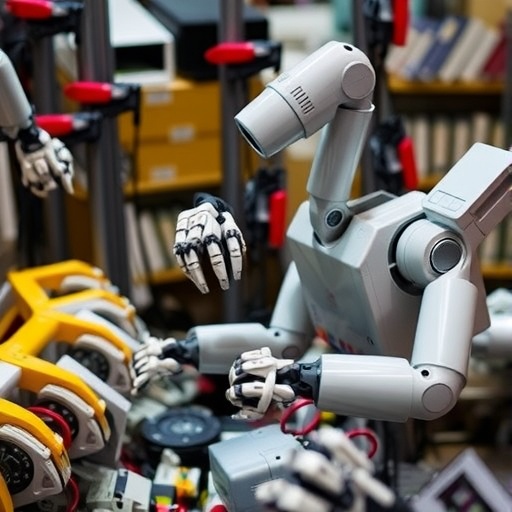
In a groundbreaking study published in the journal “Autonomous Robots,” researchers led by S. Lachhiramka, along with colleagues Pradeep J and A.A. Chandaragi, unveiled an innovative approach to robotic manipulation that promises to revolutionize the way robots interact with cluttered environments. The research, titled “Autonomous robotic manipulation for grasping a target object in cluttered environments,” focuses on the complexities and technical challenges that robots face when tasked with grasping objects surrounded by a myriad of distractions. This study marks a significant step forward in the field of robotics, particularly in improving the functionality and autonomy of robots in real-world applications.
The primary objective of this research was to develop a system that allows robots to autonomously identify and grasp target objects even when faced with obstructions. In many scenarios, the presence of clutter complicates simple robot tasks that humans often take for granted. Think of a restaurant kitchen, a workbench filled with tools, or a home space strewn with various items. In such environments, the ability of robots to adapt and make decisions based on their surroundings is crucial for achieving practical applications. The authors delve into various methodologies to enhance robotic perception and decision-making capabilities.
One of the notable methodologies presented in this research involves advanced computer vision techniques that provide robots with the ability to identify objects in a cluttered space. By employing state-of-the-art deep learning algorithms, the robots can analyze visual data and determine the most effective approach for grasping an object. This is a marked improvement over conventional methods, which often require manual programming and predefined movements. Through the integration of machine learning, the robots can learn from past experiences and refine their grasping strategies based on situational feedback.
Another cornerstone of the research is the development of sophisticated manipulation algorithms. The robot’s ability to not only locate but also effectively grab objects is pivotal to its overall functionality. The authors describe how these algorithms employ a combination of force control and trajectory planning to ensure secure and adaptable grasping actions. For instance, the algorithm can adjust the amount of grip force applied to an object based on its shape and material properties. This fine-tuning capability allows robots to handle a diverse range of objects, from delicate glassware to cumbersome tools, without incurring damage or losing efficiency.
The experimental setup presented by Lachhiramka and colleagues is equally impressive. They conducted extensive trials in both simulated and real-world cluttered environments, showcasing the versatility and robustness of their proposed methods. The robots demonstrated a significant improvement in success rates compared to previous robotic systems, illustrating not only their ability to find and grasp objects but also to adapt to unpredicted scenarios. The results of these experiments underscore the viability of using autonomous robots in practical settings—whether in warehouses, homes, or service industries.
Moreover, the research provides valuable insights into the multi-modal training processes employed to enhance the robots’ capabilities. Utilizing reinforcement learning, the robots undergo a series of training sessions in which they receive feedback based on their performance. This iterative process allows for continuous improvement, leading to increasingly refined grasping techniques. The findings indicate that the implementation of such training methodologies contributes significantly to the robots’ ability to operate efficiently in chaotic environments.
An intriguing aspect of this study is its exploration of the interaction between perception and manipulation. The authors argue that these two functions should not be viewed in isolation. Instead, an integrated approach can make robots significantly more effective. Through tight coupling of sensory data and motor commands, a feedback loop is established that improves the robot’s responsiveness to changing conditions. This synergy between perception and action allows for a more cohesive strategy when navigating through clutter, enhancing overall task performance.
The implications of Lachhiramka’s research extend far beyond laboratory experimentation. As industries increasingly adopt automation to streamline operations, the ability of robots to autonomously interact with their environments will become crucial. From logistics and manufacturing to telemedicine and domestic assistance, the potential applications for such technology are vast. The promise of autonomous robotic manipulation could herald a new era where robots seamlessly integrate into daily human activities, working alongside us to enhance productivity and improve quality of life.
Furthermore, the study’s findings could pave the way for further advancements in the field of human-robot collaboration. As robots become more adept at navigating cluttered spaces, their roles could evolve from simple task execution to more complex collaborative functions. This might include tasks such as assisting elderly individuals with daily chores or supporting warehouse workers in inventory management. By ensuring that robots can recognize and manipulate objects within cluttered environments, we inch closer to a future where technology truly complements human capabilities.
The feedback received from the robotics community has been overwhelmingly positive, with experts hailing the work as a significant contribution to the field. As technology giants and research institutions race to develop the next generation of intelligent robots, studies like this one provide a critical foundation for building more capable, adaptable machines. The advancements in robotic perception and manipulation highlighted by Lachhiramka and his colleagues serve as a beacon of innovation, pointing the way toward smarter, more efficient automated systems.
As we move into the future, the importance of such research cannot be overstated. The integration of advanced robotics into various sectors necessitates a thoughtful and well-researched approach to ensure safety and efficacy. Lachhiramka’s study stands as a testament to the relentless pursuit of understanding and enhancing how machines can operate autonomously amidst the chaos of the real world. With each new discovery and innovation, we take another step along the path to achieving truly autonomous robots capable of grasping their surroundings just as adeptly as humans can.
In conclusion, the research led by Lachhiramka et al. is a remarkable leap toward the realization of highly functional autonomous robots. By addressing the challenges posed by cluttered environments and improving object manipulation techniques, this study lays the groundwork for a future where robots can assist effectively in everyday tasks. The combination of advanced perception, sophisticated manipulation algorithms, and intelligent training methodologies demonstrates the research team’s commitment to pushing the boundaries of what is technologically possible. As this field continues to evolve, we can anticipate revolutionary changes in the role of robots in society—an exciting prospect that underscores the importance of ongoing research in autonomous robotics.
Subject of Research: Autonomous robotic manipulation in cluttered environments
Article Title: Autonomous robotic manipulation for grasping a target object in cluttered environments
Article References:
Lachhiramka, S., Pradeep J, Chandaragi, A.A. et al. Autonomous robotic manipulation for grasping a target object in cluttered environments.
Auton Robot 49, 30 (2025). https://doi.org/10.1007/s10514-025-10214-7
Image Credits: AI Generated
DOI:
Keywords: Autonomous robotics, manipulation, object grasping, cluttered environments, machine learning, computer vision, reinforcement learning.


