

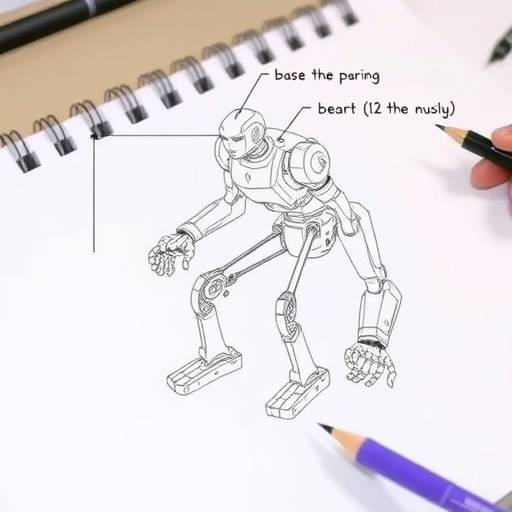
In the continuously evolving landscape of artificial intelligence and robotics, researchers are consistently seeking innovative methodologies to expand the capabilities and functionalities of robots. Emerging as a significant advancement in this field, the newly proposed framework, termed L2D2, revolutionizes the concept of how robots learn from 2D drawings. This initiative, framed within the research of Mehta, Nemlekar, and Sumant, reveals a striking paradigm shift towards enhancing robotic learning using visual representations.
The core idea behind L2D2 revolves around utilizing two-dimensional illustrations as a means for robots to comprehend and execute tasks. This concept is not merely about recognizing shapes and lines but delves deeper into understanding the semantics behind these visual cues. The methodology presented by the researchers proposes a system where robots can interpret drawings similarly to how humans do, inferring meanings and recognizing contextual information that is often implicit in such representations.
Robots historically have relied on three-dimensional environments to understand their surroundings and learn about tasks. However, the dependence on complex 3D models presents significant challenges, such as the time-consuming nature of scanning environments and the computational resources required to process 3D data effectively. L2D2 significantly alleviates these hurdles by allowing robots to abstractly think about tasks depicted in simpler, more universally understandable 2D drawings.
The technical intricacies behind L2D2 incorporate sophisticated machine learning techniques that harness the power of neural networks to interpret visual inputs. By training on vast datasets of 2D drawings coupled with their corresponding task outcomes, the robots develop a robust understanding of how to translate these drawings into actionable commands. The potential applications of this technology are extensive, encompassing fields like education, art, and industrial design, where interpreting 2D sketches is intrinsic to the workflow.
Moreover, the implications of L2D2 stretch beyond practicality. They provoke an ethical discussion about the collaboration between humans and robots. As machines begin to understand human art, designs, and ideas, there is a burgeoning need to reflect on the creative dimensions of AI. By empowering robots to learn from drawings, we are not only enhancing their utility in design tasks but also nurturing a new form of interaction where human creativity intertwines with machine learning abilities.
In addition to its practical applications, L2D2 offers intriguing insights into cognitive science. The ability of robots to learn from simplified representations raises questions about how intelligence is perceived across species—including our own. The researchers have tapped into a psychological approach by allowing robots to engage with visual imagery, presenting parallels to how human beings learn and retain information through visual clues. This convergence of technology and cognitive theory enriches our understanding of artificial intelligence and how it mirrors human cognitive processes.
It’s crucial to mention the system’s adaptability in various contexts. Not only does L2D2 facilitate learning in task-oriented scenarios, but it also encourages creativity in robots. As robots grasp the nuances of artistic expressions from drawings, they may begin to create original work, suggesting a future where machine-generated art gains acceptance within cultural conversations. This is an expansive vision that could reshape the boundaries of creativity, challenging traditional thoughts surrounding artistic authorship.
Additionally, the implications of L2D2 extend into areas like rapid prototyping and user interface design. By allowing robots to comprehend 2D sketches, designers and engineers can efficiently communicate their ideas without transitioning through multiple stages of representation. This can fast-track development cycles, saving both time and resources, while promoting a more fluid exchange of ideas between human creators and robotic assistants.
The transformative potential of L2D2 is underscored by its accessible nature. The standardization of learning from 2D drawings means that various forms of illustrative content can be utilized for training purposes. As a consequence, practically anyone with the ability to sketch or draw can engage with robots on a new level, democratizing access to robotics and artificial intelligence, and ultimately narrowing the gap between people and technology.
Despite the ambitious goals underpinning L2D2, challenges remain. For instance, ensuring the accuracy and reliability of the robot’s understanding of drawings poses critical questions regarding the training data’s diversity and representativeness. To address these concerns, continuous updates to the datasets and iterative training of the models will be imperative, fostering a dynamic learning environment responsive to evolving artistic and design sensibilities.
Nevertheless, the excitement surrounding L2D2 encapsulates a broader trend in AI—one that emphasizes the importance of visual and creative cognition as part of a machine’s learning repertoire. With the ongoing advancements in technology coupled with interdisciplinary insights from psychology and art, the future is bright for the interfusion of human creativity and robotic adaptability.
As researchers such as Mehta, Nemlekar, and Sumant continue to explore the depths of robotic learning, L2D2 exemplifies a remarkable leap towards merging the worlds of art and technology. It invites us to reimagine not only how robots learn but also the fundamental relationship we hold with machines in an increasingly automated society. As we stand on the precipice of this technological revolution, one thing remains clear—the potential of AI to engage with human creativity is vast and largely untapped, paving the way for innovative collaborations yet to be imagined.
This pioneering approach establishes a vital framework that can empower robots to comprehend and interpret human thoughts and ideas laid out through drawings, thereby fostering a collaborative future where humans and robots can coexist creatively. The exciting possibilities presented by L2D2 may redefine our understanding of intelligence and herald a new era of synergy between mankind and machines, offering limitless paths of exploration and discovery.
Still, as we embrace these advancements, we must remain vigilant about the ethical considerations that accompany such technologies. Reflexive thought around the implications of machines interpreting human creativity will be vital as we navigate this new frontier, ensuring that as we innovate, we also contemplate the social and cultural dimensions of our evolving interaction with technology.
In summary, as the development of L2D2 unfolds, it stands as a testament to the intersection of art and artificial intelligence, promising to redefine not just robotic function but the essence of creativity itself in the digital age.
Subject of Research: Robot Learning from 2D Drawings
Article Title: L2D2: Robot Learning from 2D drawings
Article References: Mehta, S.A., Nemlekar, H., Sumant, H. et al. L2D2: Robot Learning from 2D drawings. Auton Robot 49, 25 (2025). https://doi.org/10.1007/s10514-025-10210-x
Image Credits: AI Generated
DOI: 10.1007/s10514-025-10210-x
Keywords: Robot Learning, 2D Drawings, Artificial Intelligence, Cognitive Science, Machine Learning, Human-Robot Interaction, Creative AI.


