

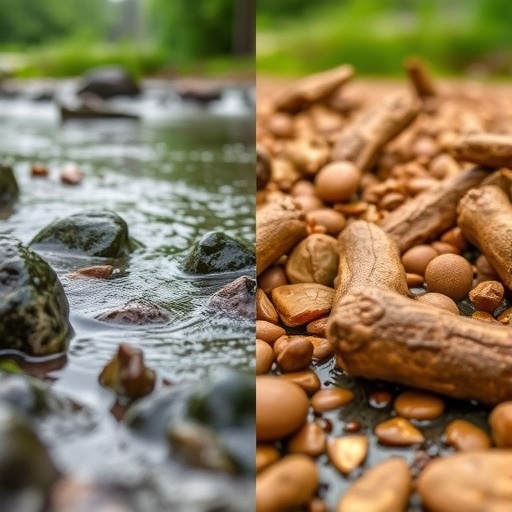
Marine Debris in River Margins: Unraveling the Complexities of Plastic Fragmentation and Degradation Under Wet and Dry Weathering Conditions
The pervasive issue of plastic pollution has long been recognized as a major environmental threat, impacting marine ecosystems worldwide. A recently published study in Microplastics and Nanoplastics delves into a particularly understudied niche within this vast challenge: the fate of discarded plastics in river margins subject to alternating wet and dry weathering. This research, led by Mladenov, Knight, Olney, and colleagues, offers critical insights into how these polymeric materials fragment and degrade when exposed to the dynamic fluvial environments and episodic climatic cycles that define riverine margins.
Plastic debris transported from inland sources often accumulates at river margins, where it is subjected to complex physicochemical and biological processes that govern its breakdown and eventual incorporation into aquatic and terrestrial ecosystems. Unlike the relatively stable marine environments, river margins experience frequent fluctuations in moisture, temperature, sunlight, and sediment interaction, all of which influence the degradation pathways of plastics in distinctive ways. Understanding these processes is vital for modeling the environmental persistence of plastics and predicting their ecological impact.
The study comprehensively characterizes the role that alternating wet and dry weathering cycles play in accelerating the fragmentation of discarded plastic debris. These cycles induce mechanical stress by repeated swelling and shrinkage of the polymer matrix, combined with photodegradation from ultraviolet radiation during dry spells. Critically, water immersion during wet phases also facilitates hydrolytic degradation and biofilm formation, which can further catalyze chemical changes within the plastic. This synergy between mechanical, photochemical, and biological weathering mechanisms emerges as a key driver in the progressive breakdown into micro- and nanoplastics.
Researchers utilized a suite of advanced analytical techniques, including scanning electron microscopy for surface morphology examination, Fourier-transform infrared spectroscopy for chemical fingerprinting, and mass loss measurements to quantify degradation rates. Their results showed pronounced surface embrittlement and fissuring after repeated weathering cycles, leading to fragmentation into micron-sized particles. Simultaneously, chemical analyses revealed oxidation and chain scission events indicative of photo- and hydrolytic degradation pathways. The transformation from bulk plastic debris into microscopic fragments significantly alters the environmental fate and potential toxicity of these materials.
One remarkable finding is how dry phases, often overlooked, contribute substantially to mechanical weathering by rendering plastics more brittle. Upon dehydration, polymer chains lose flexibility and become susceptible to crack formation under minimal stress. Subsequently, when rewetting occurs, the ingress of water and microbial colonization accelerates chemical degradation, suggesting that the cyclical nature of river margin environments creates a feedback loop exacerbating plastic breakdown. This contrasts with the slower, more uniform degradation observed in fully aquatic or terrestrial environments.
The study also highlights the role of biofilms forming on plastic surfaces during wet phases. These microbial communities not only facilitate biodegradation but also influence the physicochemical surface properties, altering hydrophobicity and potentially enhancing particle transport during high-flow events. By mediating interactions with sediment and dissolved organic matter, biofilms contribute to the complex ecological pathways through which plastic fragments disseminate and interact with biota.
Moreover, hydrodynamic forces in river margins play a crucial role in mechanical fragmentation. The repeated wetting and drying cycles create variable moisture gradients within the plastic matrix, augmenting internal stresses. Coupled with sediment abrasion during turbulent flow, these mechanical forces fragment larger debris into secondary microplastics. Such processes underscore the significance of physical weathering in riverine systems, which might be more aggressive and variable compared to open marine environments.
A vital environmental implication of this work is the enhanced production of nanoplastics—particles smaller than 100 nanometers—which pose even greater risks due to their ubiquity, bioavailability, and potential toxicity. The data suggest that cyclical wet-dry weathering facilitates fragmentation down to these nanoscale sizes more efficiently than continuous immersion or arid conditions alone. This discovery raises concerns about the underestimated environmental burden of nanoparticles originating from river margins before they enter open waters.
The interdisciplinary approach adopted by the research team also sheds light on the interplay between chemical weathering and microbial activity. Biodegradation processes, often considered slow for conventional plastics, appear to be intensified in the fluctuating river margin environment. Microbial consortia associated with biofilms showed distinct enzymatic activity capable of cleaving polymer chains, especially when synergized with oxidative chemical degradation induced by UV exposure during dry spells. This dual action enhances the breakdown but also complicates predictions about the persistence and ecological impact of plastics.
From a broader environmental management perspective, this study calls for rethinking strategies aimed at mitigating plastic pollution. River margins, frequently overlooked in pollution monitoring and cleanup efforts, emerge as dynamic hotspots for plastic fragmentation and micro/nanoplastic generation. Targeted interventions in these transitional zones could substantially reduce the flux of harmful plastic particles advancing into marine and freshwater food webs.
The research further advances scientific understanding of the physicochemical mechanisms underlying plastic degradation by contextualizing them within realistic environmental conditions. The interplay of environmental variables in river margins—temperature fluctuations, UV radiation levels, moisture cycles, and microbial colonization—creates a complex degradation landscape that cannot be replicated by laboratory simulations in isolation. Field-based experiments combined with laboratory analyses proved essential for capturing this multifaceted process.
Importantly, findings from this investigation underscore the need for incorporating wet-dry weathering cycles into future risk assessments and environmental fate models of plastic pollution. Existing models often simplify degradation as a linear process under constant environmental conditions; however, this work demonstrates the non-linearity and stochastic nature inherent in river margin environments, affecting degradation kinetics and the resultant pollutant profiles.
The implications extend beyond ecological toxicity, as nanoplastics generated in river margins potentially serve as vectors for contaminant transport. Their high surface area to volume ratio and altered surface chemistry following weathering facilitate the adsorption of persistent organic pollutants and heavy metals. This vectoring capacity enhances the risk to aquatic organisms upon ingestion, bioaccumulating toxins through food chains and possibly impacting human health indirectly.
Finally, this study opens new avenues for interdisciplinary research integrating polymer science, microbiology, hydrology, and environmental chemistry. The nuanced understanding of fragmentation and degradation offered by the authors enables the development of more effective biodegradable materials and informs policies aimed at reducing plastic waste leakage into aquatic environments. Continued collaboration across scientific domains will be crucial in tackling the growing challenge of plastic pollution at its source and along its environmental pathways.
As demonstrated by Mladenov and colleagues, river margins constitute critical yet hitherto underappreciated interfaces where complex weathering processes govern the lifecycle of discarded plastics. The intricate dance of wet and dry conditions, coupled with biological and mechanical forces, transforms large debris into microscopic pollutants with far-reaching implications. These insights represent a vital step toward mitigating the downstream impacts of plastic pollution, calling for renewed focus and innovative solutions tailored to the unique challenges posed by transitional aquatic-terrestrial environments.
Subject of Research: Marine debris fragmentation and degradation processes in river margin environments under cyclic wet and dry weathering.
Article Title: Marine debris in river margins: wet and dry weathering effects on the fragmentation and degradation of discarded plastic.
Article References:
Mladenov, N., Knight, E., Olney, A. et al. Marine debris in river margins: wet and dry weathering effects on the fragmentation and degradation of discarded plastic. Micropl.&Nanopl. (2025). https://doi.org/10.1186/s43591-025-00164-3
Image Credits: AI Generated
DOI: 10.1186/s43591-025-00164-3
Keywords: plastic pollution, river margins, fragmentation, degradation, wet weathering, dry weathering, microplastics, nanoplastics, biofilms, mechanical weathering, photodegradation, hydrolytic degradation, environmental fate, microbial activity


