

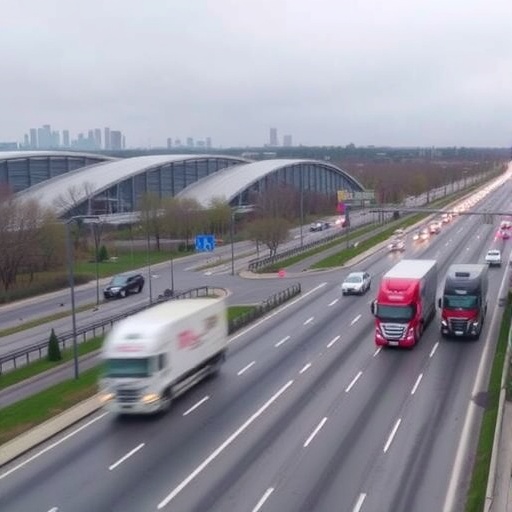
As urban landscapes continue to evolve under the relentless forces of globalization and technology, new challenges emerge, reshaping the interplay between economic growth and environmental sustainability. The soaring expansion of e-commerce and the intensification of globalized production have dramatically escalated urban road freight demand. Yet, as cities grow increasingly dependent on freight transportation networks, a burgeoning crisis related to environmental degradation and social inequity is unfolding quietly in the shadows of these developments. A groundbreaking study by Yu, Yuan, Goodchild, and colleagues, soon to be published in Nature Cities, unveils a startling landscape of spatial disparities in road freight emissions across the United States over the 2011–2020 decade, revealing heavy environmental burdens concentrated along freight corridors—burdens that disproportionately afflict minority and economically vulnerable communities.
This extensive research utilizes county-level data encompassing 3,107 US counties, offering the most granular national-scale analysis to date on freight-related emissions, including particulate matter (PM10 and PM2.5), carbon dioxide (CO2), and nitrogen oxides (NOx). The analysis identifies two pivotal types of inequities shaping the environmental justice crisis: demand-oriented inequity and socioeconomic status (SES)-oriented inequity. Demand-oriented inequity refers to the disproportionate concentration of emissions in cities located near key freight corridors or terminals—even when accounting for actual freight demand—where emission levels outpace demand projections by an alarming margin that has worsened over time, rising between 5.6 and 14.2%. This underlines a systemic failure in urban freight logistics planning to equitably distribute the environmental impact corresponding to freight activity.
The second form, SES-oriented inequity, exposes a hidden layer of environmental injustice. Evidence shows that minority communities, particularly those situated proximal to freight infrastructure, bear a dual burden: they are exposed to higher pollutant concentrations and simultaneously experience steeper declines in household income over the same period. This spatial correlation demonstrates not only a legacy of environmental racism but also highlights an intersectional crisis whereby environmental hazards exacerbate economic and social inequalities at the community level. The research poignantly illustrates how freight emissions are not merely an environmental issue, but also a profound social and public health concern.
Technically, the research integrates spatial econometrics and advanced emission modeling, effectively bridging transportation geography with environmental health studies. By deploying robust spatial correlation frameworks, the researchers unpack complex relationships between freight demand intensity, emission concentrations, and sociodemographic variables. Such interdisciplinary methodology is essential in dissecting multi-scalar patterns and trends that are frequently obscured in aggregate or city-level assessments. This study’s granular scale and decade-long temporal coverage enable unprecedented insights into the persistence—and in some cases, the exacerbation—of these inequities across the US urban fabric.
Crucially, the findings underscore the limitations of current urban freight management and environmental regulatory frameworks. Freight corridors and terminals, often considered vital economic arteries, unintentionally serve as focal points of environmental harm with insufficient mitigation or redistribution of burdens. The exacerbation of disparities occurs despite federal and state efforts to minimize pollution and promote sustainability, signifying an urgent need for a paradigm shift in urban freight strategy that explicitly integrates environmental equity objectives into planning and policy making.
This research also challenges the assumption that growing freight demand naturally results in proportional emissions exposure. Instead, it reveals that emissions are spatially decoupled from demand, with a disproportionate share concentrated in select urban areas irrespective of local freight activity. This emergent “hotspotting” effect calls for more sophisticated, place-based interventions, moving beyond broad-brush regulatory approaches toward precision-targeted solutions that reduce exposure hotspots without compromising the economic function of freight networks.
Furthermore, the association between minority populations and higher emissions spotlights the compounded vulnerabilities faced by these communities. Historic patterns of residential segregation and land-use decisions have entrenched freight infrastructure near marginalized neighborhoods. As freight intensification continues, so do associated pollutants and health risks, including respiratory illnesses and cardiovascular conditions linked with particulate and gaseous air contaminants. The socioeconomic downturn observed in these communities further aggravates resilience capacity, perpetuating a vicious cycle of environmental injustice.
From a policy perspective, this study advocates for multi-level coordinated action. National frameworks should mandate equitable distribution of freight-related emissions and enforce stringent pollution controls across freight corridors. Regional authorities need to integrate spatial justice considerations into freight planning, utilizing tools such as environmental impact assessments with demographic weighting. At the city level, urban planners and transport agencies must prioritize community engagement, ensuring that freight logistics development aligns with the welfare of frontline communities.
Technological innovation offers promising avenues as well. Electrification of freight vehicles and deployment of low-emission zones near sensitive areas can mitigate emissions significantly. Advanced routing algorithms can optimize freight flows away from heavily burdened neighborhoods without compromising supply chain efficiency. Incentivizing off-peak deliveries and investing in decentralized logistics infrastructure can also reduce spatial concentration of harmful pollutants.
Importantly, the study’s longitudinal design reveals that these disparities are not transient; on the contrary, spatial inequities have intensified over time. This trend signals urgent redress is needed to prevent the deepening of environmental health disparities and the possible erosion of urban sustainability gains, particularly those related to the Sustainable Development Goals (SDGs) 3 (Good Health and Well-being), 10 (Reduced Inequalities), and 11 (Sustainable Cities and Communities).
In light of growing urbanization and e-commerce dependence, the findings warn that ignoring freight emissions’ spatial and social dimensions risks engendering entrenched injustices. Without comprehensive interventions, the convergence of freight activity, air pollution, and socioeconomic vulnerability could become a defining feature of urban landscapes, undermining prospects for equitable and healthy cities.
This research thus pioneers a vital discourse in urban environmental science, highlighting the need to marry freight transport efficiency with environmental justice. It offers a critical evidence base for revising urban freight policies and empowering affected communities through data-driven advocacy. By exposing the undercurrents of freight-related emission inequity, the study calls on all stakeholders—governments, planners, industry, and civil society—to collaborate in crafting transport systems that sustain economic vitality without sacrificing equity or health.
As policy frameworks begin to evolve globally toward more sustainable urban futures, embedding justice into the spatial matrix of freight networks emerges as a crucial frontier. The insights from this study underscore that sustainability cannot be disentangled from equity; true urban resilience hinges on addressing the nuanced and spatially differentiated burdens of road freight emissions. Only through intentional, data-informed actions can cities transform freight challenges into opportunities for inclusive, sustainable growth.
In conclusion, the expanding freight demands catalyzed by globalization and e-commerce reveal complex and worsening inequalities across the US urban landscape. By elucidating the dual axes of demand-driven and SES-oriented emission disparities, this research charts a path forward for tackling both environmental harm and social inequity in tandem. The imperative is clear: the future of urban freight logistics must be as much about justice and community wellbeing as it is about efficiency and productivity.
Subject of Research: Urban freight emissions and spatial environmental justice disparities in road freight across US cities.
Article Title: Increasing nationwide disparities in road freight emissions across cities.
Article References:
Yu, C., Yuan, Q., Goodchild, A. et al. Increasing nationwide disparities in road freight emissions across cities. Nat Cities (2026). https://doi.org/10.1038/s44284-025-00368-x
Image Credits: AI Generated


