

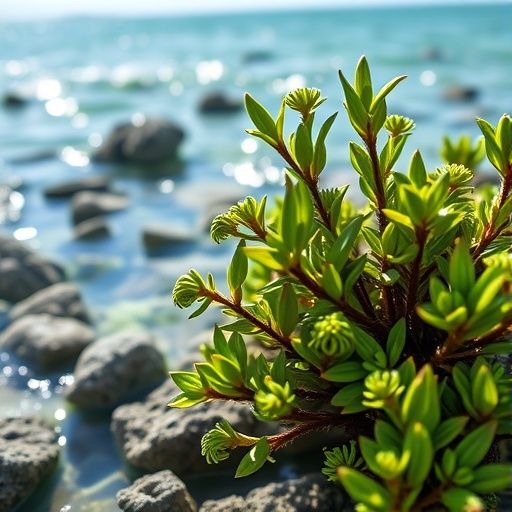
In an era marked by escalating climate change concerns, the role of natural carbon sinks has never been more critical. Marine ecosystems, particularly coastal macrophytes such as seagrasses, kelps, and salt marsh plants, have long been recognized for their exceptional capacity to sequester carbon—earning the moniker “blue carbon.” However, emerging research led by Yamuza-Magdaleno et al. provides groundbreaking insights into how increasing ocean temperatures might undermine this vital ecological function. The study elucidates the complex relationship between temperature-induced changes in dissolved organic carbon (DOC) composition and the consequent decline in the carbon storage potential of coastal macrophytes.
Organic carbon in marine environments exists in diverse forms, but a significant portion is classified as dissolved organic carbon. Within the DOC pool, a critical subset is the recalcitrant DOC (RDOC), which is resistant to microbial degradation and thus can persist in the water column for extended periods. This persistence is pivotal because it underpins the long-term sequestration of organic carbon, preventing its rapid conversion back to atmospheric CO2. Coastal macrophytes contribute substantially to RDOC through the exudation of complex organic molecules and via the slow decomposition of bounded carbon in their biomass. The team’s research demonstrates that rising temperatures can significantly accelerate the breakdown and consumption of RDOC, thereby disrupting this balance.
This depletion of RDOC in coastal waters signifies a worrying trend for blue carbon ecosystems. Yamuza-Magdaleno and colleagues employed a combination of controlled laboratory experiments and in situ observations to unravel the mechanistic underpinnings of this phenomenon. They observed that with incremental increases in temperature, microbial communities adapted by enhancing their enzymatic degradation of complex organic compounds, thus facilitating the breakdown of previously resistant DOC fractions. This bioavailability shift means carbon that was once locked away in resistant forms becomes vulnerable to rapid conversion back into dissolved CO2, which ultimately escapes to the atmosphere.
The implications of this temperature-driven shift are profound. Coastal macrophyte beds have been considered reliable carbon sinks due to their efficient carbon fixation and the storage of organic matter in sedimentary deposits. However, if the protective buffer of RDOC is compromised, the carbon cycle in these ecosystems may become skewed toward carbon release rather than sequestration. This could contribute to a feedback loop exacerbating global warming. The study’s results warn that expected ocean warming trends, particularly along continental shelves and coastal zones, might reverse or substantially diminish the benefits of blue carbon habitats.
Delving into the biochemical pathways, the researchers found that higher temperatures enhanced microbial metabolic rates and stimulated the production of extracellular enzymes such as cellulases and ligninases. These enzymes degrade structural carbohydrates and complex aromatic compounds, traditionally thought to be major components of RDOC. This enzymatic activity destabilizes organic molecules that were once chemically recalcitrant, making them accessible to heterotrophic bacteria. Hence, what was once a stable carbon reservoir becomes a transient carbon source, available for microbial respiration and eventual CO2 emission.
The study’s findings challenge existing models of coastal carbon cycling that often assume DOC, particularly RDOC, is chemically inert or only slowly cycled. By integrating temperature effects on microbial enzyme activities, the research team proposes a dynamic and temperature-sensitive model of DOC processing in coastal environments. This framework can improve predictions of carbon turnover rates in warming oceans and guide mitigation strategies for climate-related carbon emissions from marine ecosystems.
In addition to laboratory assays, the researchers corroborated their findings with long-term monitoring of coastal sites subjected to natural and anthropogenic thermal variations. Across these sites, a consistent inverse relationship between water temperature and RDOC concentration was documented. This pattern was notably evident in temperate and subtropical coastal regions, which are hotspots for macrophyte biomass and blue carbon storage. These field observations underscore the ecological relevance of the proposed mechanisms and affirm the risk posed to coastal carbon budgets in a warming world.
From an ecological perspective, this degradation of RDOC casts a shadow over the resilience of blue carbon ecosystems. Coastal macrophytes also rely on the stability of DOC pools for nutrient cycling and microbial symbiosis, which are integral to plant health and productivity. The diminished RDOC availability could disrupt these mutualistic relationships, potentially weakening macrophyte growth and reducing overall ecosystem productivity. This feedback could further impair coastal carbon sequestration, creating a cascade of deteriorating ecological functions.
Furthermore, the research highlights the potential for altered species interactions mediated by the temperature-driven shifts in DOC composition. Changes in microbial community structure and function, spurred by elevated enzymatic degradation of RDOC, can have unforeseeable effects on the broader coastal food web. For instance, bacterial populations that efficiently process newly available DOC components could proliferate, outcompeting other microbial taxa and modifying nutrient fluxes. Such microbial community restructuring may influence higher trophic levels, ultimately affecting biodiversity and ecosystem services.
From a global change science perspective, the research by Yamuza-Magdaleno et al. urges a reevaluation of how climate models incorporate blue carbon processes. Many current Earth system models treat coastal carbon sequestation as a relatively fixed parameter, without fully accounting for the thermal sensitivity of DOC dynamics. The interface between biogeochemical and microbial processes, as revealed in this study, points to a need for finer resolution in climate predictions, especially considering the vast coastal areas vulnerable to warming seas.
This study also opens avenues for applied research focused on mitigating the negative effects of warming on blue carbon storage. Identifying mechanisms that stabilize RDOC or inhibit temperature-driven microbial degradation could inform restoration strategies or biotechnological interventions. For instance, enhancing sediment burial of organic carbon or promoting macrophyte species with more resilient DOC exudates might help preserve blue carbon stores against thermal stress.
Additionally, policymakers and environmental managers must recognize the nuanced challenges highlighted by this research when designing conservation strategies for marine protected areas and coastal habitats. Efforts to conserve or restore blue carbon ecosystems need to integrate temperature projections to safeguard the intricate organic carbon dynamics sustaining these habitats. Failure to do so risks undermining the climate mitigation potential attributed to coastal macrophytes.
In sum, the groundbreaking work by Yamuza-Magdaleno and colleagues accentuates the delicate balance between temperature, microbial activity, and organic carbon dynamics in coastal blue carbon ecosystems. Their findings reveal that warming oceans could erode the stability of recalcitrant dissolved organic carbon, a backbone of long-term carbon sequestration in marine habitats. This thermal vulnerability underscores the urgency of addressing climate change with a multidimensional approach, incorporating both atmospheric and oceanographic feedback loops.
As humanity faces the daunting task of mitigating and adapting to climate change, understanding the intricate interactions governing natural carbon sinks becomes imperative. Studies such as this not only deepen our scientific knowledge but also sharpen the focus of global climate strategies. Protecting blue carbon reservoirs requires a concerted effort grounded in robust science that anticipates and accounts for the accelerating environmental shifts in our warming planet.
The implications of this research reverberate beyond marine science, touching upon global carbon budgets, ecosystem management, and climate policy. It becomes clear that sustaining natural carbon sinks in the face of temperature-driven challenges will demand innovative scientific, technical, and governance solutions. This pivotal study stands as a clarion call to the research community and policymakers alike, emphasizing the need to safeguard the multifaceted, yet fragile, mechanisms underpinning blue carbon storage.
Subject of Research: Impact of rising ocean temperatures on recalcitrant dissolved organic carbon and the consequent effects on carbon storage potential in coastal macrophyte ecosystems.
Article Title: Temperature-driven decline in recalcitrant dissolved organic carbon weakens coastal macrophyte’s blue carbon storage potential.
Article References:
Yamuza-Magdaleno, A., Azcárate-García, T., Egea, L.G. et al. Temperature-driven decline in recalcitrant dissolved organic carbon weakens coastal macrophyte’s blue carbon storage potential. Commun Earth Environ (2026). https://doi.org/10.1038/s43247-026-03417-y
Image Credits: AI Generated


