

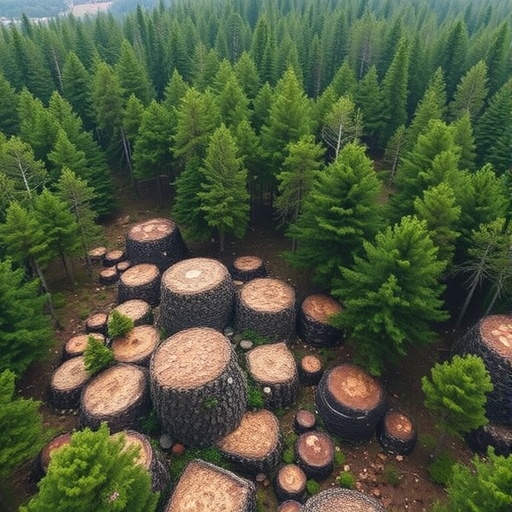
In recent decades, the escalating impacts of climate change have reshaped ecosystems globally, with Europe’s vast forested landscapes standing at the forefront of these transformations. A groundbreaking study published in Science presents a compelling forecast: as the 21st century unfolds, climate-driven disturbances in European forests are projected to intensify markedly, ushering in unprecedented levels of ecological upheaval. This large-scale modeling effort leverages advanced artificial intelligence, satellite imagery, and state-of-the-art climate projections to elucidate how wildfire outbreaks, insect infestations, and other dynamic hazards will interact with changing environmental conditions to drive tree mortality and forest landscape alterations across the continent.
The study confronts a formidable challenge long faced by ecologists and forest managers—the inherent complexity and feedback loops within forest disturbance regimes. Climate-related factors not only directly influence the frequency and severity of events such as fires and pest outbreaks but also alter tree growth patterns and species vulnerabilities, creating nonlinear and spatially heterogeneous responses. To model these intricate interactions, researchers utilized a deep learning framework trained on extensive Landsat satellite datasets that chronicle disturbance histories at high resolution throughout Europe. This novel approach enables robust simulation of how disturbances will propagate and amplify over time under distinct climate scenarios.
By integrating forest growth dynamics with evolving climate stressors and disturbance agents, the model operators simulated forest disturbance rates and resultant tree mortality at a continental scale, spanning the entirety of the 21st century. Three climate pathways were examined, from aggressive greenhouse gas mitigation to continued high emissions. Across all trajectories, a common theme emerges: increasing disturbance regimes that accelerate forest turnover and alter species composition. Disturbance frequencies climb steadily, but the most alarming patterns appear in the latter half of the century when projected emissions remain unabated, indicating that current mitigation efforts are crucial to sidestep catastrophic forest degradation.
The modeling highlights wildfire as the principal driver of future disturbance-induced mortality, especially pervasive in Mediterranean ecosystems characterized by aridity and fire-adapted vegetation. However, fires are not confined to these traditional hotspots. Novel fire regimes are predicted to emerge in temperate and even boreal forests where historical fire incidence has been relatively low. Such shifts suggest profound changes in fire behavior linked to longer, hotter drought periods and altered fuel connectivity. This transformation may disrupt established forest successional cycles and greatly impact carbon storage capacities.
In parallel, bark beetles are identified as another formidable force reshaping European forests. These insects, notorious for mass tree die-offs, thrive under warming climates that accelerate their life cycles and weaken conifer defenses. Central European temperate forests face heightened vulnerability, confronting synchronized outbreaks that can decimate large forest patches rapidly. The interplay of drought stress and insect infestation creates synergistic effects compounding tree mortality beyond individual disturbance events.
Beyond these dominant disturbances, the study recognizes the role of additional factors such as storms and pathogen outbreaks, which also respond dynamically to climate trends. The cumulative effect of multiple, interacting disturbances amplifies uncertainty in forest trajectory predictions but underscores an overarching message: Europe’s forests are entering an era of unprecedented ecological flux. The long-term consequences extend beyond biodiversity loss, influencing ecosystem services, timber production, and carbon sequestration critical to climate mitigation efforts.
One of the study’s pivotal contributions is its demonstration of the efficacy of deep learning techniques in environmental forecasting. Traditional statistical or mechanistic models often struggle to capture nonlinear feedbacks and spatial heterogeneity at continental scales. By harnessing satellite-derived disturbance records and coupling them with climate and biological process data, the researchers constructed a predictive system capable of nuanced forecasts. This methodological advance opens avenues for proactive forest management, enabling stakeholders to anticipate disturbance hotspots and optimize adaptation strategies.
Importantly, the simulations underscore the urgency of mitigating greenhouse gas emissions. Under scenarios assuming aggressive climate action, disturbance intensities stabilize or increase at slower rates, allowing forest ecosystems greater capacity for adaptation and resilience. Conversely, continued high emissions yield spiraling disturbance cycles with feedback loops exacerbating stress and mortality rates. These trajectories highlight the intertwined fate of climate policy and natural ecosystem health.
Ecologically, intensified disturbances may trigger shifts in species assemblages, favoring more resilient but potentially less diverse communities. The alteration of forest structure, from mature, closed-canopy stands to younger, patchier landscapes, will reverberate through habitat availability and trophic interactions. Such changes could imperil species dependent on stable forest conditions and influence broader landscape connectivity and ecological function.
From a socio-economic perspective, increased wildfire and pest outbreaks pose direct threats to human settlements, forestry industries, and recreation sectors. The financial costs of fire suppression, timber losses, and restoration efforts escalate alongside these disturbance trends. Moreover, forests’ role as carbon sinks may be compromised, undermining global climate stabilization goals and necessitating integrated management approaches.
In sum, this comprehensive modeling study delivers a sobering outlook on the fate of European forests under climate change. The integration of cutting-edge machine learning with satellite observation and ecological theory provides an unprecedented window into future disturbance regimes. It calls upon scientists, policymakers, and citizens alike to recognize the vulnerabilities of these critical ecosystems and to act decisively to mitigate climate change impacts, safeguard biodiversity, and sustain the myriad benefits forests provide.
As the climate crisis accelerates, understanding and anticipating the responses of forest systems becomes not just an academic exercise but a foundation for resilience and stewardship. Europe’s forests, shaped by millennia of natural and human influences, now face a new era dominated by rapid environmental change and disturbance escalation. This study equips the scientific community and society with crucial foresight—the first step toward meaningful preservation in an uncertain future.
Subject of Research: Climate-driven forest disturbances and their projected increase in Europe throughout the 21st century due to climate change.
Article Title: Climate change will increase forest disturbances in Europe throughout the 21st century
News Publication Date: 5-Mar-2026
Web References: 10.1126/science.adx6329
Keywords: climate change, forest disturbances, wildfire, bark beetle outbreaks, tree mortality, deep learning, satellite imagery, European forests, ecosystem resilience, carbon sequestration


