

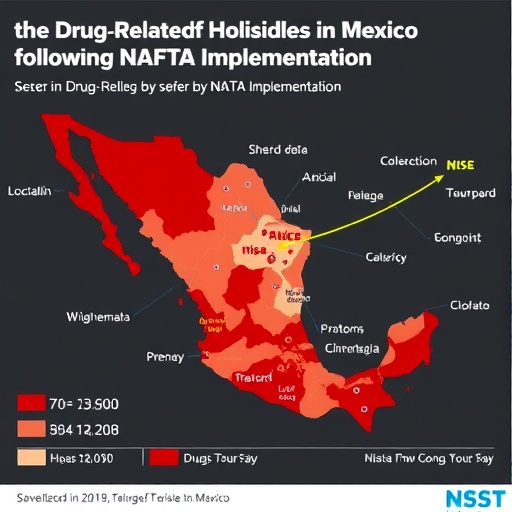
In 1994, the inauguration of the North American Free Trade Agreement (NAFTA) marked a pivotal moment in economic integration between Mexico, the United States, and Canada. While the agreement enabled unprecedented growth in legal trade and commerce, a groundbreaking study conducted by Erik Hornung and colleagues reveals a stark and often overlooked consequence: a marked surge in drug-related violence concentrated in Mexican regions that serve as crucial conduits for illicit trafficking. This research, positioned at the confluence of economic history and public policy, sheds new light on how expanding legal economic corridors inadvertently fostered violent competition among criminal organizations vying to control the most profitable trafficking routes.
The analysis specifically focused on municipalities strategically situated along what can be conceptualized as “optimal” drug smuggling pathways linking key production and transit points in Mexico with prominent U.S. land border crossings. Leveraging the Dijkstra algorithm—a computational technique traditionally used to identify shortest paths in a network—the researchers ingeniously mapped these trafficking routes overlaid on Mexico’s existing road infrastructure. This approach enabled a precise spatial correlation between trade dynamics and shifts in violence, highlighting that the escalation in homicides was far from uniformly distributed but narrowly concentrated in areas hosting these trafficking arteries.
Findings from the study paint a stark picture: after NAFTA’s implementation, homicide rates among males aged 15 to 39 soared by an average of 2.1 cases per 100,000 inhabitants within these corridor towns—a staggering 26 percent increase relative to prior levels. Intriguingly, municipalities devoid of these trafficking routes exhibited no comparable upsurge in violence, reinforcing the localized nature of this phenomenon. This specificity suggests a direct causal mechanism linked to the trafficking infrastructure rather than a generalized social upheaval.
Underpinning this violent escalation is the transformation in cross-border commerce precipitated by NAFTA. Mexican exports to the U.S. surged, effectively doubling their share of gross domestic product within a few years. This exponential rise in trade volume corresponded with a dramatic increase in truck traffic across the border, compounded by a decrease in inspection rates. The consequence was an augmented ability for drug cartels to conceal illicit substances—including cannabis, opium, and cocaine—within otherwise legitimate shipments traversing busy checkpoints. This facilitated smuggling translated into enhanced cartel revenues, redefining the stakes associated with territorial control over these trafficker-critical routes.
The competitive landscape among Mexico’s drug cartels intensified in response. The augmented profitability fomented a “rapacity effect,” wherein rival organizations engaged in violent clashes to assert dominance over lucrative corridors. Notably, the surge in homicide was predominantly attributable to inter-cartel conflict rather than confrontations with law enforcement, illustrating the primacy of economic incentives in catalyzing violent competition within the illegal drug market.
Alternative hypotheses were rigorously explored to contextualize these findings. A prominent consideration concerned NAFTA-induced economic disruptions, particularly heightened import competition in Mexico’s agricultural sector. Maize farmers, for example, faced diminished incomes, theoretically increasing motivation to enter illicit activity due to reduced legal earning prospects. However, the spatial distribution of violence did not coincide with regions afflicted by agricultural import competition. Moreover, other mortality causes such as accidents or suicides did not exhibit parallel increases, nor did demographic groups outside typical offender profiles experience heightened risk, underscoring the specificity of the drug trafficking violence effect.
The persistence of elevated homicide rates along these trafficking corridors extended well into the 2000s, underscoring the enduring legacy of NAFTA’s unintended externalities. Despite the implementation of multifaceted law enforcement strategies, these regions remained hotspots of cartel rivalry rather than areas predominantly affected by state security interventions. This dynamic challenges traditional public safety approaches by emphasizing the economic logic driving organized crime and violence.
These insights provoke critical reflections on the broader implications of free trade agreements. Typically celebrated for fostering economic integration and growth, such accords may incur severe side effects in contexts characterized by entrenched illicit markets and fragile governance structures. The study by Hornung and colleagues nudges policymakers and analysts to consider the complex interplay between expanding legitimate commerce and the shadow economy of drug trafficking, advocating for nuanced interventions that complement market liberalization with targeted violence reduction strategies.
This study also exemplifies the power of interdisciplinary methodologies, combining economic history, computational algorithms, and spatial analysis to unpack complex societal phenomena. By quantifying the tangible human cost associated with shifts in economic infrastructure, it provides a compelling framework through which future trade policy considerations might be evaluated, especially in regions vulnerable to criminal exploitation.
In essence, the research serves as a cautionary tale against viewing trade liberalization in isolation from its social and security ramifications. It prompts a reevaluation of how cross-border economic policies intersect with crime and violence, emphasizing the need for comprehensive governance frameworks that anticipate and mitigate potentially corrosive outcomes alongside economic benefits.
The researchers conclude that abolishing free trade is not the answer. Instead, they advocate for proactive and effective measures to combat drug-related violence, underscoring the importance of tailoring strategies to the unique socio-economic landscapes shaped by evolving trade patterns. This nuanced understanding can inform both national and transnational policies aimed at reducing the human toll wrought by the illicit drug economy while preserving the gains of open commerce.
Subject of Research: Not applicable
Article Title: NAFTA and drug-related violence in Mexico
News Publication Date: 27-Feb-2026
Web References: http://dx.doi.org/10.1016/j.jdeveco.2026.103719
References: Journal of Development Economics
Keywords: NAFTA, drug trafficking, Mexico, violence, trade liberalization, homicide rates, drug cartels, Dijkstra algorithm, economic history, illicit markets, cross-border trade, cartel competition


