

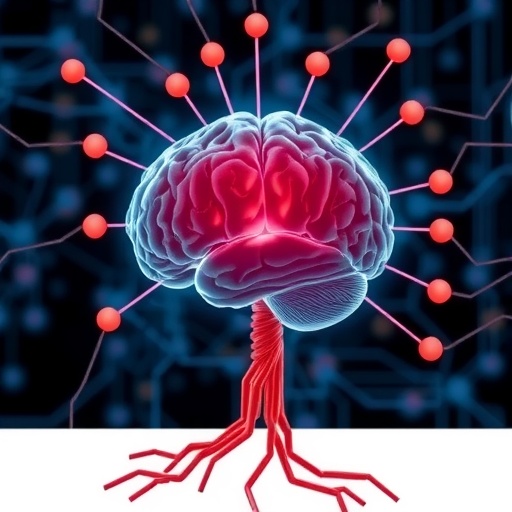
In a groundbreaking study poised to redefine our understanding of post-traumatic stress disorder (PTSD), researchers have illuminated a critical neural mechanism that underpins the stubborn persistence of negative cognitions in those afflicted by this debilitating condition. Utilizing the cutting-edge capabilities of ultrahigh-field 7-Tesla functional magnetic resonance imaging (fMRI), the investigation took a deep dive into the elusive connectivity dynamics between the mediodorsal thalamus and the medial prefrontal cortex—two pivotal brain regions implicated in cognitive restructuring.
Cognitive restructuring, a hallmark feature of many psychotherapies for PTSD, involves the challenging and reframing of maladaptive negative thoughts that plague patients after trauma exposure. Despite its clinical importance, the precise neural substrates through which cognitive restructuring exerts its therapeutic effects had remained largely speculative—until now. This study, involving a robust cohort of 70 individuals diagnosed with PTSD and 66 trauma-exposed controls, mapped the intricate dance of brain signals during intentional cognitive restructuring efforts, revealing a nuanced picture of circuit dysfunction.
Central to the discovery is the mediodorsal thalamus, a deep brain structure known for its integrative role in synchronizing cortical activity. Previous studies have highlighted the thalamus as a crucial relay station, but this research uniquely positions the mediodorsal thalamus at the heart of the thalamocortical networks responsible for managing higher-order executive functions and emotional regulation. By applying dynamic causal modeling to the fMRI data, the researchers quantified effective brain connectivity, allowing them to discern not just where activity occurs, but how different brain regions influence each other across time.
The results were striking: compared to their trauma-exposed, non-PTSD counterparts, individuals with PTSD exhibited notably weaker inhibitory control exerted by the medial prefrontal cortex over the mediodorsal thalamus during tasks requiring cognitive restructuring. This diminished cortical modulation suggests that the neural circuits that should temper and recalibrate thalamic activity fail to do so effectively in PTSD, potentially trapping sufferers in maladaptive cognitive cycles that reinforce negative worldviews and self-perceptions.
This weakened communication pathway held a significant predictive power, correlating robustly with the severity of post-traumatic cognitions concerning the world and other people, with a correlation coefficient of 0.38 and a statistically significant p-value of 0.006. This finding not only cements the mediodorsal thalamus – medial prefrontal cortex axis as a key node in PTSD pathology but also places it squarely at the intersection of cognition and emotion regulation dysfunctions that typify the disorder.
From a neurobiological perspective, the weakening of prefrontal inhibition effectively means that the balance of excitation and inhibition within thalamocortical loops is disrupted. This imbalance potentially leads to a failure in the top-down control processes critical for reinterpreting trauma-related thoughts. Such impairment could explain why many PTSD patients struggle to distance themselves from distressing memories and maladaptive beliefs embedded within their trauma narratives, despite therapeutic attempts to restructure these cognitions.
The elegant use of ultrahigh-field 7-Tesla MRI was instrumental in achieving the spatial and temporal resolution necessary to capture these subtle changes in effective connectivity. This imaging technology allows for a much finer granularity in studying deep brain structures and offers a powerful window into the brain’s real-time processing during complex cognitive tasks. Leveraging this advanced approach, the study pioneers a path forward for neuroscience research focused on psychiatric disorders, demonstrating how precise brain circuit maps can inform targeted therapeutic interventions.
Moreover, the employment of dynamic causal modeling (DCM) represents a sophisticated analytical leap beyond conventional correlation analyses, enabling a mechanistic interpretation of the brain network interactions. Through DCM, the research unpacked not only the difference in connectivity strength but also the directionality of influence between the prefrontal cortex and the thalamus, key for understanding the flow of information disruption in PTSD pathology.
Clinically, these insights open promising new avenues for refining PTSD treatments. By directly targeting the dysfunctional mediodorsal thalamus – prefrontal cortex circuitry, novel interventions, including neuromodulation techniques like transcranial magnetic stimulation (TMS) or deep brain stimulation (DBS), might be tailored to restore the critical inhibitory control that cognitive restructuring therapies rely on but currently fail to evoke adequately in many patients.
The study also challenges existing conceptual frameworks of PTSD by repositioning the thalamus, not merely as a passive relay but as an active hub whose dysfunction sustains pathological cognitive processes. This reframing could spur a reevaluation of neuropsychological models of trauma and resilience, emphasizing the interplay between cortical and subcortical networks rather than isolated prefrontal deficits alone.
Importantly, the findings raise fundamental questions about whether the observed connectivity impairments are a cause or consequence of chronic PTSD, a chicken-and-egg dilemma that future longitudinal studies must address. Establishing causality would be transformative for early identification and prevention strategies in trauma-exposed populations at risk for developing PTSD.
The sample size in this research—the largest of its kind yet deploying ultrahigh-field imaging—enhances confidence in the statistical robustness and reproducibility of the findings. It also underscores the feasibility of integrating high-resolution neuroimaging into clinical neuroscience pipelines, potentially accelerating the translation of neural biomarkers into everyday psychiatric practice.
Furthermore, this research adds to accumulating evidence that cognitive therapies must be conceptualized and optimized not only at the psychological level but also at the neurobiological circuit level. Such integrative perspectives are crucial for moving beyond symptom management approaches towards precision psychiatry, where interventions are individualized based on the unique neural signatures underlying each patient’s symptoms.
The implications of this work extend beyond PTSD alone. Since disruptions in thalamocortical connectivity have been implicated in a range of neuropsychiatric conditions—including depression, schizophrenia, and anxiety disorders—understanding the specific circuitry nuances in PTSD could inform transdiagnostic frameworks and common mechanistic targets for diverse mental illnesses.
Finally, the research overall represents a compelling example of how multidisciplinary collaboration among psychiatry, neurology, cognitive neuroscience, and bioengineering can yield transformative insights into one of the most complex and burdensome mental health conditions. By elucidating how brain networks falter in PTSD, it lays a foundational stone toward a future where therapeutic breakthroughs are grounded in precise mechanistic knowledge and innovative brain technology.
In sum, this pioneering study charts an exciting path forward for PTSD research and treatment. It reveals that weakened cortical inhibition of the mediodorsal thalamus compromises the brain’s ability to restructure trauma-related cognitions effectively, helping to explain the stubborn negative beliefs that endure in PTSD. The advanced neuroimaging and modeling approaches used herald a new era of circuit-level understanding, with profound implications for developing next-generation, neuroscience-informed therapies to untangle the grip of trauma on the mind.
Subject of Research: Cognitive restructuring and thalamocortical circuit dysfunction in post-traumatic stress disorder.
Article Title: Cognitive restructuring and thalamocortical circuit alterations in post-traumatic stress disorder.
Article References:
Agathos, J.A., Harrison, B.J., Felmingham, K.L. et al. Cognitive restructuring and thalamocortical circuit alterations in post-traumatic stress disorder. Nat. Mental Health (2026). https://doi.org/10.1038/s44220-026-00614-8
Image Credits: AI Generated


