

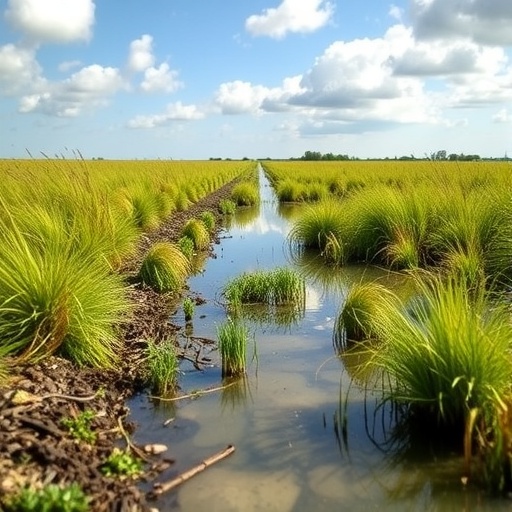
In a groundbreaking study published in the journal Commun Earth Environ, researchers Zhao, B., Zhang, W., and Wang, P., alongside their colleagues, present a novel approach to understanding the complex interactions between wetland hydrology and greenhouse gas emissions. While wetlands are recognized as critical ecosystems for biodiversity and carbon storage, their role in mitigating climate change can be greatly influenced by fluctuations in water tables. This research endeavors to unravel how optimized wetland rewetting strategies can effectively manage the release of methane, carbon dioxide, and oxygen, which are vital to maintaining ecological balance and addressing climate change.
Wetlands, often referred to as the “Earth’s kidneys,” play a crucial role in filtering water and providing essential services to both the environment and humanity. However, the changing climate, alongside human activities such as drainage for agriculture, poses a significant threat to these vital ecosystems. The fluctuation of water tables results in various biogeochemical responses, which can enhance the production of greenhouse gases like methane (CH4) and carbon dioxide (CO2). Given the urgency surrounding climate action, understanding these dynamics has never been more critical.
The research team conducted a series of experiments across different wetland types, examining how altered hydrological regimes could impact gas emissions. Specifically, the study looked at intermittent rewetting, which mimics natural water table fluctuations, thereby providing insights into how these conditions influence microbial processes responsible for greenhouse gas production. This experimentation aims to propose strategic management techniques that can optimize the ecological functions of wetlands while curbing unwanted gas emissions.
One of the key findings of the study is the relationship between the water table depth and the rate of methane production. Increased water levels tend to create anaerobic conditions favorable for methanogenic microorganisms, thus escalating methane emissions. The researchers emphasized that by fine-tuning rewetting strategies, it might be possible to regulate these anaerobic zones, thereby achieving a balance between wetland restoration and greenhouse gas mitigation. This nuanced approach does not merely seek to enhance biological functions but also regards the implications of climate change in its entirety.
On the other hand, the study also examined the relationship between water tables and carbon dioxide emissions. The release of CO2 is often associated with aerobic decomposition processes, which can be stimulated under certain water table conditions. The balance between methane and carbon dioxide emissions in wetlands illustrates a delicate interplay that requires significant attention. The researchers provide compelling evidence that their optimized rewetting strategies could potentially minimize CO2 emissions while controlling the rate of methane output, leading to an overall positive impact on climate change mitigation efforts.
Moreover, the research utilized a robust modeling framework that integrated empirical data and existing scientific literature. By quantifying the interactions among water tables, gas emissions, and biota, the team successfully demonstrated that adopting flexible water management practices could enhance carbon storage capabilities while significantly reducing greenhouse gas emissions. It is a method that embraces the dynamic nature of wetlands instead of attempting to sterilize them into static systems, which often leads to unintended ecological ramifications.
As the study delves deeper, it reveals a fundamental truth about wetlands that many policymakers may overlook: a one-size-fits-all approach is ineffectual. Different wetland types exhibit unique responses to environmental changes, and as such, the methodologies applied must be tailored to the specific conditions of these ecosystems. The researchers call for a multidisciplinary perspective, involving ecologists, hydrologists, and climate scientists, to devise strategies that are scientifically sound and practically implementable.
The implications of this research extend far beyond the laboratory and into the realm of conservation and land management. Given that wetlands serve as vital carbon sinks, the strategies outlined in this study could inform policies surrounding land use and climate adaptation frameworks. By prioritizing wetland health, communities can harness the natural capabilities of these ecosystems to bolster their resilience toward climate change.
The researchers also highlighted the importance of public awareness and the involvement of local communities in wetland conservation efforts. Education and outreach can significantly enhance community engagement and compliance with innovative management practices that are both sustainable and effective in controlling gas emissions. Local stakeholders are likely to play a critical role in monitoring and adapting these strategies in response to evolving climatic and hydrological conditions.
Another critical aspect of the study is its emphasis on long-term sustainability. While immediate results from optimized rewetting strategies might be beneficial, understanding their longevity is essential for future wetland conservation approaches. The researchers advocated an adaptive management framework that emphasizes continual monitoring and review of wetland health and associated greenhouse gas emissions. Such an approach ensures realms of flexibility and resilience in the face of ongoing climate change challenges.
Equally significant is the study’s acknowledgment of the limitations of current research concerning wetland management. While progress has been made, gaps in knowledge related to microbial community dynamics, soil carbon processes, and their responses to various rewetting strategies remain. The researchers assert that future studies must focus on these aspects to create a more holistic understanding of wetland ecosystems and their responses to climate change.
In conclusion, the research conducted by Zhao et al. stands as a beacon of hope for wetland conservation in the context of climate change. By presenting optimized rewetting strategies to manage greenhouse gas emissions, the study provides a framework that balances environmental health and climate action. As ecosystems on the frontline of climate change, wetlands must be recognized and preserved, not only for their intrinsic value but also for their vital role in climate stability. The insights derived from this research encourage a fundamental shift in how we view and manage wetlands—viewing them not as mere land resources but as essential allies in the global fight against climate change.
Through collaborative efforts, scientific innovation, and community involvement, the pathway toward sustainable wetland management and greenhouse gas mitigation becomes clearer. The study serves as an essential reminder that the answers to complex environmental challenges can often be found in the delicate balance of nature itself.
Subject of Research: Methane, carbon dioxide, and oxygen responses in wetlands due to water table fluctuations and their optimal management strategies.
Article Title: Optimized wetland rewetting strategies can control methane, carbon dioxide, and oxygen responses to water table fluctuations.
Article References:
Zhao, B., Zhang, W., Wang, P. et al. Optimized wetland rewetting strategies can control methane, carbon dioxide, and oxygen responses to water table fluctuations.
Commun Earth Environ (2026). https://doi.org/10.1038/s43247-025-03163-7
Image Credits: AI Generated
DOI: 10.1038/s43247-025-03163-7
Keywords: wetlands, methane, carbon dioxide, greenhouse gases, water table, rewetting strategies, climate change, environmental management, ecosystems.


