

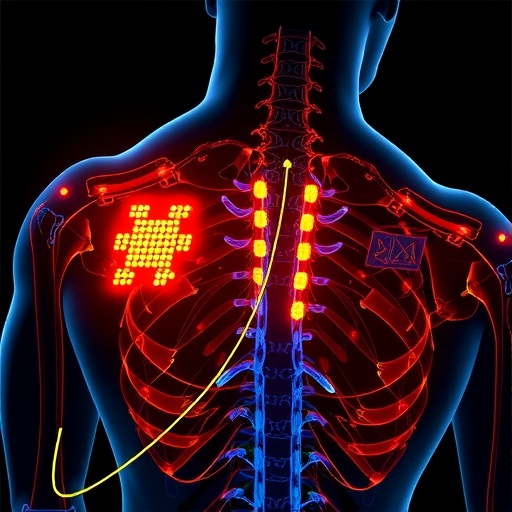
In the fast-evolving realm of wearable technology, the quest for sensors that harmonize high sensitivity, extended linearity, and unwavering medical-grade performance has become increasingly essential. Responding to this demand, a groundbreaking development has emerged from the Chongqing Institute of Green and Intelligent Technology, led by esteemed researchers Professors Chao Zhang and Jun Yang. This innovative team has introduced a bioinspired dual-mechanism iontronic pressure sensor, a device designed explicitly for real-time monitoring of musculoskeletal load. What sets this sensor apart is its remarkable ability to mimic the structural intricacies of human skin, effectively achieving unprecedented levels of linearity and sensitivity in pressure detection.
The advent of this bioinspired sensor marks a significant milestone in the field of wearable health monitoring. As the need for precise health diagnostics continues to rise, traditional sensors often grapple with the inherent limitations of sensitivity and linearity. Notably, this new device, characterized by its ultra-linear response, maintains a coefficient of determination (R²) exceeding 0.997 across a pressure spectrum of 0 to 1 MPa. This remarkable feat addresses the longstanding challenges faced by many flexible sensors, bridging the gap between exceptional sensitivity and reliable linear response—two vital attributes necessary for effective monitoring of physical loads.
Medical-grade accuracy is another significant advantage of this newly developed sensor. The team reported a mere 1.8% error rate in ground reaction force (GRF) estimation, significantly outperforming existing nonlinear sensors, which exhibit errors as high as 6.5%. Such precision empowers healthcare professionals and researchers to enhance early fracture-risk prediction intelligently. This sensor’s validity has been further substantiated through extensive testing, demonstrating its potential for integration into everyday wearable devices with a reliable performance track record.
One of the many innovative features of this dual-mechanism sensor is its unique structural design. By combining two distinct sensing mechanisms—contact area expansion and ion concentration modulation—the device achieves a linear response in capacitance-pressure dynamics. The physical principles underpinning these mechanisms ensure that the sensor responds consistently to pressure changes while encapsulating the flexibility and adaptability characteristic of human skin. This design is not only a triumph in engineering but also a stunning testament to the adoption of biomimetic principles in modern technology.
The durability and stability of this sensor have also been thoroughly evaluated. The team reported that the device withstood over 10,000 loading cycles without significant performance degradation. It maintains stable operation even under varying conditions, including bending, humidity, and temperature fluctuations. Such resilience is crucial for long-term wearability and ensures that this technology can withstand the demands of daily life while delivering reliable data for health monitoring purposes.
As we consider the broader applications of this pioneering pressure sensor, its integration into smart insoles stands out as particularly promising. This technology enables real-time tibial load monitoring during physical activities such as walking or running across different surfaces, including concrete, tracks, and lawns. The implications for gait analysis are equally compelling, as the sensor can accurately classify walking speeds with remarkable precision and predict tibial stress levels effectively.
The research team’s innovative approach further extends the potential of this sensor in various medical domains, including rehabilitation robotics and sports medicine. By providing crucial data on musculoskeletal health, this technology opens avenues for personalized health monitoring and innovative interventions. It empowers users and healthcare practitioners alike, facilitating personalized treatment designs and enhancing recovery processes following musculoskeletal injuries.
In consideration of the implications for public health, the sensor’s early fracture-risk prediction capabilities could serve as a game-changer for athletes, elderly populations, and individuals engaged in physically demanding occupations. The ability to monitor musculoskeletal loads and detect abnormal wearing patterns could prompt timely interventions, ultimately reducing injury occurrences and improving overall health outcomes.
Consequently, this groundbreaking research not only offers a universal design paradigm for high-performance flexible sensors that excel in linearity but also represents a significant intersection of biology and engineering. The advancements achieved through this project can inspire future innovations, fostering the development of new wearable technologies that prioritize user health and well-being.
The collaborative efforts of Professors Zhang and Yang highlight the essential role of interdisciplinary research in driving technological advancements. As their team continues to present solutions that transcend traditional boundaries, the future of wearables looks increasingly promising, with significant prospects for transforming healthcare standards and practices planned.
In conclusion, this innovative bioinspired pressure sensor signifies a remarkable leap forward in wearable technology, embodying the potential for meaningful change in health monitoring. As researchers build upon this foundational work, the integration of enhanced technologies into clinical and everyday settings could revolutionize our approach to health and wellness, offering unprecedented opportunities for proactive health management.
Subject of Research: Bioinspired dual-mechanism iontronic pressure sensors for wearable musculoskeletal monitoring
Article Title: SkinInspired UltraLinear Flexible Iontronic Pressure Sensors for Wearable Musculoskeletal Monitoring
News Publication Date: 1-Sep-2025
Web References: http://dx.doi.org/10.1007/s40820-025-01887-x
References: Nano-Micro Letters
Image Credits: Pei Li, Shipan Lang, Lei Xie, Yong Zhang, Xin Gou, Chao Zhang, Chenhui Dong, Chunbao Li, Jun Yang.
Keywords
Applied sciences, engineering, technology, sensors.


