

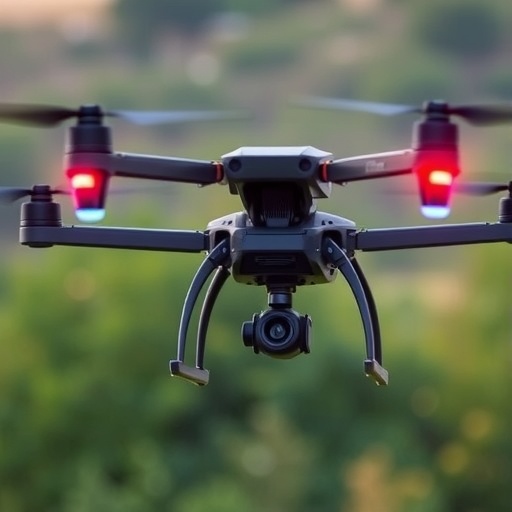
In the rapidly evolving landscape of aerial robotics, researchers have been pioneering techniques that enhance the capabilities of unmanned aerial vehicles (UAVs). A recent study titled “FIMD: Fast Isolated Marker Detection for UV-based Visual Relative Localisation in Agile UAV Swarms,” authored by Vrba et al., explores innovative approaches for improving the navigation techniques of UAV swarms. The repercussions of this research extend well beyond simple advancements in drone technology—this could be a game-changer in applications from search and rescue missions to agricultural monitoring.
At the heart of this groundbreaking work is the Fast Isolated Marker Detection (FIMD) framework, which leverages ultraviolet (UV) markers for defining relative positioning. Traditional systems often rely on visible light and conventional optical markers, which can present several challenges, particularly in diverse environmental conditions such as varying light levels, obstructions, or even adverse weather. By shifting the focus to UV markers, the researchers aim to overcome such limitations.
The FIMD methodology was designed to ensure that UAVs within a swarm can rapidly and accurately identify isolated markers. The importance of speed in detection becomes paramount in swarm operations, where split-second decisions can impact mission success. In this study, the authors detail algorithms that significantly reduce marker detection time, enabling UAVs to operate more efficiently and effectively in synchrony.
Moreover, the study delves into the algorithms behind FIMD, discussing the mathematical models and computational techniques that facilitate the rapid processing of UV data. The authors introduce robust statistical methods that allow the UAVs to distinguish between different markers quickly while filtering out noise and irrelevant data. This technological leap suggests that UAVs can now achieve higher degrees of autonomy, leading to self-sufficient swarms that can make decisions in real-time.
The implications of this research extend to real-world applications. For instance, in disaster scenarios, UAV swarms equipped with FIMD could navigate through debris to locate survivors, using UV markers to guide their pathways. This innovation could drastically reduce the time required for search and rescue operations, making them more effective and saving lives in critical situations.
Further, agricultural stakeholders stand to benefit immensely from these advancements. The ability of UAVs to conduct precise monitoring and mapping of crop conditions using isolated UV markers might provide farmers with data-driven insights into their fields. This capability supports efficient resource management, ultimately contributing to increased crop yields and sustainable farming practices.
The utility of FIMD isn’t limited to rescue missions or agriculture, however. The maritime industry could leverage these improvements as well. Think about multi-UAV operations where drones need to coordinate to monitor vast oceanic regions. The integration of UV markers for navigation can enhance operational safety and efficiency, allowing for continuous surveillance without the risks associated with traditional navigation methods.
In terms of performance metrics, the authors present compelling evidence of FIMD’s superiority compared to conventional detection methods. The study outlines various experimental setups and results, demonstrating not only the speed and accuracy of their solution but also its adaptability to different UAV platforms. With this newfound flexibility, the research opens doors for further innovations in UAV design and applications tailored towards specific missions.
Unity in a swarm is essential, and the ability of individual UAVs to detect and act upon relative positioning is just the tip of the iceberg. The algorithms described in the study allow for collective behavior that can mimic natural swarms in wildlife, showcasing how robotic systems can learn from nature’s ingenuity. This focus on distributed intelligence makes for resilient and adaptable systems capable of evolving as their environments change.
While the technological advancements presented by the FIMD approach are impressive, it is crucial to highlight the ongoing challenges in the field. Notably, the implementation of such systems necessitates considerations about security and reliability. As UAVs become more autonomous, ensuring these vehicles can operate without interference from malicious actions or environmental factors becomes essential.
The researchers also explore potential future directions for their work. A significant aspect lies in integrating machine learning to enhance marker detection further. By training algorithms using vast datasets that include various environmental conditions and marker configurations, UAVs can develop sophisticated recognition capabilities, leading to even greater operational autonomy.
In conclusion, the study by Vrba et al. marks a pivotal moment in UAV technology. By introducing the Fast Isolated Marker Detection framework, they have significantly advanced the capabilities for visual relative localization in agile UAV swarms. The implications of their research are vast, spanning various domains and paving the way for future innovations in autonomous drone operations. This technological leap not only aids in improving efficiency in existing applications but can redefine how drones interact with the world, ultimately delivering better solutions across a multitude of industries.
Subject of Research: Fast Isolated Marker Detection for UAV relative localization
Article Title: FIMD: fast isolated marker detection for UV-based visual relative localisation in agile UAV swarms
Article References:
Vrba, V., Walter, V., Štěpán, P. et al. FIMD: fast isolated marker detection for UV-based visual relative localisation in agile UAV swarms.Auton Robot 49, 13 (2025). https://doi.org/10.1007/s10514-025-10197-5
Image Credits: AI Generated
DOI: https://doi.org/10.1007/s10514-025-10197-5
Keywords: UAV, marker detection, visual localization, autonomous swarms, UV technology, algorithms, robotics, agricultural monitoring, search and rescue, maritime surveillance


