

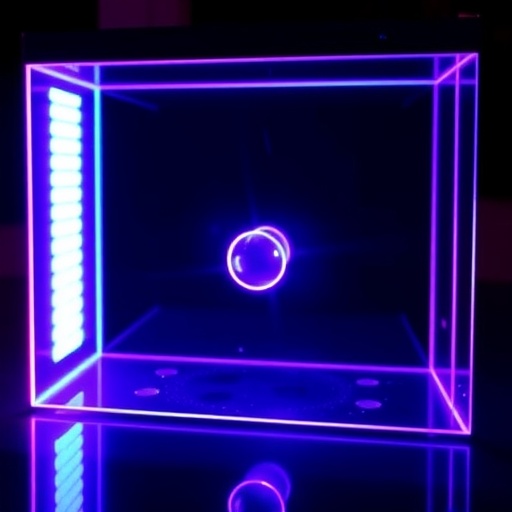
In a groundbreaking advancement that could redefine the boundaries of ultracold chemistry and quantum physics, researchers at the Fritz Haber Institute have successfully achieved magneto-optical trapping of aluminum monofluoride (AlF) molecules. This feat marks the first time a stable, chemically inert “spin-singlet” molecule has been cooled and trapped using laser light, reaching temperatures in the millikelvin range. The experiment’s significance lies not only in the molecule chosen but also in the extreme ultraviolet laser technologies employed and the subsequent quantum mechanical opportunities enabled by this work.
Cooling matter to near absolute zero temperatures—just fractions of a degree above 0 Kelvin—has long served as a key pathway to unveiling and manipulating quantum phenomena. Magneto-optical traps (MOTs), which utilize a symphony of precisely tuned laser beams and magnetic fields, have been indispensable tools in trapping ultracold neutral atoms since their inception nearly four decades ago. Yet extending this methodology to molecular species introduces a daunting complexity due to their richer internal structure, including vibrational and rotational modes.
Historically, laser cooling of molecules was limited to reactive species with unpaired electrons, termed spin-doublet molecules. These molecules, while challenging, allowed researchers to begin exploring molecular quantum control with relative ease compared to chemically stable alternatives. AlF, by contrast, stands out due to its remarkably strong chemical bond and spin-singlet electronic ground state. This inertness promises reduced loss rates from unwanted chemical reactions, making AlF a prime candidate for robust ultracold molecular experiments.
However, this stability comes at a cost. The energetic gap between electronic states in AlF demands laser photons in the deep ultraviolet region, a notoriously challenging spectral regime for laser generation and manipulation. The team overcame this obstacle by innovating four distinct laser systems, each operating near the record-short wavelength of 227.5 nm. This wavelength marks the shortest employed in a magneto-optical trap, pushing the envelope of laser technology with demanding requirements for power stability, beam quality, and optical components resistant to deep UV damage.
The experimental arrangement combined these lasers with magnetic fields to generate a confining potential that both slows the velocity of incoming AlF molecules and captures them effectively at ultracold temperatures. Unlike previous molecular MOTs that were restricted to cooling within a single rotational quantum state, this setup uniquely enabled selective trapping across three different rotational levels. This advance affords unprecedented access to quantum states that carry distinct molecular dynamics and interactions, broadening the horizons for quantum simulation and precision measurement.
Such fine control over rotational levels stems from AlF’s electronic configuration, which enables laser cooling transitions easily across these states. This capability is set to unlock studies into molecular coherence, quantum entanglement, and tests of fundamental symmetries with enhanced precision. Meanwhile, the molecule’s inert character is expected to facilitate long trapping lifetimes critical for these delicate experiments.
Achieving this state-of-the-art trap was no trivial endeavor. Over eight years of persistent research culminated in this breakthrough, involving detailed spectroscopic mapping of AlF’s energy landscape and extensive development of deep ultraviolet lasers and optics. The collaborative effort drew upon expertise ranging from molecular physics and quantum optics to laser engineering, underscoring the multidisciplinary nature of cutting-edge quantum science.
Looking forward, the presence of a metastable spin-triplet electronic state in AlF introduces exciting possibilities. Transitions from the ground spin-singlet state into this metastable state via additional ultraviolet excitation promise pathways to even lower temperatures and novel quantum phases. Harnessing such states could radically enhance control over molecular interactions and coherence, potentially enabling platforms for quantum information processing and tests of fundamental physical theories.
Moreover, the team envisions transiting AlF production from sophisticated beam methods towards compact, vapor-based sources, akin to those used for alkali atom experiments. Early indications suggest that AlF molecules can withstand thermalizing collisions with vacuum chamber walls without loss, a promising sign for scalable and practical ultracold molecule technologies.
This advancement not only exemplifies the technical prowess of contemporary laser physicists but also opens a new frontier where stable, chemically inert molecules can be trapped and manipulated with exquisite precision. Its implications ripple through fields as varied as quantum computation, molecular spectroscopy, and fundamental physics, heralding a new era where molecules, not just atoms, can be brought fully under quantum control.
The research was partly funded by the Horizon Project UVQuanT and the European Research Council’s Starting Grant CoMoFun, illustrating the importance of sustained investment in high-risk, high-reward scientific endeavors. As these efforts mature, ultracold AlF and its related molecular species are poised to become vital tools for the exploration of quantum matter in regimes previously inaccessible.
In summary, the magneto-optical trapping of aluminum monofluoride represents a seminal step forward, marrying cutting-edge deep ultraviolet laser technology with the subtle complexities of molecular quantum physics. This accomplishment lays the foundation for future explorations that may redefine our understanding of chemical interactions and quantum phenomena at ultracold temperatures, potentially catalyzing revolutionary technologies in the years to come.
Subject of Research: Not applicable
Article Title: Magneto-optical trapping of aluminum monofluoride
Web References:
- Horizon Project UVQuanT: https://www.uvquant.eu/
- Article DOI: http://dx.doi.org/10.1103/ksnd-9fyf
Image Credits: © FHI
Keywords
Aluminum monofluoride, ultracold molecules, laser cooling, magneto-optical trap, spin-singlet molecule, deep ultraviolet laser, quantum control, rotational quantum states, metastable electronic state, quantum simulation, molecular physics, ultracold chemistry


