

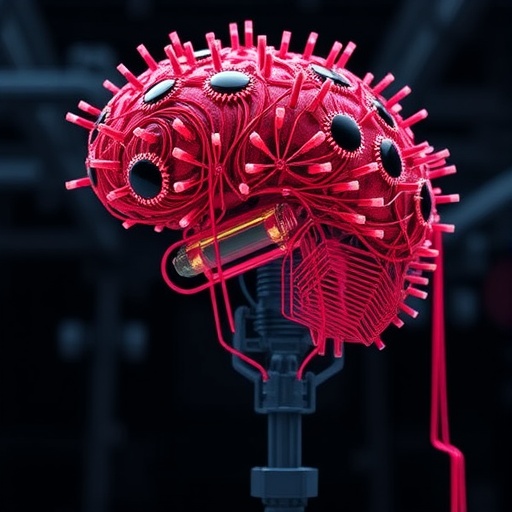
In a groundbreaking development poised to revolutionize the field of neurotechnology, researchers have unveiled a sophisticated brain-computer interface (BCI) that integrates an impressive array of 65,536 electrodes onto a single device capable of initiating high-bandwidth communications between the brain and external devices. This innovation marks a significant leap forward in the capabilities of electrocorticography, which records electrical activities from the surface of the brain using flexible, non-penetrating electrodes. This technology holds the potential for transformative applications in medicine, rehabilitation, and even augmenting human capabilities.
The core of this advanced BCI lies in the integration of a dense electrode array with sophisticated signal processing and wireless communication systems, all housed on a mere 50-micron-thick substrate made from complementary metal-oxide-semiconductor (CMOS) technology. By merging electrodes with advanced electronics on a single platform, the researchers have overcome significant hurdles faced by previous BCIs in terms of scalability and channel density. This innovative approach could pave the way for the development of more efficient, reliable, and versatile brain interfaces that are less invasive than traditional methods.
A remarkable feature of this new BCI is its ability to facilitate simultaneous recordings from a selective subset of electrodes, allowing for up to 1,024 channels to be monitored concurrently. This capability is vital for accurately capturing the nuanced signals that the brain produces during various functions, such as movement and sensory processing. The implications of such high-resolution recordings are profound, particularly in fields such as neuroscience and neuroprosthetics, where understanding brain activity in real-time is paramount for the design of responsive therapies.
Moreover, this device is wirelessly powered, marking a substantial advancement in ensuring its functionality during prolonged periods post-implantation. Chronic and reliable data collection is crucial for understanding brain dynamics over time, as well as for developing adaptive technologies that respond to the user’s mental state or intentions. In preclinical trials with pigs and non-human primates, the device has demonstrated its potential to provide reliable recordings for periods extending from two weeks to two months, highlighting its durability and efficacy in vivo.
One of the significant challenges in the field of BCI development has been the balance between invasiveness and functionality. Traditional implants often require complicated surgeries and can lead to complications and a risk of rejection by the body. However, this new flexible interface can be implanted beneath the dura mater, the tough protective layer surrounding the brain, minimizing damage to surrounding tissues and reducing risk. This feature may significantly ease the path toward clinical applications, as reducing the invasiveness of brain implants is a primary concern for both researchers and patients alike.
The versatility of this BCI extends beyond basic applications, potentially enabling real-time signal decoding from diverse brain regions. Preliminary studies have shown its ability to extract meaningful signals associated with the somatosensory, motor, and visual cortices, providing insights that could enhance our understanding of neural encoding processes. Such clarity and breadth of data could inform the design of future neural prosthetics that interface more seamlessly with the brain, offering improved control and functionality for users.
In addition to its physiological implications, this advancement holds promise for the fields of cognitive neuroscience and neurorehabilitation. The prospects of decoding specific brain states or intentions in real-time can lead to more personalized therapeutic strategies for patients suffering from neurodegenerative diseases, paralysis, or other neurological disorders. The potential for integrating this technology with existing therapeutic frameworks is immense, offering avenues for innovation in patient care.
Furthermore, the wireless, bidirectional communication capabilities of the device establish an essential feedback loop between external systems and the brain. Such communication not only allows for data retrieval but enables the delivery of stimuli or therapeutic interventions directly to targeted brain regions based on real-time analysis. This potential for adaptive neurotherapy represents a paradigm shift, granting researchers and clinicians unprecedented control and insight into brain-machine interactions, possibly leading to breakthroughs in treating mental health disorders and cognitive impairments.
Despite the challenges that lie ahead, including regulatory hurdles and long-term biological safety assessments, the research team is optimistic about the practical applications of their invention. Testing in non-human primates has yielded promising results, and the impending transition to human trials could provide even deeper insights into the capabilities and limitations of this technology. As researchers continue to refine the device’s features and enhance its safety profile, the potential for this BCI to redefine our understanding of brain function and rehabilitation strategies grows increasingly feasible.
As the field of neurotechnology rapidly evolves, the implications of this wireless subdural-contained brain-computer interface are profound and far-reaching. Researchers envision a future where such devices could augment cognitive function, restore motor capacity, and improve quality of life for millions affected by neurological disorders. The journey from theoretical exploration to practical application is often long and fraught with challenges, yet the groundwork laid by this research marks a significant step toward a new era of brain-computer interaction.
The ongoing collaboration between scientists, engineers, and clinicians remains vital in pushing this field forward. As we continue to navigate the complexities of the human brain, such innovations remind us of the powerful intersection of technology and biology. The journey has only just begun, but the potential to unlock the mysteries of the brain and enhance human capabilities is a tantalizing prospect we are now closer to realizing than ever before.
In conclusion, this innovative BCI technology promises to bridge the gap between biological systems and computational devices, setting the stage for new advances in rehabilitation, augmentation, and even our understanding of consciousness itself. As researchers continue to innovate and explore the capabilities of such devices, the future may hold unprecedented possibilities for interactions between humans and machines that were once the realm of science fiction.
Subject of Research: Brain-Computer Interfaces
Article Title: A wireless subdural-contained brain–computer interface with 65,536 electrodes and 1,024 channels
Article References:
Jung, T., Zeng, N., Fabbri, J.D. et al. A wireless subdural-contained brain–computer interface with 65,536 electrodes and 1,024 channels.
Nat Electron (2025). https://doi.org/10.1038/s41928-025-01509-9
Image Credits: AI Generated
DOI: https://doi.org/10.1038/s41928-025-01509-9
Keywords: Brain-Computer Interface, Electrocorticography, Flexible Electronics, Neural Interfaces, Wireless Technology, Neuroscience, Neuroprosthetics


