

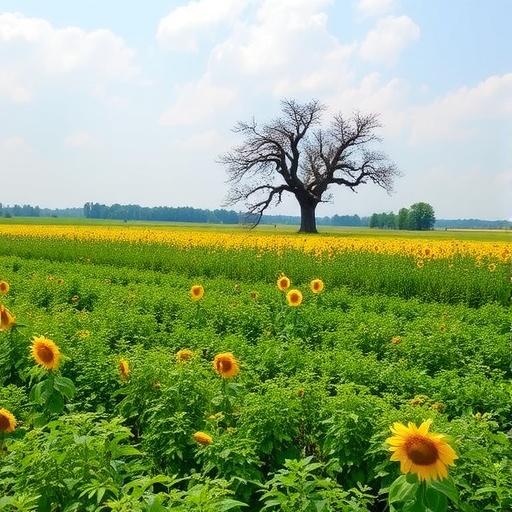
In the face of accelerating biodiversity loss across Europe’s agricultural landscapes, innovative approaches to conservation and ecosystem management are urgently needed. Dr. Elena Velado-Alonso of the University of Göttingen is spearheading groundbreaking research through a newly awarded Marie Skłodowska-Curie Actions Postdoctoral Fellowship. Her project, METAGROLAND, promises to revolutionize our understanding of plant-pollinator metacommunity dynamics and enhance the efficacy of agri-environmental schemes (AES), which are vital for sustaining agricultural biodiversity and ecosystem services.
Agri-environmental schemes are critical tools designed to encourage environmentally sustainable farming practices. These government-funded programs aim to reconcile agricultural productivity with the conservation of biodiversity by incentivizing farmers to implement measures such as habitat restoration and the establishment of wildflower strips. Despite widespread adoption, the effectiveness of many AES interventions in attracting and sustaining pollinator populations remains uncertain. METAGROLAND seeks to bridge this knowledge gap by investigating how these measures influence pollinator communities and the intricate networks of interactions that underpin pollination services essential for crop production.
Biodiversity loss on farmland is not merely a decline in the number of species; it also denotes a collapse of the ecological interactions crucial for ecosystem functioning. Plant-pollinator relationships, in particular, exhibit complex metacommunity structures characterized by spatially distributed populations interacting across landscapes. These networks facilitate resilience and adaptive capacity in agricultural ecosystems but are threatened by habitat fragmentation, pesticide use, and climate change. By applying metacommunity ecology frameworks, METAGROLAND will dissect the spatial and temporal dynamics of pollinator assemblages, offering a robust, mechanistic understanding of how AES interventions mediate these processes.
A unique facet of this research is its dual social-ecological approach. Beyond ecological monitoring and modeling, METAGROLAND examines the social networks of land managers—farmers, advisors, and policymakers—whose knowledge exchange and decision-making critically influence on-the-ground conservation outcomes. This integrative perspective acknowledges that ecological success is contingent upon socio-economic realities and governance structures. By elucidating how social interactions shape environmental management, the project aims to propose AES designs that are not only ecologically sound but also socially feasible and economically viable.
Central to the project is empirical fieldwork conducted across diverse agricultural contexts, including the establishment and evaluation of permanent wildflower strips in regions such as Northeim, Germany. These floral habitats are hypothesized to serve as biodiversity reservoirs, bolstering pollinator abundance and diversity. However, METAGROLAND will rigorously test this hypothesis by tracking insect population trajectories and network stability over time and across spatial scales, employing advanced analytical techniques such as network analysis and spatial statistics.
The implications of METAGROLAND’s findings extend beyond conservation biology into sustainable food production. Pollination directly affects plant reproduction and crop yields, influencing food security on both local and global scales. Understanding how metacommunity dynamics can be harnessed to optimize pollinator services offers the potential to mitigate yield losses and foster resilient agricultural systems under increasing environmental pressures. Thus, this project aligns ecological integrity with agricultural productivity—a synthesis urgently needed in modern agroecosystems.
Moreover, the project will generate practical, scalable tools to inform AES policy and implementation. Current AES frameworks often suffer from variability in effectiveness and lack of adaptability to specific landscape contexts. By integrating ecological data and social insights, METAGROLAND’s outputs will help tailor AES to promote landscape-wide coherence in conservation efforts, enhancing connectivity, and supporting sustainable population levels of key pollinator taxa.
The timing of METAGROLAND is particularly pertinent as Europe grapples with the twin crises of biodiversity decline and climate change impact on agriculture. The European Union’s Horizon Europe programme’s support underscores the strategic significance of this research in advancing green transition goals. By fostering resilient ecosystems through refined AES, METAGROLAND contributes to broader objectives of environmental sustainability, climate mitigation, and rural development.
Dr. Velado-Alonso emphasizes the necessity of expanding conservation perspectives beyond isolated field interventions. Her vision is to understand and manipulate the complex web of interactions encompassing entire agricultural landscapes to promote persistence and resilience of ecological functions. This landscape-scale focus, empowered by metacommunity theory and social network analysis, signifies an innovative paradigm in agroecology research.
As agricultural landscapes are mosaics shaped by human activity, the project’s social dimension is essential. Understanding farmers’ knowledge-sharing networks will identify barriers and facilitators to adoption of effective AES measures. This insight enables co-creation of conservation strategies that are culturally acceptable and economically sustainable, enhancing implementation success and ecological benefits.
Anticipated outcomes from METAGROLAND will include comprehensive datasets, predictive models of plant-pollinator dynamics, and policy recommendations grounded in robust science. Such integrative knowledge is critical for designing AES that effectively support biodiversity while ensuring continued agricultural productivity—a balance pivotal for global sustainability goals.
In sum, METAGROLAND represents a pivotal advance in agroecological science. By intertwining ecological and social dimensions, and leveraging cutting-edge analytical methods, the project charts a path toward resilient, biodiverse, and productive agroecosystems. The knowledge generated will equip farmers, conservationists, and policymakers with the tools to confront biodiversity loss and sustain ecosystem services crucial for humanity’s well-being.
Contact for further details and collaborations is Dr. Elena Velado-Alonso at the University of Göttingen’s Agroecology & Functional Agrobiodiversity Group.
Subject of Research: Metacommunity dynamics of plant-pollinator interactions in agroecosystems to improve the design and efficacy of agri-environmental schemes.
Article Title: METAGROLAND: Harnessing Metacommunity Ecology to Advance Pollinator Conservation and Sustainable Agriculture
Web References:
University of Göttingen – METAGROLAND Project
Image Credits:
Arne Wenzel – Image of a permanent flower strip in agricultural land, Northeim region, Germany.
Keywords:
Pollination ecology, agri-environmental schemes, metacommunity dynamics, agroecosystems, biodiversity loss, plant-pollinator interactions, sustainable agriculture, social-ecological systems, EU Horizon Europe, landscape ecology, conservation biology, ecosystem services.


