

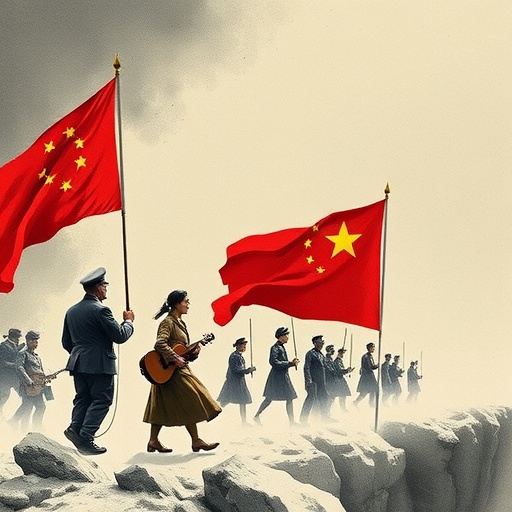
In the annals of wartime history, the role of music as a potent tool for cultural resilience and national identity often remains overshadowed by military strategies and geopolitical maneuvers. However, recent scholarship by D. Zheng, published in the International Journal of Anthropology and Ethnology, uncovers the profound significance of resistance songs during the World Anti-Fascist War period from 1931 to 1945. This research meticulously explores how these songs served as a vocal embodiment of the Chinese nation’s spirit, operating on a cultural front that was as critical as any battlefield.
Throughout the fraught years of the Second Sino-Japanese War and the broader global conflict, music transcended mere artistic expression to become an instrument of psychological warfare and communal solidarity. Zheng’s study delves into an extensive corpus of resistance songs, analyzing their lyrical content, melodic structures, and performative contexts to reveal their role in galvanizing popular resistance against fascist incursions. This analysis positions these cultural artifacts as central to sustaining morale and constructing a collective identity amid adversity.
The investigation highlights that resistance songs were not incidental but carefully crafted narratives blending patriotic fervor with historical memory. They functioned as oral historiographies, narrating stories of heroism, sacrifice, and unity, thus forging a symbolic “Chinese nation” that was culturally coherent in the face of fragmentation. Through ethnomusicological methodologies, Zheng deciphers how these songs integrated traditional Chinese musical idioms with contemporary revolutionary rhetoric, creating a hybrid form that resonated deeply with diverse demographics.
Moreover, the study contextualizes the political ramifications of such cultural production. It argues that these songs were deployed strategically by political groups and grassroots organizations to counteract fascist propaganda and colonial domination. By embedding resistance within everyday cultural practices—public performances, labor environments, and informal gatherings—these songs fostered an insurgent consciousness that challenged occupation forces’ authority and bolstered internal cohesion.
Zheng also examines the performative dimensions, emphasizing how collective singing engendered a participatory space for expressing dissent and imaginative futures. This modality of performance was not merely entertainment but a dynamic medium for social mobilization, enabling communities to assert agency and envision liberation. The embodied nature of these performances transformed audiences into active participants in the anti-fascist struggle, demonstrating the interrelation between culture and politics.
From a technical perspective, the article utilizes a multidisciplinary approach, drawing on archival research, oral histories, and musicological analysis to reconstruct the socio-cultural landscape in which these songs flourished. It reveals that many resistance songs followed pentatonic scales native to Chinese musical traditions yet incorporated sudden modulations and rhythmic variations to evoke urgency and defiance. This fusion highlights the adaptive evolution of musical forms in wartime conditions.
The research also identifies regional variations in the song repertoire, reflecting localized experiences of occupation and resistance. These regional specificities underscore the decentralization of cultural resistance, indicating a pluralistic yet interconnected struggle across China’s vast territories. This geographic diversity in musical response enriched the resistance’s cultural fabric and complicated simplistic national narratives.
Importantly, Zheng’s work alerts contemporary audiences to the enduring legacy of these resistance songs, which continue to inform Chinese cultural memory and identity politics in the 21st century. By excavating these musical artifacts from historical obscurity, the study invites a reevaluation of how intangible cultural heritage shapes national resilience and historical consciousness beyond conventional political histories.
The article concludes by positing that understanding resistance music as a form of cultural front not only enriches historiography of the World Anti-Fascist War but also offers new frameworks for analyzing cultural resistance in modern conflicts globally. It suggests that music and other cultural expressions function as vital arenas where contested narratives of power, identity, and liberation are negotiated and performed.
Zheng’s research exemplifies the necessity of integrating humanities and social science methodologies to capture the complex dynamics of wartime cultural production. By foregrounding the voices articulated through song, this study reclaims a dimension of the anti-fascist struggle that underscores human creativity and resilience amid oppression, reminding readers that battles are waged equally in hearts and minds as on fields and cities.
The revelation of the “Chinese nation” as vocalized through resistance songs revolutionizes how we perceive cultural resistance and enriches our understanding of the multi-layered fabric of war. This groundbreaking scholarship thus holds tremendous relevance for historians, ethnomusicologists, anthropologists, and anyone intrigued by the interplay between culture and conflict.
In sum, through a compelling narrative and rigorous analysis, Zheng’s article broadens the scope of wartime studies, urging the incorporation of cultural artifacts like resistance songs in constructing comprehensive histories of nationalism and anti-fascist movements. These sonic emblems provided emotional sustenance and ideological clarity, ensuring that the spirit of resistance persevered even when conventional military victories were elusive.
This scholarship is not only a tribute to the resilience of a people but also a call to acknowledge and preserve the cultural expressions that continue to inspire identity formation and resistance worldwide. As conflicts evolve in the modern era, the study of such cultural phenomena remains indispensable for understanding the fuller human dimensions of war and peace.
Subject of Research: Resistance songs as cultural expressions of the Chinese national identity during the World Anti-Fascist War (1931–1945).
Article Title: Giving voice to the “Chinese nation”: Resistance songs on the cultural front in the World Anti-Fascist War (1931–1945).
Article References:
Zheng, D. Giving voice to the “Chinese nation”: Resistance songs on the cultural front in the World Anti-Fascist War (1931–1945). Int. j. anthropol. ethnol. 10, 2 (2026). https://doi.org/10.1186/s41257-026-00150-4
Image Credits: AI Generated
DOI: 10.1186/s41257-026-00150-4 (30 January 2026)


