

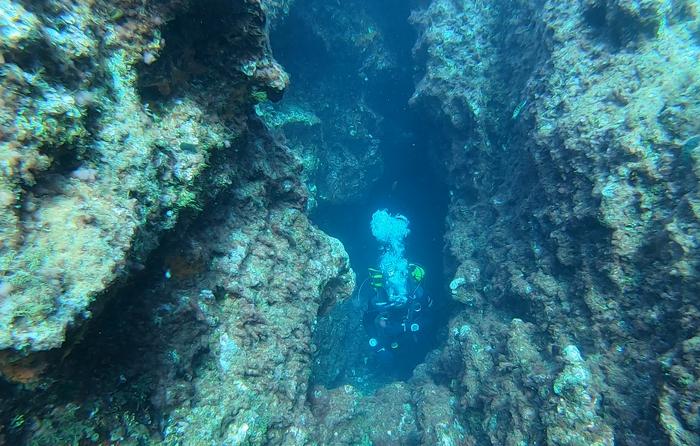
The goal is to encourage divers to not only store their data for themselves, but also to share them online through a database portal. “Every person who dives uses a special small computer that is usually worn on their wrist. With the help of our concept of a calibrated diving station, recreational and professional divers become citizen scientists, and their diving computers are transformed into scientific instruments,” explains Dr. Christophe Galerne of MARUM – Center for Marine Environmental Sciences at the University of Bremen.

Credit: MARUM – Center for Marine Environmental Sciences, University of Bremen; C. Galerne
The goal is to encourage divers to not only store their data for themselves, but also to share them online through a database portal. “Every person who dives uses a special small computer that is usually worn on their wrist. With the help of our concept of a calibrated diving station, recreational and professional divers become citizen scientists, and their diving computers are transformed into scientific instruments,” explains Dr. Christophe Galerne of MARUM – Center for Marine Environmental Sciences at the University of Bremen.
The new project is called “Divers for Ocean Temperature – Coastal temperature database for monitoring ocean surface water past and present,” BlueDOT for short. It is being coordinated by MARUM – Center for Marine Environmental Sciences at the University of Bremen, and funding for the citizen science project is provided by the Federal Ministry of Education and Research (BMBF). The work is led by Dr. Christophe Galerne of MARUM, Dr. Rebecca Zitoun of the GEOMAR Helmholtz Centre for Ocean Research Kiel, Prof. Achim Kopf of MARUM, and Arne Schwab of SchwaRTech, official industry partner of the project.
Understanding temperature rise through data analysis
With BlueDOT, Galerne combines his scientific work and passion with his hobby. “Over the past five or six years, divers have reported temperature anomalies that suggest the presence of a severe heat wave in the Mediterranean. Surprisingly, this has not been indicated by the monitoring systems currently in place. A distinct increase in average surface-water temperatures compared to earlier records was first recognized in the spring of 2023. In order to understand what is happening worldwide and in the Mediterranean, we need to analyze more data. That is exactly what is made possible by the collection of data from diving computers, and it will even allow us to analyze what has happened in the past. This is the only way we can find out exactly what causes the heatwaves and how their effects can be mitigated,” says Galerne.
There are similar data-collection projects being carried out for the surface waters, for example, using surfboards. These involve the use of a “smart fin” attached to the board that can record certain parameters in the surface waters. Galerne points out that, “Our project goes further and deeper, down to around 40 meters.” People go diving at locations in the Mediterranean Sea every day. “We can use their data to fill a large gap in the present monitoring system.”
Rebecca Zitoun of GEOMAR adds, “Diving computer data are already available online, and we have a large amount of historical data that we can use. Our project will make use of these historical data and collect new data in order to analyze past trends of water temperature in the Mediterranean, and to understand how it could develop in the future.” These kinds of data are important for climate models as well as for risk assessments for governments, communities and the general public, to aid in making informed decisions.
In practice, it looks like this: after each dive, the data from a calibrated diving computer, which include the place, time, pressure and temperature, are downloaded to a PC or laptop after each individual dive. This is where the BlueDOT project comes in, for which Galerne and his colleagues are programming a portal where dive data can be uploaded and processed regardless of the brand of diving computer. The data is then processed by the analysis team for scientific evaluation.
Successful in the “Innovation Sprint”
The team applied to take part in an “innovation sprint” as part of the DATIpilot funding guideline. The BMBF is funding 300 technological and social innovation projects from around 3,000 applications that offer solutions to current challenges and produce added societal value. The team is supported in its work by the University of Bremen’s UniTransfer office.
The project begins in December with two diving stations in the Mediterranean. Calibration stations for the diving computers will be set up on the Costa Brava and on the Maltese island of Gozo. Divers at these sites will receive training to ensure that the data is of high quality. The citizen scientists will collect data for 18 months that will subsequently be analyzed. These two locations were selected based on diver experience in recent years.
With its cooperation partners, the team is currently working on the sensors and on buoys anchored to the sea floor that record stationary temperatures and serve as reference stations for the diving computers. Work is also continuing on the database structure and the portal for uploading the data. They are also drawing up guidelines for data standards and working procedures for citizen scientists. “The development of community-based procedures for the collection, management, storage, and use of diving data is an important part of the project. These assure us that everyone is using the same methods when they contribute to the project. This provides us with confidence in our data so that it can be used for scientific modeling,” emphasizes Zitoun.
And, of course, the team will seek to establish contacts with divers in Malta and on the Costa Brava to recruit them for the scientific project. “We need dedicated individuals and diving centers to support us in this work. Our planned Ocean Literacy campaigns and workshops are therefore an important component of BlueDOT. With their contributions, enthusiastic individuals can help to find solutions, because scientists cannot solve the problems alone. That is why citizen science projects like ours are becoming more important,” says Zitoun.
It is already possible for divers to record their data now and upload it later when the programming of the app is complete. As Galerne emphasizes, “We first want to contact local people who dive especially often and in all kinds of weather.” This would avoid a “sampling bias” – for example, when more dives are completed in the summer and correspondingly fewer when travel restrictions are in effect or in winter conditions. Diving during the winter months is particularly important in order to achieve a sufficient amount of data for all months and all latitudes. The team is committed to involving the diving community even after the data collection phase is completed – after all, water is their element.
More information:
Funding guidelines for the DATIpilot of the BMBF: (German only)
University of Bremen Press Release: (German only)
Contacts:
Dr. Christophe Galerne
MARUM – Center for Marine Environmental Sciences
Geosciences Department
University of Bremen
Email: cgalerne@marum.de
Prof. Achim Kopf
MARUM – Center for Marine Environmental Sciences
Geosciences Department
University of Bremen
Email: akopf@marum.de
Dr. Rebecca Zitoun
GEOMAR Helmholtz Centre for Ocean Research Kiel
Email: rzitoun@geomar.de
Arne Schwab
Schwab Research Technology (SchwaRTech)
Email: aschwab@schwartech.de
MARUM produces fundamental scientific knowledge about the role of the ocean and the seafloor in the total Earth system. The dynamics of the oceans and the seabed significantly impact the entire Earth system through the interaction of geological, physical, biological and chemical processes. These influence both the climate and the global carbon cycle, resulting in the creation of unique biological systems. MARUM is committed to fundamental and unbiased research in the interests of society, the marine environment, and in accordance with the sustainability goals of the United Nations. It publishes its quality-assured scientific data to make it publicly available. MARUM informs the public about new discoveries in the marine environment and provides practical knowledge through its dialogue with society. MARUM cooperation with companies and industrial partners is carried out in accordance with its goal of protecting the marine environment.

