

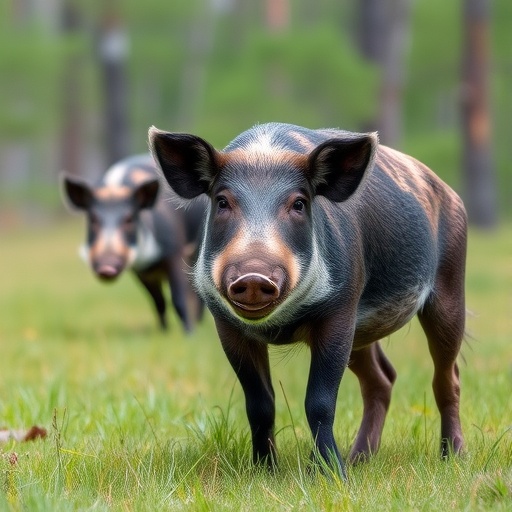
The persistent threat posed by feral hogs across the southeastern United States continues to challenge landowners, agricultural stakeholders, and wildlife managers. Infamous for their destructive behavior, feral swine inflict an estimated $2.5 billion annually in damages and control efforts nationwide, disrupting ecosystems, damaging crops, and threatening native species. Recent empirical investigations conducted by researchers at the University of Arkansas provide critical insights into the human dimensions shaping responses to this invasive species, unveiling the pivotal role of trust dynamics and landowner experience in the efficacy of feral hog management programs.
Foremost among these studies is a comprehensive survey examining private landowners’ attitudes towards feral hog control in Arkansas, Louisiana, and East Texas. This research foregrounds trust as a foundational element influencing whether landowners actively engage in managing feral swine populations. Trust operates on multiple societal levels: trust in neighbors and communities enhances self-initiated control measures, fostering localized cooperation that is essential due to the migratory nature of feral hogs. The spatial mobility of these animals necessitates coordinated efforts among various stakeholders to prevent reinvasion and effectively mitigate damage.
However, this community trust simultaneously presents paradoxical consequences. High trust levels in local networks may inadvertently suppress participation in government-led initiatives, as landowners tend to perceive their own community-driven interventions as more efficacious than external programs. Such findings elucidate the complex social interplay influencing management strategies, emphasizing that outreach and policy designs must be contextually attuned to these social dynamics to optimize engagement and resource allocation.
A crucial aspect identified in this body of research is landowners’ preference for lethal control methods over non-lethal alternatives. The data reveals a prevalent acceptance of population reduction through targeted eradication techniques, likely driven by the urgency to safeguard personal property and natural resources. The predominant motivations for control include protection of private land, safety of local wildlife, family security, and environmental stewardship. These motivations reflect multifaceted concerns that transcend simple economic calculations, highlighting the integrative role of cultural and perceptual factors in shaping environmental management decisions.
Complementing these attitudinal insights, a second quantitative study investigates landowners’ willingness to financially support organized, state-sponsored feral hog control programs. The analysis distinguishes considerable variation in willingness to pay (WTP) based on land use typology and geographic location. Notably, agricultural cropland owners demonstrate a higher WTP relative to timberland and pastureland proprietors, suggesting differential risk perceptions and economic dependencies influence financial commitment. This stratification underscores the need for tailored policy interventions that reflect heterogeneity in stakeholder priorities and land-use contexts.
Geographically, the study reports that East Texas landowners exhibit markedly greater WTP levels compared to counterparts in Arkansas and Louisiana. This gradient mirrors the historical intensity and economic burden of feral hog damage in the region, which has cultivated heightened awareness and urgency. Conversely, Louisiana’s relatively lower historical loss correlates with diminished financial support for control measures. These findings advocate for adaptive management approaches that account for local epidemiology and economic impact to engender effective collective action.
The interdisciplinary research team stresses that a monolithic approach to feral hog management is inherently flawed. Regional ecological variations, coupled with divergent social attitudes and economic realities, necessitate the development of context-specific outreach and intervention programs. Effective management depends on recognizing the nuanced landscape of stakeholder motivations, trust networks, and land use patterns that collectively shape responses to invasive species threats.
The implications of this research extend beyond local landowner engagement, signaling critical considerations for cooperative management frameworks that bridge public and private sectors. Given the diffuse nature of feral hog populations across ownership boundaries, fostering collaboration within and among communities is paramount. This calls for innovative governance models that incentivize participation, mitigate free-rider problems, and leverage existing social capital to amplify control efforts.
From a policy perspective, these findings provide a compelling case for integrating socio-economic variables and human behavioral factors within invasive species management strategies. By aligning program designs with landowners’ experiential knowledge, trust structures, and economic capacities, resource managers can significantly enhance program acceptance and efficacy. This approach advances beyond traditional ecological trapping and culling techniques, embedding human dimensions as central to sustainable invasive species control.
Moreover, the research underscores the urgency of enhancing educational campaigns that are geographically and culturally resonant. Disseminating tailored information that resonates with individual landowners’ concerns and values will likely increase proactive behaviors. Outreach efforts should seek to build trust not only within communities but also between landowners and government agencies, overcoming skepticism and fostering collaboration.
As academic institutions and governmental agencies continue to confront invasive species challenges, such as those posed by feral hogs, these studies exemplify the vital intersection of social science and natural resource management. Understanding the attitudes, economic considerations, and social networks that drive landowner behavior is essential to devising informed, multifaceted solutions that can protect agricultural productivity, biodiversity, and ecosystem health.
In summation, the dynamic interplay of trust, economic willingness, and experience with feral hogs outlines a complex but navigable pathway toward managing an otherwise insidious ecological threat. The nuanced comprehension of private landowners’ perspectives presented by this research offers a beacon for crafting adaptive, inclusive, and regionally appropriate control programs. Continued interdisciplinary research and stakeholder engagement remain indispensable to confront the feral hog dilemma effectively within the evolving landscapes of the American South.
Subject of Research: People
Article Title: Private Landowners’ Perspectives on Managing Feral Swine in Arkansas, Louisiana, and East Texas
News Publication Date: 29-Jan-2026
Web References:
https://doi.org/10.1002/jwmg.70165
https://doi.org/10.20900/jsr20250070
References:
Tian, N., Mineau, A., & Gan, J. (2026). Private Landowners’ Perspectives on Managing Feral Swine in Arkansas, Louisiana, and East Texas. Journal of Wildlife Management.
Choi, J., Tian, N., & Gan, J. Private Landowners’ Willingness to Pay for Managing Feral Swine in the West Gulf Region. Journal of Sustainability Research.
Image Credits: UADA photo
Keywords: Natural resources management, Pest control, Agriculture, Environmental management, Forest resources, Land use, Social research


