

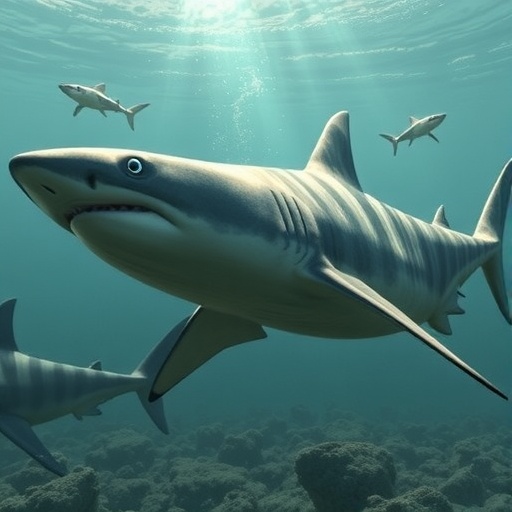
In an extraordinary advance in paleontological research, scientists have unveiled compelling evidence of prehistoric interactions between apex marine predators and their prey in the North Sea, dating back approximately five million years. This breakthrough stems from the meticulous analysis of two fossilized whale skulls recovered from the Early Pliocene epoch. These specimens have yielded the rare and telling presence of embedded shark tooth fragments, providing unprecedented insights into ancient feeding behaviors and ecological dynamics within these now-temperate waters.
The skulls, discovered in Belgium over several decades, belong to two distinct cetacean species representative of that era’s marine megafauna. One is a diminutive member of the extinct right whale lineage, while the other is related to the monodontids—a family including modern belugas and narwhals. Through state-of-the-art computed tomography (CT) scanning techniques, researchers have non-invasively visualized these fossil remains, identifying shark teeth lodged within the cranial bones. This methodology has been pivotal, preserving the integrity of the fossils while allowing detailed reconstruction of the interspecies interactions.
Dr. Olivier Lambert, a leading paleontologist from the Royal Belgian Institute of Natural Sciences, emphasized the significance of this discovery. “Our understanding of North Sea paleoecosystems has long been incomplete, largely due to limited fossil data. The presence of shark teeth embedded in whale skulls opens a window into predator-prey dynamics during the Early Pliocene, enriching our comprehension of marine trophic structures millions of years ago,” he remarked. This exemplifies how advancements in imaging technologies can revolutionize interpretations of fossil evidence.
The embedded teeth tell a story not merely of predation but more specifically of scavenging behavior. The tooth fragments’ anatomical positioning, particularly those found in the rostral region of the right whale skull, suggests the whale carcass was scavenged while in a supine, or belly-up, position. This orientation typically characterizes deceased cetaceans drifting post-mortem, indicating sharks targeted carrion rather than live prey in these instances. This behavioral inference is significant for reconstructing paleoecological food webs and energy transfer dynamics in extinct marine systems.
Intriguingly, the shark species implicated belong to lineages no longer resident in the southern North Sea region. One tooth fragment originates from Hexanchus griseus, commonly known as the bluntnose six-gill shark or cow shark, while the other is attributed to a relative of the modern great white shark, Carcharodon carcharias. The occurrence of these large predatory sharks alongside ancient whales paints a strikingly different picture of the North Sea’s prehistoric biodiversity compared to its current marine ecosystem, which lacks these formidable predators.
These findings also highlight the biogeographical shifts in marine fauna over geological timescales. The absence of such shark species in present North Sea waters may correlate with climatic fluctuations, habitat alterations, and anthropogenic pressures influencing marine predator distributions. Understanding historical predator-prey dynamics through fossil evidence can thus inform contemporary conservation strategies by contextualizing the natural variability and resilience of marine ecosystems.
Professor John Stewart, an evolutionary paleoecologist from Bournemouth University who originally unearthed one of the whale skulls as a teenager decades ago, expressed deep satisfaction with the new revelations. “Paleontology often relies on indirect evidence to infer ecological interactions. This discovery is remarkable because it provides concrete, physical proof of these ancient feeding relationships, moving beyond mere speculation,” he stated. Such data are invaluable for refining models of early marine mammal ecology.
Furthermore, the involvement of non-professional fossil enthusiasts in the collection of these specimens underscores the importance of citizen science contributions to paleontological research. Dr. Paul Gigase, a pathologist, along with his son Pierre, discovered the second skull, enriching the available fossil record for scientific inquiry. This collaboration between academics and amateurs exemplifies the democratization of science facilitated by public engagement and shared passion for natural history.
The reconstructed imagery derived from Alexander Lovegrove’s painting vividly brings to life these extinct interactions, depicting a bluntnose six-gill shark scavenging on the carcass of a small right whale while a pod of beluga-like monodontids swims in the background. Such visual reconstructions, grounded in empirical fossil data, are potent tools for communicating complex scientific findings to the broader public and stimulating interest in paleoecology.
The ongoing research not only deepens our understanding of prehistoric marine ecosystems but also poses compelling questions about future ecological shifts. Given the current trajectory of climate change and its impact on marine mammal distributions in the North Sea, there is speculation about whether large predatory sharks, including great whites, might return to these waters to exploit prey such as local seal populations. This hypothesis bridges paleontological knowledge with modern ecological concerns, illustrating the relevance of ancient evidence to contemporary biodiversity management.
As we continue to uncover the fossilized remnants of ancient biodiversity, studies like this illuminate the dynamic and often turbulent history of marine life. They remind us that current ecosystems are but snapshots in a long continuum of biological change. The integration of advanced imaging modalities, meticulous fossil analysis, and interdisciplinary collaboration propels our capacity to reconstruct Earth’s deep past, offering invaluable lessons for predicting and mitigating future ecological transformations.
This remarkable study represents a milestone in paleoecological research, revealing intricate predator-prey relationships from a time when the southern North Sea was a thriving habitat for both whales and large predatory sharks. By identifying the species involved and interpreting the nature of their interactions, scientists are crafting a more detailed narrative of Early Pliocene marine life, enhancing our grasp of evolutionary processes and environmental change in Earth’s history.
Subject of Research: Animals
Article Title: Evidence for different shark species feeding on a diminutive right whale and a relative of the beluga in the Early Pliocene of the southern North Sea
News Publication Date: 18-Mar-2026
Web References: 10.4202/app.01297.2025
Image Credits: Alexander Lovegrove
Keywords: Paleoecology, Ecology, Ecosystems, Evolutionary ecology, Paleoenvironments, Life sciences, Evolutionary biology, Dentition, Conservation biology, Behavioral ecology, Paleontology, Fossils, Organismal biology, Anatomy, Animal anatomy, Marine mammals, Marine biology, Marine life, Natural history, History of life


