

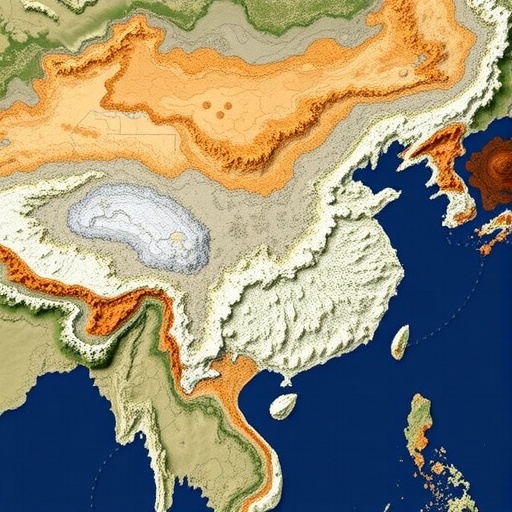
In a groundbreaking advance in paleontology and stratigraphy, a new study has delivered an intricately refined stratigraphic framework for the Sanqushan Group in South China, radically reshaping our comprehension of the Katian stage within the Zhe-Gan platform. The research, conducted by Guang-Xu Wang and Ren-Bin Zhan from the Nanjing Institute of Geology and Palaeontology, Chinese Academy of Sciences, integrates novel sedimentological and paleontological datasets to create a high-resolution portrayal of shallow marine biotic evolution immediately preceding the Late Ordovician Mass Extinction (LOME).
The late Katian carbonate successions within the Jiangshan–Changshan–Yushan (JCY) region represent an exceptionally preserved archive of shallow marine ecosystems, unparalleled in South China. In contrast to the graptolite-dominated facies prevalent across the broader region, these carbonate deposits harbor a vivid spectrum of fossil assemblages that illuminate the dynamics of marine life during a critical interval of evolutionary and ecological upheaval.
Historically, the Sanqushan Formation—the unit encompassing these carbonate rocks—has been mineralogically and temporally ambiguous, with its stratigraphic boundaries and correlation to regional lithostratigraphy subjects of ongoing debate. Previous models proposed an equivalency between the Xiazhen Formation and the Sanqushan Formation, both assigned broadly within the late Katian age without nuanced subdivision. Such generalizations, researchers argue, have obscured complex biotic signals and lithostratigraphic variations critical to understanding Ordovician marine ecosystems.
Wang and Zhan’s study undertakes a comprehensive reevaluation, employing integrated sedimentologic observations alongside detailed biostratigraphic analyses, specifically focusing on graptolite biozones as chronological markers. Their meticulous fieldwork reveals that the Sanqushan Formation deserves elevation from formation to group status, encompassing three discrete formations arranged stratigraphically from oldest to youngest: Yaojiakeng, Jitoushan, and Xiazhen.
The Yaojiakeng and Jitoushan formations are correlated consistently with the Dicellograptus complexus Biozone, a pivotal marker interval within the late Katian, demarcating critical stages in graptolite evolution. This contrasts with the overlying Xiazhen Formation, which aligns with the Paraorthograptus pacificus Biozone, indicating a younger, distinct chronological horizon. Such refined biozonation permits an unprecedented framework for temporally constraining evolutionary events in the shallow marine realm.
This refined stratigraphy enables the reconstruction of high-resolution biotic dynamics, revealing a dramatically more intricate picture of ecosystem evolution preceding the LOME than earlier models suggested. Rather than a simple, homogenous decline or transition, the marine communities exhibit nuanced fluctuations in diversity, composition, and ecological interactions, reflecting responsive environmental shifts and biotic stresses in the final million years before the mass extinction event.
The implications of this study extend beyond regional stratigraphy, as the Sanqushan Group’s uniquely preserved marine biotas form one of the few windows into shallow water niches during the Ordovician in South China. This insight is crucial, especially given the dominance of deep-water graptolitic facies elsewhere, which limit ecological interpretations to pelagic ecosystems and obscure nearshore ecological processes that are vital to reconstructing the full scope of Ordovician biodiversity crises.
Moreover, understanding the detailed stratigraphic framework informs models of environmental changes—such as sea-level fluctuations, sedimentation rates, and oceanographic conditions—that collectively shaped the evolutionary trajectories of marine faunas. The estimated temporal durations and biotic turnovers within these newly proposed formations enable paleobiologists to correlate regional extinction and recovery patterns with global Ordovician trends, advancing knowledge of resilience and vulnerability mechanisms in ancient ecosystems.
Wang emphasizes that these findings necessitate a paradigm shift in approaching Late Ordovician paleobiology in South China, urging researchers to employ more granular stratigraphic and biostratigraphic frameworks and to revisit legacy collections and stratigraphic correlations under this refined lens. The study adeptly demonstrates the synergy between lithological context and paleontological evidence as essential to unraveling complex biotic events with temporal precision.
Ren-Bin Zhan highlights that by elucidating the stratigraphic intricacies of these shallow marine deposits, the research unveils previously undetectable ecological signals, including the timing and nature of key faunal turnovers that prefigured the LOME. Such signals may provide analogs for understanding biotic responses to environmental perturbations across deep time, with potential analogies for modern biodiversity crises.
Published in the forthcoming issue of Continent and Life Evolution, this work challenges prior interpretations and offers a vital stratigraphic toolset for future paleontological and sedimentological investigations targeting the Great Ordovician Biodiversification Event (GOBE) and its subsequent catastrophic collapse. The refined taxonomy of formations and their biozones establishes a robust template for integrating regional South China data with global Ordovician stratigraphy and mass extinction studies.
In sum, Wang and Zhan’s stratigraphic refinement not only resolves enduring controversies but also enriches the paleobiological narrative of one of Earth’s most significant biotic turnovers, showcasing the complexity and dynamism of marine ecosystems on the cusp of mass extinction. This research highlights the importance of high-resolution temporal frameworks in disentangling the interplay between environmental drivers and biotic responses at critical junctions in Earth’s deep history.
Subject of Research: Not applicable
Article Title: Stratigraphic refinement unveils high-resolution shallow marine biotic dynamics immediately preceding the Late Ordovician Mass Extinction in South China
News Publication Date: 9-Feb-2026
Web References: http://dx.doi.org/10.55092/cle20260002
Image Credits: Guang-Xu Wang & Ren-Bin Zhan / Nanjing Institute of Geology and Palaeontology, Chinese Academy of Sciences
Keywords: Geologic periods


