

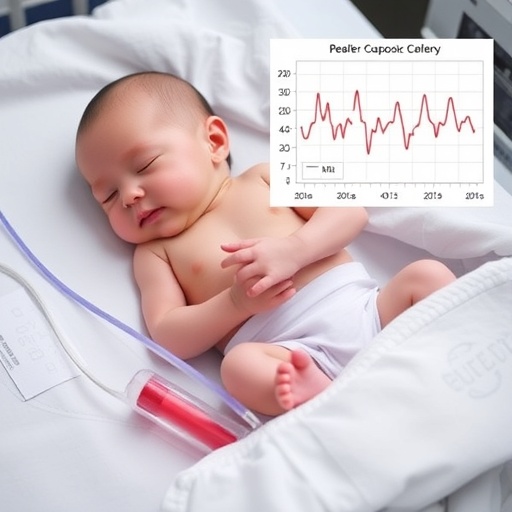
In a groundbreaking prospective cohort study, researchers have meticulously charted the minute-by-minute systemic hemodynamic responses to packed red blood cell (PRBC) transfusions in extremely low gestational age neonates (ELGANs). This study, published in Pediatric Research, offers an unprecedented glimpse into the delicate physiological shifts occurring in these vulnerable infants during transfusion therapy—a standard yet complex intervention critical for their survival and development. The detailed hemodynamic data acquired sheds new light on the intricacies of cardiovascular adaptations occurring over brief timescales, highlighting the need for precision medicine approaches in neonatal intensive care units (NICUs).
Extremely premature infants, defined as those born before 28 weeks of gestation, often present with profound anemia due to multiple medical conditions and frequent blood draws. The administration of packed red blood cells is a cornerstone of their clinical management, aimed at enhancing oxygen delivery to tissues. However, the immediate effects of such transfusions on systemic hemodynamics—the dynamics of blood flow and pressure throughout the circulatory system—have remained inadequately characterized until now. This study bridges this critical gap by employing continuous, high-resolution monitoring techniques to capture dynamic cardiac and vascular responses in real-time.
The methodology is particularly notable for its utilization of advanced monitoring technologies facilitating minute-by-minute tracking of key hemodynamic parameters, such as mean arterial pressure (MAP), cardiac output (CO), and heart rate (HR). This granular approach departs from traditional intermittent measurements, enabling detection of subtle transient changes that might otherwise evade clinical attention. The cohort comprised ELGANs receiving PRBC transfusion in a controlled NICU environment, ensuring data reliability and clinical relevance. The researchers systematically synchronized hemodynamic data with the timing of transfusion initiation and completion, allowing for an incisive temporal analysis.
Their findings revealed a complex biphasic pattern in MAP following transfusion onset. An initial transient surge in blood pressure was observed within the first ten minutes, suggesting an acute vascular response possibly mediated by increased blood viscosity and volume expansion. This was followed by a gradual normalization or even a slight dip in MAP thereafter, indicating adaptive mechanisms recalibrating cardiovascular homeostasis. Such hemodynamic fluctuations underscore the necessity for vigilant monitoring during and immediately after transfusion to mitigate risks of hypo- or hypertension that could jeopardize cerebral perfusion and contribute to adverse neurological outcomes.
In addition to pressure dynamics, alterations in cardiac output provided critical insights. The study showed that CO transiently increased in response to enhanced circulating volume and improved oxygen-carrying capacity of the transfused erythrocytes. This hemodynamic boost likely supports tissue oxygenation during a vulnerable period, yet the modulation of this response over subsequent minutes suggested a finely tuned balance between supply and metabolic demand. The precise characterization of these changes challenges prior assumptions that transfusions simply elevate circulatory volume in a linear fashion, revealing instead a nuanced interplay reflecting neonatal cardiac reserve and vascular compliance.
Heart rate trends further complemented the hemodynamic profile. Researchers documented a modest increase in HR concurrent with MAP surges, potentially driven by baroreflex-mediated autonomic responses aiming to stabilize systemic pressure. However, the transient nature of tachycardia post-transfusion points toward rapid neural and humoral feedback loops restoring hemodynamic equilibrium. Elucidating such neural control mechanisms in ELGANs has significant implications, as dysregulated autonomic function is often implicated in neonatal morbidities, including intraventricular hemorrhage and necrotizing enterocolitis.
The ramifications of these findings extend beyond physiological insights. Clinically, real-time minute-by-minute monitoring could transform transfusion protocols by tailoring duration, volume, and rate of administration to the individual neonate’s hemodynamic responses. Standard fixed-dose transfusions might be suboptimal or even deleterious without accounting for dynamic cardiovascular reactions. This precision approach holds promise to enhance safety, optimize oxygen delivery, and reduce complications, marking a paradigm shift in neonatal transfusion medicine.
Moreover, the study highlights potential avenues for technological innovation. Integration of continuous non-invasive hemodynamic monitoring tools, such as near-infrared spectroscopy and impedance cardiography, with bedside electronic health records could facilitate automated alerts and decision-support algorithms. These systems could identify hemodynamic instability early, prompting timely interventions. This intersection of biomedical engineering and neonatology opens exciting possibilities for systematized care in fragile preterm populations.
This research also prompts reconsideration of the underlying pathophysiology of transfusion-related complications. For instance, the biphasic MAP response might illuminate mechanisms behind transfusion-associated circulatory overload and its contribution to pulmonary edema or cardiac strain in premature infants. Future studies leveraging the minute-resolution approach could unravel individual susceptibility factors, guiding risk stratification and prophylactic strategies in transfusion management.
Additionally, the authors call attention to the need for longitudinal studies linking these acute hemodynamic responses with longer-term neurodevelopmental outcomes. Understanding how early fluctuations in cerebral and systemic blood flow during transfusion impact brain maturation could inform both clinical decision-making and counseling of families. Given the profound vulnerability of ELGANs to hypoxic-ischemic injury, refining transfusion practices based on hemodynamic evidence may be instrumental in improving survival and quality of life.
The implications of this study resonate with broader themes in neonatal care, particularly the push toward personalization and data-driven interventions. By unveiling the rapid cardiovascular adaptations during PRBC transfusion, the research underscores the dynamic physiology of premature infants—far from static entities, their systems ebb and flow with remarkable sensitivity to clinical interventions. The minute-by-minute analytical paradigm exemplifies how deep temporal resolution can reveal physiologic complexities that snapshot measures miss, urging a reexamination of existing clinical guidelines.
This work is emblematic of the power of prospective cohort designs harnessing continuous monitoring to extract rich, actionable data. It also embodies interdisciplinary collaboration, synthesizing neonatology, cardiology, physiology, and biostatistics to tackle a critical clinical challenge. As the neonatal research community digests these findings, it is anticipated that future protocols will incorporate real-time hemodynamic feedback into routine transfusion safety monitoring, potentially setting new standards for neonatal intensive care worldwide.
In sum, this pioneering study not only charts the immediate systemic hemodynamic responses to PRBC transfusions in ELGANs with unprecedented temporal precision, but also lays a foundational framework for next-generation, precision-tailored neonatal transfusion medicine. Its insights offer hope for improving outcomes for some of the most fragile patients, revealing the intricate cardiovascular choreography that ensues with every drop of transfused blood. The prospect of transforming neonatology through such detailed physiological surveillance reflects a new frontier in pediatric research and clinical care, where every minute truly counts.
Subject of Research: Hemodynamic responses to packed red blood cell transfusion in extremely low gestational age neonates.
Article Title: Minute-by-minute systemic hemodynamic responses to packed red blood cell transfusion in extremely low gestational age neonates: a prospective cohort study.
Article References:
Chakkarapani, A.A., Jamil, A., Awada, Z. et al. Minute-by-minute systemic hemodynamic responses to packed red blood cell transfusion in extremely low gestational age neonates: a prospective cohort study. Pediatr Res (2026). https://doi.org/10.1038/s41390-026-04805-y
Image Credits: AI Generated
DOI: 12 February 2026


