

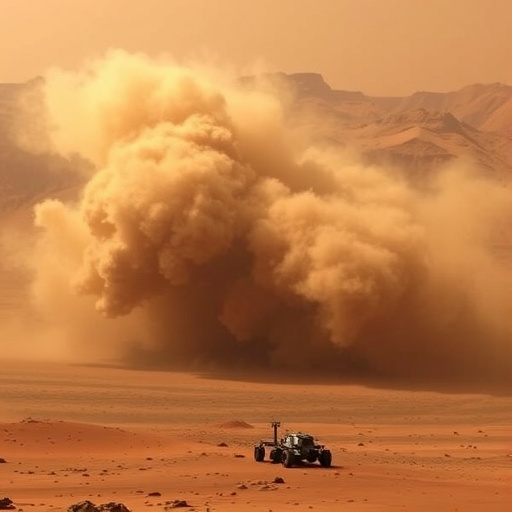
In a groundbreaking development in planetary science, recent observations and analyses have unveiled an extraordinary phenomenon on Mars that challenges long-standing assumptions about the Red Planet’s atmospheric dynamics and water loss mechanisms. This new study, published in Communications Earth & Environment, reveals that a powerful and localized dust storm during Mars’ Northern Hemisphere summer dramatically enhanced the transport of water vapor to the upper atmosphere—an event previously thought improbable in this season. This discovery reshapes our understanding of how water has been lost from Mars over billions of years and sheds light on the intricate interplay between Martian weather and climate evolution.
Mars today is known as a cold, arid desert planet, its surface barren and hostile to life as we know it. However, geological evidence left on its ancient landscape—such as dried river channels, sedimentary layers altered by liquid water, and hydrated minerals—indicates a dramatically different past when water was much more abundant on the surface. Understanding the processes by which this water was lost to space remains one of the central challenges in planetary science, requiring careful integration of atmospheric chemistry, climate modeling, and space mission data. Despite many models suggesting various water loss pathways, significant gaps remain, particularly in quantifying how episodic events might accelerate this escape.
The new research marks a significant advance by documenting the effects of an anomalously intense yet localized dust storm that occurred during Martian northern summer of year 37 (Earth years 2022–2023). Using data from multiple Mars orbiters—including the European Space Agency’s Trace Gas Orbiter (TGO) with its NOMAD instrument, NASA’s Mars Reconnaissance Orbiter (MRO), and the Emirates Mars Mission (EMM)—the team captured an unexpected surge in water vapor concentration in the middle atmosphere, reaching levels up to tenfold higher than typical values during this season. Such elevated water transport in the upper atmosphere had never been observed before, nor anticipated by prevailing climate simulations.
This localized storm’s impact was profound: by injecting substantial amounts of water vapor into high altitudes, the storm created favorable conditions for enhanced photodissociation—a process in which solar ultraviolet radiation breaks water molecules into hydrogen and oxygen atoms. The liberated hydrogen, being lightweight, can then reach the exobase, the outer boundary of Mars’ atmosphere where it easily escapes into space. Indeed, measurements showed a subsequent increase in hydrogen abundance at the exobase of 2.5 times relative to preceding years, marking a pronounced spike correlating temporally with the dust event.
Until this study, the scientific consensus emphasized the Southern Hemisphere’s summer as the main period driving Martian water loss, attributed to its warmer temperatures and dynamic atmospheric conditions. By contrast, the Northern Hemisphere summer was considered less critical for water escape due to cooler temperatures and lower water vapor content in the upper atmosphere. This new evidence overturns that paradigm and asserts that even regional-scale dust storms outside the traditional “loss season” can produce substantial and episodic bursts of atmospheric escape, fundamentally altering our temporal understanding of Martian climate processes.
Dust storms on Mars are well known to influence atmospheric heating by absorbing and scattering sunlight, which in turn affects vertical mixing and water vapor distribution. The exceptional intensity of the storm studied here enhanced vertical transport processes that lofted water far above the normally observed altitude range. This mechanism, now validated through direct observation, must be incorporated into future climate and atmospheric escape models to accurately simulate long-term water depletion rates on Mars, ensuring that episodic and spatially localized events are no longer overlooked.
The international collaboration behind this study combined expertise and data from diverse sources, highlighting the indispensable value of multi-mission coordination in planetary research. The integration of remote sensing measurements from orbiters orbiting Mars enabled a comprehensive temporal and spatial view of atmospheric changes induced by the dust storm. Such synergy provides the empirical foundation for refining climate models, testing hypotheses, and guiding future exploration strategies focused on Mars’ hydrological and atmospheric evolution.
Scientists have long sought to quantify Mars’ historical water budget—how much water once existed, how it transformed, and how much ultimately escaped to space. Hydrogen escape serves as a key proxy in this endeavor because it directly results from the breakdown of water molecules in the atmosphere. This study’s observations that transient dust storms can cause brief but intense surges in hydrogen escape strongly suggest that cumulative water loss may be modulated by such episodic phenomena, thereby contributing to a more nuanced and temporally varying escape history.
Adrián Brines from the Instituto de Astrofísica de Andalucía (IAA-CSIC) and Shohei Aoki of the University of Tokyo and Tohoku University co-led this research effort. Their team’s results add an essential dimension to our understanding of Mars’ climatic trajectory. By establishing that intense localized dust storms play a decisive role in redistributing water vapor to escape-critical altitudes outside of commonly modeled periods, they open new avenues for interpreting Mars’ complex environmental record.
This finding also emphasizes the importance of continuous, high-resolution monitoring of Mars’ atmosphere to identify and characterize such transient events. As future missions target Mars’ atmospheric composition, climate, and habitability potential, acknowledging the impact of these short-lived but powerful meteorological phenomena will be critical. Their implications extend beyond water loss, influencing near-surface climate conditions, dust cycle dynamics, and potentially seasonal habitability niches.
Mars’ mysterious transition from a once warm and wet planet to the cold, dry world we observe today has puzzled scientists for decades. The confirmation that not only global but also regional dust storms can accelerate water escape highlights the multifaceted and dynamic nature of the planet’s atmospheric processes. This complexity must be accounted for in models that aim to predict Mars’ climate past and future, as well as in evaluating whether remnants of liquid water might still transiently exist in near-surface environments.
In conclusion, this pivotal study reshapes the scientific landscape by identifying a new driver of Martian water escape—out-of-season, strong localized dust storms during northern summer. It demonstrates the necessity of integrating episodic phenomena into the conceptual framework of planetary climate evolution. Such improved understanding will enhance our knowledge of Mars’ potential habitability and inform missions that seek clues about the planet’s capacity to support life, past or present.
Subject of Research: Water loss mechanisms on Mars driven by localized dust storms and their impact on Martian climate evolution.
Article Title: Out-of-season water escape during Mars’ northern summer triggered by a strong localized dust storm
News Publication Date: 2 February 2026
Web References:
http://dx.doi.org/10.1038/s43247-025-03157-5
Image Credits: ©NASA, ESA, STScI
Keywords: Mars, Planetary science, Planets, Water, Weather


