

Prepare to have your understanding of the cosmos fundamentally challenged as a groundbreaking new study unveils a theoretical model of a black hole that defies conventional astrophysical wisdom, a celestial enigma now theorized to be enveloped by the elusive cosmic force known as quintessence. This remarkable fusion of concepts, articulated by researchers M.H. Macêdo, J. Furtado, and R.R. Landim, published in the esteemed European Physical Journal C, proposes a revolutionary re-imagining of the universe’s most enigmatic entities, pushing the boundaries of theoretical physics and offering a tantalizing glimpse into the exotic behavior of spacetime at its most extreme. Imagine a black hole, typically conceived as a voracious singularity of infinite density from which nothing, not even light, can escape, being cushioned and perhaps even altered by quintessence, a hypothetical form of dark energy that permeates the universe and is believed to be driving its accelerated expansion. This paradigm-shifting proposition opens an exciting new frontier for cosmological exploration, prompting us to re-evaluate the very fabric of reality and the forces that govern its evolution on the grandest scales imaginable, potentially reshaping our cosmic narrative.
The theoretical framework introduced in this seminal work centers on the Dymnikova black hole model, a fascinating departure from the standard Schwarzschild black hole. Unlike its classical counterpart, the Dymnikova black hole is characterized by a finite size and a non-singular interior, possessing a delicate internal structure instead of an infinitely dense point. This crucial distinction allows for a more nuanced physical interpretation and opens the door to exploring its interactions with surrounding fields in a way that would be impossible with a pure singularity. Now, imagine this already exotic object being cloaked in quintessence, a concept that has long perplexed scientists. Quintessence, unlike the cosmological constant, is a dynamic energy field that can vary in time and space, offering a more flexible and potentially richer theoretical landscape for understanding the universe’s expansion. The interplay between the Dymnikova black hole’s unique geometry and the pervasive, mysterious influence of quintessence is what forms the core of this revolutionary investigation, promising to unlock secrets about the universe’s fundamental constituents and their intricate dance.
The profound implications of this research extend far beyond mere academic curiosity; they touch upon the very nature of gravity, energy, and the ultimate fate of the universe. By considering a Dymnikova black hole immersed in quintessence, the physicists are able to explore how this exotic dark energy might influence the black hole’s properties, such as its mass, spin, and potentially even its observable characteristics. Traditional black holes are thought to be primarily shaped by their gravitational pull and the matter they consume, but the presence of quintessence introduces a new layer of complexity, suggesting that these cosmic titans may not be as solitary and immutable as we once believed. This interaction could lead to subtle but significant deviations from predicted gravitational effects, offering testable hypotheses for future astronomical observations, igniting the imaginations of cosmologists and astrophysicists worldwide with this audacious theoretical proposal.
One of the most compelling aspects of this new model is its potential to resolve long-standing puzzles in cosmology. The accelerated expansion of the universe, a phenomenon attributed to dark energy, remains one of the greatest mysteries in modern physics. Quintessence offers a compelling, albeit theoretical, explanation for this cosmic acceleration. If a Dymnikova black hole can interact with and be influenced by quintessence, it might provide crucial insights into the behavior and properties of this enigmatic energy field. This could lead to a deeper understanding of how dark energy has shaped the universe’s evolution over billions of years and what its ultimate role will be in its distant future, potentially offering a unified perspective on gravity’s influence at both cosmic and sub-cosmic scales.
The researchers meticulously explore the mathematical formalisms required to describe such an exotic scenario. Their work involves intricate calculations that account for the Einstein field equations, modified to incorporate the gravitational influence of the Dymnikova black hole’s structure and the dynamic energy density of quintessence. This theoretical scaffolding allows them to predict how the spacetime geometry around such an object would behave, including its effects on light rays and the orbits of nearby celestial bodies. The precision of these calculations is paramount, as any deviation observed in future astronomical data could provide concrete evidence for the existence of this peculiar black hole-quintessence system, turning theoretical musings into tangible discoveries.
The Dymnikova black hole itself is a fascinating construct, conceived as a regular solution to Einstein’s field equations, meaning it doesn’t possess an infinite singularity at its core. Instead, it features a region of compressed matter or exotic vacuum energy, which theoretically smooths out the singularity. This characteristic makes it a more plausible candidate for astrophysical phenomena compared to the idealized point-like singularities of more conventional black hole models. When this non-singular black hole is surrounded by quintessence, a fluid with negative pressure responsible for driving cosmic acceleration, the interaction becomes incredibly rich, allowing for a spectrum of complex physical behaviors that challenge our current astrophysical paradigms.
The research delves into how the presence of quintessence might affect the event horizon of the Dymnikova black hole. In standard black hole physics, the event horizon is the boundary beyond which escape is impossible. However, the interaction with quintessence could lead to modifications of this horizon, potentially making it less absolute or altering its size and shape. This could have profound implications for how we detect and study black holes, as subtle changes in their gravitational influence might become observable, providing scientists with new avenues for exploration and discovery in the vast cosmic ocean.
Furthermore, the proposed model suggests that the quintessence field surrounding the Dymnikova black hole could exert a repulsive gravitational effect, counteracting the black hole’s inherent attractive pull to some extent. This delicate balance between attraction and repulsion could lead to unique astrophysical phenomena, such as the formation of exotic accretion disks or peculiar gravitational lensing patterns that deviate from those predicted by models of isolated black holes. Identifying such anomalies in observational data would be a monumental achievement, solidifying this theoretical framework and opening up unparalleled avenues for understanding the universe.
The implications for gravitational wave astronomy are particularly exciting. As black holes merge, they generate ripples in spacetime known as gravitational waves. The unique properties of a Dymnikova black hole interacting with quintessence could lead to distinct gravitational wave signatures that differ from those produced by binary systems of standard black holes. Advanced gravitational wave detectors, like LIGO and Virgo, are constantly refining their sensitivity, making it increasingly possible to detect these subtle gravitational whispers from the cosmos, potentially revealing the presence of these novel cosmic entities.
The scientific community is abuzz with the potential of this research. While the Dymnikova black hole model itself has been explored theoretically, its coupling with quintessence marks a significant evolutionary leap in our understanding of these cosmic phenomena. This integration invites new avenues of inquiry into the nature of dark energy and its pervasive influence on the structure and evolution of the cosmos, potentially paving the way for a more comprehensive theory of cosmic phenomena.
The researchers’ detailed mathematical analysis provides a robust foundation for this exploration, offering predictions that can, in principle, be tested through future astronomical observations. The quest to confirm or refute such theories is what drives scientific progress, pushing the boundaries of our knowledge and revealing the universe in ever-greater detail, one theoretical breakthrough at a time.
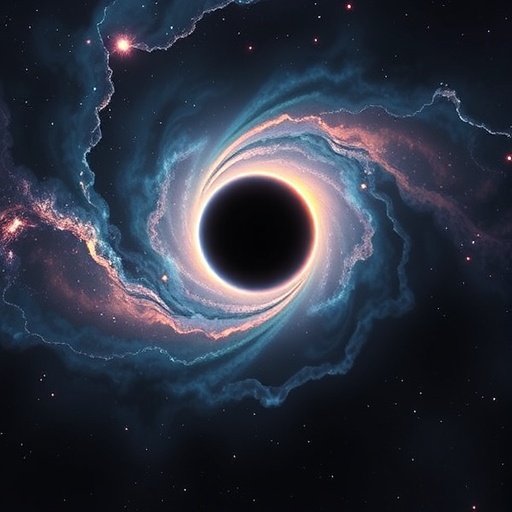
The visual representation accompanying this study, depicting a Dymnikova black hole cradled within a luminous, swirling field of quintessence, serves as a potent symbol of this theoretical fusion. Though an artistic rendition, it encapsulates the awe-inspiring nature of these cosmic concepts and the profound questions they raise about the universe’s composition and behavior. It invites us to gaze upon the stars with renewed wonder, considering the hidden forces and exotic structures that may shape our cosmic reality.
This pioneering work serves as a powerful reminder that our understanding of the universe is far from complete. The cosmos continues to surprise us with its complexity and its capacity for phenomena that defy our current imagination. The marriage of the Dymnikova black hole and quintessence is a testament to the relentless pursuit of knowledge, demonstrating humanity’s innate drive to unravel the universe’s most profound mysteries, pushing the frontiers of scientific understanding ever onward, and inspiring future generations of explorers.
The study of exotic black holes and the enigmatic quintessence field represents the cutting edge of theoretical physics and cosmology. By proposing a concrete model that interweaves these two concepts, Macêdo, Furtado, and Landim have not only advanced our theoretical understanding but have also provided a tangible roadmap for future research, potentially leading to paradigm-shifting discoveries that could redefine our place in the cosmos and our comprehension of its fundamental workings. The implications for our understanding of fundamental physics are immense, and the scientific community eagerly awaits further developments and observational evidence to support this audacious, yet compelling, theoretical framework.
Subject of Research: The theoretical study of a Dymnikova black hole surrounded by quintessence and its implications for cosmology and gravity.
Article Title: Dymnikova black hole surrounded by quintessence
Article References: Macêdo, M.H., Furtado, J. & Landim, R.R. Dymnikova black hole surrounded by quintessence. Eur. Phys. J. C 86, 57 (2026). https://doi.org/10.1140/epjc/s10052-025-15266-8
Image Credits: AI Generated
DOI: https://doi.org/10.1140/epjc/s10052-025-15266-8
Keywords: Black holes, Quintessence, Dark energy, Dymnikova black hole, Theoretical physics, Cosmology, General relativity, Spacetime physics, Gravitational physics, Exotic objects


