

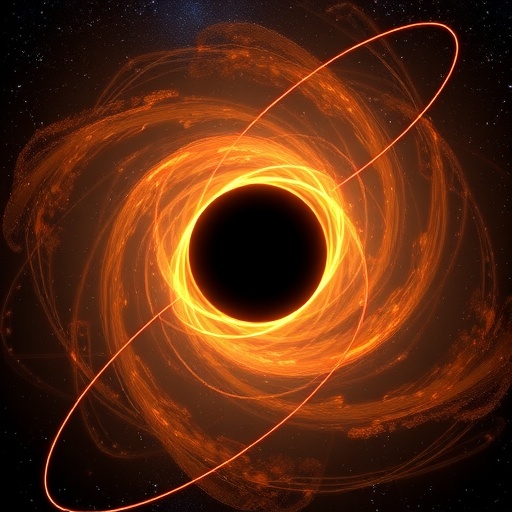
Unveiling the Secrets of the Cosmos: Charged Regular Black Holes and the Symphony of Quasars
The universe, a canvas of unimaginable scales and profound mysteries, continues to astound us with its intricate workings. At the heart of this cosmic ballet lie black holes, enigmatic entities that warp spacetime and challenge our most fundamental understanding of physics. While the iconic Schwarzschild black hole, a singular point of infinite density, has long dominated our theoretical landscape, the pursuit of a more complete picture has led scientists to explore alternative models. Recent groundbreaking research, published in the prestigious European Physical Journal C, delves into the fascinating realm of charged regular black holes and their interaction with the luminous outbursts of quasars, offering a tantalizing glimpse into the universe’s deepest secrets and potentially rewriting our cosmic narrative.
This pioneering study, spearheaded by researchers G. Mustafa, F. Javed, S.G. Ghosh, and their esteemed colleagues, ventures beyond the singularity-laden Schwarzschild model to investigate a class of black holes characterized by their absence of a central singularity. These “regular” black holes, imbued with an electric charge, present a unique gravitational environment, and their influence on surrounding celestial phenomena can act as a cosmic fingerprint, revealing their true nature. The observed epicyclic frequencies, the characteristic orbital oscillations of matter around these massive objects, serve as the crucial data points in this ambitious scientific endeavor, providing an unprecedented opportunity to probe the very fabric of spacetime near these powerful cosmic engines.
The choice of quasars as the observational targets for this study is not arbitrary. Quasars, the extremely luminous active galactic nuclei powered by supermassive black holes at the centers of galaxies, are known for their intense radiation and relativistic jets. The accretion disks surrounding these behemoths are fertile grounds for observing the subtle gravitational effects of the central black hole. By meticulously analyzing the patterns of light emitted by these quasar disks, scientists can infer the presence and properties of the underlying black hole. The epicyclic frequencies, specifically, are exceptionally sensitive indicators of the spacetime geometry, making them ideal probes for distinguishing between different black hole models.
The concept of a “regular” black hole is a significant departure from the traditional understanding of these cosmic titans. The classical black hole models, like the Schwarzschild and Kerr black holes, predict a singularity at their center, a point where the laws of physics as we currently understand them break down. However, theoretical frameworks suggest that such singularities might be artifacts of incomplete theories or that quantum gravity effects could resolve them. Regular black holes, in contrast, possess a smooth, non-singular interior, often supported by exotic matter or quantum corrections, offering a potentially more physically realistic representation of the most extreme gravitational objects in the universe.
The addition of electric charge to these regular black holes introduces another layer of complexity and observational possibility. The Reissner-Nordström black hole, a charged, spherically symmetric variant, is a well-studied example, but research into charged regular black holes introduces a nuanced gravitational field. This electric charge, much like the mass, influences the orbits of nearby matter. The study’s focus on charged regular black holes allows for the probing of a broader spectrum of gravitational phenomena, and by comparing observations with theoretical predictions, researchers can test the validity of different black hole solutions and constrain their parameters with unprecedented accuracy.
The mathematical framework employed in this research is deeply rooted in general relativity and involves the intricate calculation of epicyclic frequencies. These frequencies are derived from the equations of motion for particles orbiting a central mass, taking into account the spacetime curvature dictated by the black hole’s mass and charge. By solving these complex equations for a charged regular black hole model and comparing the predicted frequencies with those observed in quasars, the researchers can place stringent limits on the parameters that define the black hole, such as its mass, charge, and the specific form of its regular structure.
The data for this study is drawn from a diverse set of quasars, allowing for a robust statistical analysis and minimizing the impact of any individual celestial object’s peculiar characteristics. Each quasar serves as a unique laboratory, its accretion disk a meticulously orchestrated dance of matter influenced by the unseen black hole at its core. The painstaking acquisition and analysis of this observational data are crucial for validating theoretical predictions and pushing the boundaries of our cosmic comprehension. The collective wisdom of cosmic observations, when channeled through rigorous scientific inquiry, offers invaluable insights into the universe’s grand design.
The significance of this research extends far beyond the academic journals. The potential to confirm or refute the existence of regular black holes has profound implications for our understanding of gravity, quantum mechanics, and the very origins of the universe. If regular black holes are indeed prevalent, it would necessitate a re-evaluation of many astrophysical models and open new avenues for theoretical exploration. The universe, it seems, is far more inventive than we have imagined, and each new discovery unravels another layer of its breathtaking complexity, inspiring awe and fueling our insatiable curiosity.
One of the most compelling aspects of this study is its potential to provide observational evidence for phenomena that have, until now, been largely confined to theoretical speculation. The absence of singularities in regular black holes offers a potential resolution to some of the most persistent paradoxes in black hole physics, such as the information paradox. By observing the signatures of these unique gravitational environments, scientists can move closer to a unified theory of quantum gravity, a holy grail of modern physics that seeks to reconcile the seemingly disparate realms of the very small and the infinitely massive.
The methodology employed involves fitting the observed epicyclic frequencies of various quasars to the theoretical predictions generated by different charged regular black hole models. This intricate process resembles piecing together a cosmic puzzle, where each observed frequency is a tessera that, when placed correctly, reveals the underlying picture of the black hole’s nature. The remarkable precision of modern astronomical instruments allows for the measurement of these subtle orbital oscillations, transforming theoretical constructs into tangible, observable realities that shape our understanding of the cosmos.
Furthermore, the study’s findings could have implications for our understanding of galaxy evolution. Supermassive black holes at the centers of galaxies play a crucial role in shaping their host galaxies through feedback mechanisms. If these black holes are indeed regular and charged, their gravitational influence and energetic output might differ significantly from their singular counterparts, leading to observable differences in galaxy formation and evolution patterns across the cosmos, painting a more nuanced picture of cosmic interplay.
The very act of observing and analyzing these distant celestial phenomena represents a triumph of human ingenuity and scientific endeavor. From the construction of sophisticated telescopes to the development of complex analytical tools, each step in this research journey is a testament to our collective quest for knowledge. The ability to peer across billions of light-years and scrutinize the workings of phenomena like charged regular black holes is a profound reminder of our place in the grand tapestry of existence, a small but curious observer in an infinitely vast and wondrous universe.
Looking ahead, the researchers anticipate that this work will pave the way for future investigations, potentially utilizing even more advanced observational techniques and theoretical frameworks. As our technological capabilities grow and our theoretical understanding deepens, we can expect to uncover even more astonishing revelations about the nature of black holes and the fundamental laws that govern our universe. The journey of discovery is far from over; indeed, it has only just begun, promising more mind-bending insights into the cosmos.
In conclusion, this study represents a monumental leap forward in our quest to comprehend the universe’s most enigmatic objects. By combining cutting-edge theoretical physics with precise astronomical observations, the researchers have provided us with a compelling new perspective on charged regular black holes and their role in the cosmic drama. The symphony of quasars, when listened to with the discerning ear of science, reveals melodies of gravity and spacetime that resonate with profound implications for our understanding of reality itself, urging us to ponder the deep structures and forces at play within the vast cosmic expanse.
Subject of Research: Studying the characteristics of charged regular black holes by analyzing the epicyclic frequencies of matter orbiting them, using observational data from quasars.
Article Title: Epicyclic frequencies around charged regular black hole: constraints using different quasars data.
DOI: https://doi.org/10.1140/epjc/s10052-025-15223-5
Keywords:


