

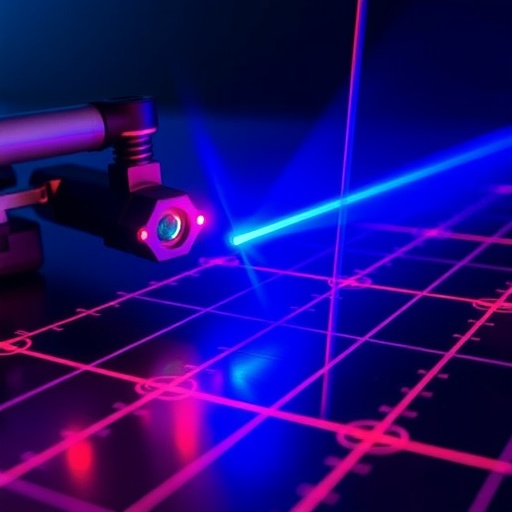
Researchers at the University of Bristol have unveiled a groundbreaking laser range-finding technology that draws inspiration from the realm of quantum physics to achieve extraordinary precision in distance measurements, even under intense solar illumination. This new technique leverages advanced concepts from quantum sensing while utilizing classical laser systems, marking a significant leap in overcoming long-standing challenges posed by environmental noise and sunlight interference in optical distance sensing.
The development addresses one of the most formidable barriers in long-range optical measurements: the disruptive ‘noise’ caused by sunlight and atmospheric fluctuations. Traditionally, such environmental disturbances have severely limited the accuracy and reliability of laser-based sensing systems outdoors. However, the Bristol team has demonstrated a revolutionary approach that suppresses background noise without compromising the strength and clarity of the signal, thereby unlocking potential applications across autonomous vehicle navigation, infrastructure monitoring, geospatial surveying, and even space exploration.
Central to the innovation is an elegant adaptation of a quantum phenomenon known as energy-time entanglement. Instead of generating delicate quantum light directly—which is often fraught with stability and scalability issues—the researchers ingeniously recreated its most beneficial noise-resistant characteristics using a carefully engineered classical laser system. This breakthrough allows the system to maintain robust signal correlations critical for precise range-finding, all while operating with the simplicity and power efficiency inherent in classical optics.
The team put their system to the test across the University of Bristol’s campus, conducting highly precise distance measurements between iconic landmarks such as the Queens Building, Wills Memorial Building, and Cabot Tower. Even under the variable and often harsh conditions of full daylight and changing weather, the system consistently delivered astonishing accuracy, achieving sub-millimeter precision over distances exceeding 400 meters. Specifically, the measurement between the Queens Building and Wills Memorial Building reached an accuracy of better than 0.1 millimeters over approximately 155 meters—a remarkable feat considering the environmental noise present.
One of the most striking aspects of this technology is its operational efficiency. The laser used for measurements operates at power levels significantly lower than a typical laser pointer, ensuring minimal energy consumption and enhanced safety. Additionally, the rapid acquisition speed—completing measurements in just one-tenth of a second—demonstrates the system’s suitability for real-time applications where quick, reliable data is essential.
Achieving these results involved sophisticated engineering of the laser pulses and their spectral properties. By dynamically modulating the color of the laser pulses at high speeds through optical fibers and electronic modulators, the researchers created signals with tailored correlations that mimic the quantum mechanical advantages of entangled photons. These engineered classical correlations provide the resilience necessary to reject intense solar background, all while producing light millions of times brighter than conventional quantum light sources—a crucial factor for practical deployment in ambient conditions.
According to Dr. Weijie Nie and Professor John Rarity, lead authors on the study and members of the University’s School of Electrical, Electronic and Mechanical Engineering, this work bridges a vital gap between theoretical quantum advantages observed in laboratory experiments and the demands of real-world sensing technologies. Their findings reveal that it is not strictly necessary to generate true quantum entanglement to reap the associated noise-rejection benefits; judiciously crafted classical correlations suffice and offer greater scalability, robustness, and operational simplicity.
Further validation was completed by extending the range of measurements beyond 400 meters between different campus locations. These trials underscored the system’s capability to function reliably in an outdoor urban environment, where unpredictable weather and fluctuating sunlight intensities pose significant challenges to conventional optical systems. The success of these experiments marks a significant milestone in demonstrating that advanced quantum-inspired sensing techniques can be transitioned from controlled laboratory setups to everyday applications.
The innovation holds transformative potential for numerous fields reliant on precise distance measurement. Autonomous vehicles, for instance, could greatly enhance safety and navigational accuracy by incorporating such noise-resistant range-finding technologies. Similarly, infrastructure monitoring efforts could benefit from highly accurate, rapid, and low-power measurements to ensure structural stability and detect early signs of degradation. Moreover, aerospace applications could exploit these advancements to perform long-distance ranging with unprecedented precision, despite the harsh and noisy conditions of space.
Dr. Alex Clark, co-author and Associate Professor in Quantum Technologies at the University of Bristol’s School of Physics, emphasizes the historical significance of this research within the university’s legacy of quantum science achievements. By conducting these tests using some of the university’s most emblematic buildings, the team not only demonstrated technological prowess but also paid homage to Bristol’s rich tradition of pioneering discoveries in quantum physics and engineering.
Looking forward, the research group aims to further enhance the capabilities of their system by extending its operational range and miniaturizing the hardware components. The incorporation of integrated photonic devices—compact, chip-scale optical circuits—could significantly reduce the size and complexity of the fibre-optic setups, facilitating easier deployment in practical field scenarios. Such miniaturization efforts are essential for embedding this technology into mobile platforms and expanding its industrial and commercial reach.
This work signifies a pivotal stride towards next-generation optical sensing systems that combine quantum-inspired robustness with classical technological convenience. As the researchers continue to refine and upscale their approach, the potential to revolutionize sensing applications across diverse sectors becomes ever more tangible, heralding a future where precision measurement is unhindered by environmental noise, enabling safer, smarter, and more connected technologies worldwide.
Subject of Research: Quantum-inspired laser range-finding technology and noise-resistant optical distance measurement systems
Article Title: Entanglement-inspired frequency-agile rangefinding
News Publication Date: 24-Jan-2026
Web References:
https://doi.org/10.1038/s41467-026-68589-9
References:
Nie, W., Rarity, J., et al. (2026). Entanglement-inspired frequency-agile rangefinding. Nature Communications.
Image Credits: University of Bristol
Keywords
Quantum measurement, Laser systems, Quantum sensing, Energy-time entanglement, Optical range-finding, Noise suppression, Classical laser technology, Integrated photonics, Autonomous vehicle sensing, Infrastructure monitoring, Space exploration optics, Frequency-agile lasers


