

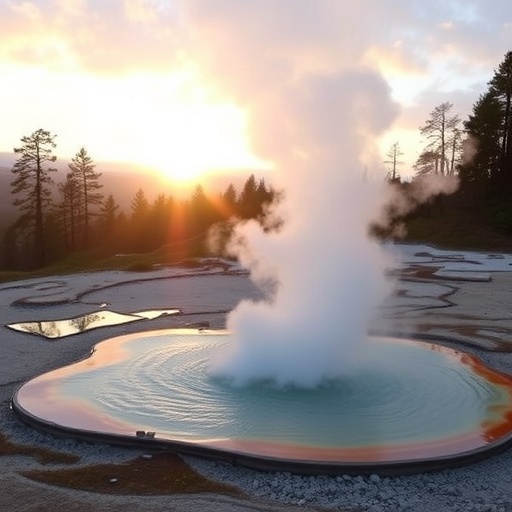
In a transformative advance for clean energy research, Quaise Energy, an MIT spin-off, has generously donated $750,000 to Oregon State University (OSU) to support pioneering work into superhot rock (SHR) geothermal energy—a resource with the potential to revolutionize global energy systems. This significant funding, directed through the OSU Foundation, aims to propel fundamental laboratory investigations that mimic the extreme conditions found miles beneath the Earth’s surface, where superhot rock geothermal resources reside. These conditions have traditionally posed formidable challenges for direct field study, making experimental simulation an essential pathway to unlocking this promising energy frontier.
The essence of SHR geothermal energy lies in accessing rock formations at depths ranging from two to twelve miles below the earth’s crust, where temperatures and pressures soar to extremes. These superhot environments contain vast reservoirs of heat energy that, if harnessed, could deliver carbon-free, reliable power on a scale orders of magnitude greater than current global electricity generation. Carlos Araque, CEO and co-founder of Quaise Energy, highlights that exploiting just one percent of these resources could provide approximately 63 terawatts of firm and sustainable energy—exceeding world electricity demand by over eightfold. This underscores why SHR geothermal energy stands as a beacon for the future of the energy transition.
Central to this endeavor is the behavior of water under supercritical conditions. Water at around 374 degrees Celsius and extremely high pressures enters a supercritical phase—a dense, steam-like state that transcends familiar liquid or vapor forms. In this phase, water’s energy-carrying capacity increases up to five times compared to regular hot water, presenting an extraordinarily efficient medium for extracting geothermal energy. Understanding how fluids navigate through deep, fractured rock in this supercritical state is vital for designing systems that can transport heat efficiently to the surface for conversion into electricity.
At OSU’s Experimental Deep Geothermal Energy (EDGE) laboratory, Assistant Professor Brian Tattitch leads the development of a custom-built flow-through reactor, capable of replicating the punishing conditions experienced in SHR environments—temperatures up to 500 degrees Celsius and pressures reaching 500 atmospheres, about 500 times surface Earth pressure. This specialized apparatus allows researchers to observe fluid dynamics and rock-fluid interactions in real time under controlled laboratory settings, providing unprecedented insights into processes that have remained elusive in natural geothermal reservoirs.
The research conducted at the EDGE lab confronts the current limitations of geothermal modeling, which falter at SHR conditions due to the complex interplay of thermal, chemical, and mechanical forces. By generating empirical data on how fluids behave through hot, fractured subterranean rock formations, the lab’s experiments aim to resolve uncertainties related to scaling, mineral precipitation, and the durability of geothermal wells and reservoirs. These findings are crucial for reducing the technical and financial risks faced by innovators like Quaise, who are developing revolutionary drilling techniques to reach these deep geothermal resources.
Quaise Energy’s innovation represents a paradigm shift in drilling technology, described by Araque as the first major breakthrough in a century. In 2025, their team set a record by drilling vertically 118 meters into granite rock in Texas using millimeter-wave drilling technology—an unprecedented achievement with plans to extend this to over one kilometer in 2026. This leap promises to overcome the economic and technical barriers associated with accessing SHR zones, which conventional oil and gas methods cannot economically penetrate.
In the EDGE lab, three primary research avenues are being pursued. The first focuses on the complex behaviors of different rock types under superhot, high-pressure fluid flow. Since geological formations are heterogeneous, understanding the varied mineralogical responses to hot fluids is vital. For instance, minerals like quartz and silica may precipitate and crystallize within fluid pathways, potentially clogging fractures and hindering fluid circulation. Real-time monitoring in the lab enables researchers to simulate these scenarios, decipher kinematic pathways of mineral growth, and translate these insights to field-scale extraction strategies.
A second research thrust centers on the vitrified liners—glass-like, fused materials created by Quaise’s drilling approach, which forms a hardened, stable barrier along borehole walls. This liner could help prevent borehole collapse, a longstanding problem in geothermal drilling. OSU scientists seek to characterize how these liners perform under SHR conditions over varying timescales, assessing their structural integrity and interactions with the surrounding geological media. Understanding the longevity and resilience of this vitrified material could inform the design of more durable geothermal wells.
The EDGE lab’s third focus area involves studying the performance of auxiliary materials essential to geothermal energy production, such as proppants and fracture-supporting sands. Conventional geothermal systems rely on materials that maintain open fractures to facilitate fluid flow. However, many such materials have poorly understood behaviors at the elevated temperatures characteristic of SHR environments, sometimes degrading or altering in ways that reduce permeability. Research here aims to identify or develop materials capable of sustaining functionality, thus ensuring the efficiency and reliability of future SHR geothermal infrastructure.
Beyond the profound scientific and engineering challenges, the EDGE lab fosters education and workforce development by engaging undergraduate and graduate students. By participating in cutting-edge SHR geothermal research, these emerging scientists and engineers are being prepared to lead the field as it matures. SHR geothermal energy is a nascent frontier with enormous potential to reshape the energy landscape, making today’s students tomorrow’s pioneers in sustainable power generation.
As the global community intensifies efforts to transition to renewable energy sources, SHR geothermal energy stands out for its promise of providing continuous, firm power with minimal environmental footprint. The partnership between Quaise Energy and Oregon State University exemplifies a proactive investment in foundational research that will underpin this transformation, underscoring the critical role of laboratory experimentation in validating and optimizing the technologies that will unlock the Earth’s deep thermal wealth.
With continued innovation, multidisciplinary research, and strategic collaborations, SHR geothermal energy could soon evolve from a scientific curiosity to a cornerstone of the world’s clean energy portfolio—offering a pathway to energy security, climate mitigation, and economic development. The future of deep geothermal power is being forged today in the labs and drilling rigs where the Earth’s most intense heat awaits its release.
— By Elizabeth A. Thomson, correspondent for Quaise Energy
Subject of Research: Superhot Rock (SHR) Geothermal Energy and Experimental Laboratory Simulations
Article Title: Unlocking the Earth’s Deep Heat: Quaise Energy and Oregon State University Pioneer Superhot Rock Geothermal Research
News Publication Date: Not specified in the source content
Web References:
- Quaise Energy: https://www.quaise.energy/
- Oregon State University: https://oregonstate.edu/
- Clean Air Task Force SHR Roadmap: https://www.catf.us/2025/12/road-map-de-risking-scaling-next-generation-geothermal-energy/
- Quaise Deep Geothermal News: https://www.quaise.com/news/deep-geothermal-energy-lifes-origin-future
- Quaise 2025 Milestones: https://www.quaise.com/news/looking-back-on-2025
Image Credits: Oregon State University
Keywords: Superhot Rock Geothermal, SHR, Deep Geothermal Energy, Renewable Energy, Carbon-Free Power, Fluid Dynamics, Mineral Precipitation, Vitrified Liner, Experimental Reactor, Geothermal Drilling Innovation, Energy Transition, Clean Energy Research


