

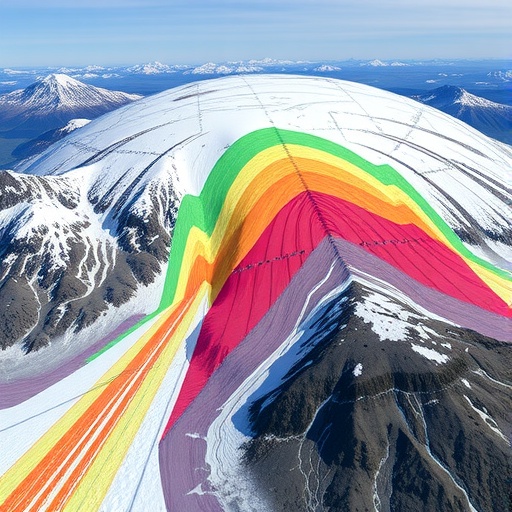
In the quest to decode the future trajectories of global sea-level rise, scientists are increasingly turning to the geological archives of ice sheets from past interglacial periods. These warm intervals in Earth’s history offer a unique natural laboratory to observe how vast ice masses respond to sustained temperature increases. A groundbreaking new study has now provided compelling evidence from beneath the Greenland Ice Sheet that reveals a striking episode of deglaciation during the Middle Holocene, around 7,000 years ago, when global temperatures were elevated.
The research, carried out at Prudhoe Dome in northwestern Greenland, involved drilling through more than 500 meters of firn and ice to tap into sediment that once lay exposed to sunlight before the onset of modern ice cover. This sediment has been analyzed using infrared stimulated luminescence (IRSL) techniques, which measure the last moment minerals were exposed to light, thereby giving a direct date for when the ground beneath the ice was free of glacial cover. Remarkably, these measurements date the ice-free period to 7.1 ± 1.1 thousand years before present, synchronizing with similar indications of retreat recorded elsewhere across northern Greenland.
Prudhoe Dome stands as a critical node for understanding regional ice dynamics due to its summit location and sensitivity to climate fluctuations. This new evidence suggests a near-complete deglaciation of this ice dome, a revelation that challenges previous assumptions about the resilience of the Greenland Ice Sheet during periods of natural warming. Other peripheral ice caps in northern Greenland show concurrent reductions in ice extent, collectively painting a picture of substantial ice sheet shrinkage driven by Holocene warmth.
The broader implications of this finding resonate deeply with contemporary concerns surrounding anthropogenic warming. The early Holocene, characterized by summer temperatures estimated to be 3 to 5 degrees Celsius warmer than today based on paleoclimate reconstructions, mirrors projections for the coming decades if carbon emissions continue unabated. Understanding the ice sheet’s past responses thus provides a valuable analogue for anticipating how Greenland’s glaciers might behave under future climate regimes.
Intriguingly, the ice core records from Prudhoe Dome reveal shifts in δ18O isotopic ratios consistent with an interglacial-only signal. This isotopic signature lends further weight to the argument that the ice now atop this section of Greenland was deposited following a substantial episode of ice retreat. Such coherence between the physical sediment exposure dating and ice core chemistry strengthens the confidence in these reconstructions and elevates their significance for ice sheet modeling efforts.
The sub-ice sediment chronology and ice depth-age modeling combine to tell a story of dynamic ice sheet behavior, responsive not just to gradual climate shifts but to relatively rapid Holocene warming episodes. This suggests that the northwest Greenland Ice Sheet is more vulnerable to temperature increases than previously believed, with partial or even complete ice mass losses occurring over millennial timescales in response to climatic thresholds.
From a methodological standpoint, the use of infrared stimulated luminescence dating techniques to analyze subglacial sediments marks an important advancement in ice sheet paleoclimate studies. This approach circumvents some of the challenges tied to radiocarbon dating in glacial environments and provides direct temporal constraints on periods of ice absence, offering a powerful new tool to unravel ice sheet histories hidden beneath kilometers of ice.
This new data not only revises our understanding of the Holocene climate-ice sheet nexus but calls for intensified monitoring of Greenland’s current ice conditions. If temperatures projected by climate models for the 21st century are indeed sufficient to replicate or exceed Holocene warmth, the Prudhoe Dome findings serve as an early indicator of potential future ice loss and associated impacts on global sea levels.
Moreover, the prospect of a previously unknown or underestimated phase of Greenland deglaciation emphasizes the importance of integrating geological and ice core datasets. High-resolution chronology combining luminescence signals with isotopic and stratigraphic ice core analyses offers a template for future investigations aiming to resolve competing hypotheses on ice sheet sensitivity to warming.
This convergence of multiple lines of evidence from Prudhoe Dome enriches our comprehension of Arctic ice sheet evolution, illustrating the ice sheet’s ability to retreat dramatically under conditions comparable to near-future projections. Such developments provide a crucial empirical baseline against which climate and ice sheet models may be tested and refined.
In climatic terms, the early Holocene warmth identified here was likely driven by orbital forcing — changes in Earth’s position relative to the sun — which concentrated summer solar insolation in the Northern Hemisphere. This natural climate driver led to sustained regional warming, triggering deglaciation events consistent with the exposed sub-ice sediments dated by Walcott-George et al.
Although the Holocene warming was naturally occurring, it serves as a poignant analogue as modern anthropogenic greenhouse gas emissions push global temperatures toward similar or even higher levels over much shorter timescales. Thus, the Prudhoe Dome study underlines the urgency in understanding ice sheet thresholds and the pace at which ice loss can manifest in response to warming episodes.
These findings also implicate broader biogeochemical and oceanographic feedbacks that accompany ice sheet retreat. Reduced ice extent alters surface albedo, regional hydrology, and freshwater influx to the ocean—processes that can accelerate ice melt and influence ocean circulation patterns. Investigations into these cascading effects remain a critical frontier sparked by studies like this one.
Finally, this work reaffirms the value of multidisciplinary approaches harnessing glaciology, paleoclimatology, geochronology, and sedimentology to tackle pressing questions about Earth’s climate system. Prudhoe Dome, previously enigmatic beneath its modern ice veneer, now reveals profound insights into past climate dynamics with direct relevance for our planetary future.
As global temperatures climb toward those seen during the Middle Holocene, the exposed sediments beneath Greenland’s ice offer a cautionary narrative: even the colossal ice masses of the Arctic harbor vulnerabilities that could profoundly shape sea levels and global climate systems. This study ushers in a new era of ice sheet research that marries past and future, emphasizing both the impermanence and power of Earth’s frozen realms.
Subject of Research: Deglaciation and climate response of the Greenland Ice Sheet during the Middle Holocene.
Article Title: Deglaciation of the Prudhoe Dome in northwestern Greenland in response to Holocene warming.
Article References:
Walcott-George, C.K., Brown, N.D., Briner, J.P. et al. Deglaciation of the Prudhoe Dome in northwestern Greenland in response to Holocene warming. Nat. Geosci. (2026). https://doi.org/10.1038/s41561-025-01889-9
Image Credits: AI Generated


