

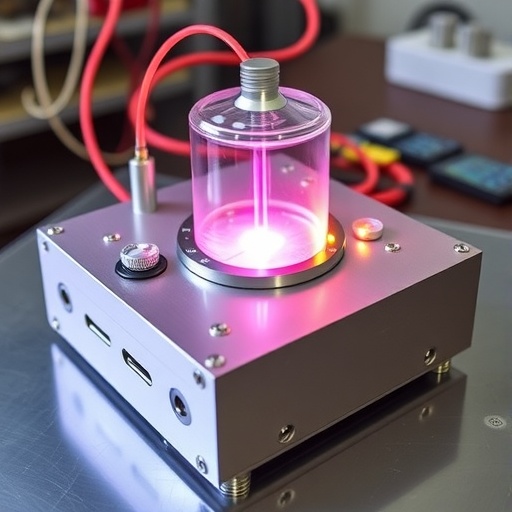
In a groundbreaking advancement poised to redefine nuclear material detection, researchers have unveiled a pioneering prototype table-top neutron resonance transmission analysis (NRTA) system. This compact system was demonstrated at full scale for the first time, showcasing the immense potential of miniaturized neutron-based technologies to deliver high-precision, rapid nuclear material identification. The breakthrough heralds a new era where robust detection capabilities can be integrated into compact platforms, dramatically enhancing security and verification processes.
Traditional neutron resonance transmission analysis has long been a stalwart technique for identifying isotopic compositions by exposing materials to a neutron beam and analyzing the resonant absorption patterns unique to specific nuclear species. However, conventional systems employing large accelerator facilities or bulky neutron sources have remained constrained by their size, cost, and limited deployability. This recent achievement decisively addresses these longstanding issues, condensing complex neutron spectrometry into an accessible and scalable table-top form factor.
The research team led by C.J. Guembou Shouop and H. Tsuchiya navigated an ambitious engineering and scientific challenge by integrating advanced neutron generation, detection, and data processing components into a cohesive prototype system. The result is a compact, bench-top instrument capable of performing full neutron resonance transmission analyses with unprecedented efficiency. By connecting miniaturized neutron sources with precise time-of-flight measurement techniques, the system accurately discerns the isotopic fingerprints of nuclear materials embedded within various matrices.
One of the most striking aspects of this demonstration is the system’s ability to operate in situ without necessitating massive shielding or complex infrastructure. Such autonomy dramatically lowers logistical hurdles, enabling deployments in a variety of environments including border crossings, ports, and nuclear facilities. The portability and simplicity foster new possibilities for safeguarding nuclear materials, ensuring compliance with nonproliferation treaties, and accelerating forensic investigations when nuclear materials are detected illicitly.
Central to the operational principle is neutron resonance transmission analysis’s sensitivity to resonant features in neutron absorption cross-sections, which are isotope-specific and sharp in the epithermal neutron energy range. The compact neutron source produces pulsed epithermal neutron beams, which traverse the sample under inspection. Detectors capture transmitted neutron spectra that are subsequently analyzed for dips corresponding to particular nuclides. The prototype’s design preserves spectral resolution and eliminates extraneous background signals that have traditionally plagued smaller systems.
The pilot prototype employs state-of-the-art neutron detectors with enhanced temporal resolution to distinguish resonance energies accurately from the complex neutron time-of-flight data. By integrating cutting-edge digital signal processing and machine learning algorithms, the system rapidly processes spectral information, delivering near-real-time identification results. This represents a quantum leap from legacy systems unable to provide actionable data without significant post-measurement analysis.
Additionally, the developments in neutron source technology underpinning this system are notable. Utilizing novel compact accelerator technologies, the neutron production mechanism achieves sufficient flux and energy spread tailored explicitly for resonance analysis purposes. These advancements dismantle the perception that high-powered neutron sources must be sizeable and immobile, opening new frontiers in nuclear diagnostic instrumentation.
The team’s success is also marked by meticulous calibration protocols and validation tests using certified nuclear material standards. The results confirmed that the prototype identifies nuclear isotopes with accuracy comparable to large-scale neutron facilities, attesting to the system’s reliability. Reproducibility and stability in extended testing highlight the robustness of the design against environmental variations, an essential factor for field deployment.
Moreover, this pilot demonstration elucidates a scalable pathway to further miniaturization and cost reduction. Future iterations may incorporate advanced materials and integrated circuits to enhance functionality while diminishing physical footprint. Such evolution would democratize access to sophisticated nuclear interrogation tools, enabling stakeholders from regulatory bodies to emergency responders to benefit immensely.
Beyond security applications, this innovation holds promising implications for nuclear science and industry. Precise isotopic characterization facilitated by accessible instruments could improve quality control in nuclear fuel manufacturing, support environmental monitoring around nuclear sites, and advance research into novel nuclear materials. The system’s versatility may also spur interdisciplinary studies combining nuclear physics with materials science and engineering.
The publication of this research not only introduces a transformative technology but also sets the stage for expanded collaboration across international nuclear nonproliferation efforts. By demonstrating a feasible, accurate, and portable neutron resonance transmission analysis system, the authors provide a blueprint for future deployment scenarios that can deter illicit trafficking and unauthorized nuclear activities globally.
As nuclear security challenges grow increasingly complex, innovations such as this table-top NRTA system stand as critical tools. They empower authorities with scientifically rigorous, fast, and adaptable methods to inspect, verify, and monitor nuclear materials with unparalleled ease. In doing so, this advancement solidifies neutron resonance transmission analysis’s position at the forefront of next-generation nuclear diagnostics.
Ultimately, the implications of this research transcend technical achievement alone. By miniaturizing sophisticated nuclear material detection into a table-top device, the researchers have catalyzed a paradigm shift in how nuclear security and safeguards can be implemented worldwide. This democratization of neutron-based interrogation methods could reshape policies, enhance transparency, and foster a safer global nuclear environment.
With anticipated further developments aimed at device commercialization and integration into existing detection frameworks, the impact of this pilot full-scale demonstration is poised to ripple across scientific, governmental, and industrial sectors. It is a critical milestone that not only underscores the power of interdisciplinary innovation but also promises tangible enhancements in the stewardship of nuclear materials.
This pioneering work clearly reflects a future where advanced neutron technologies are no longer confined to specialized labs but become accessible instruments in the hands of critical stakeholders dedicated to peace and security. The consolidation of neutron resonance transmission analysis into a practical table-top prototype embodies the convergence of scientific rigor, engineering ingenuity, and societal necessity.
Subject of Research: Nuclear material detection using neutron resonance transmission analysis.
Article Title: Pilot full-scale demonstration of a prototype table-top neutron resonance transmission analysis system for nuclear material detection.
Article References:
GUEMBOU SHOUOP, C.J., TSUCHIYA, H. Pilot full-scale demonstration of a prototype table-top neutron resonance transmission analysis system for nuclear material detection. Commun Eng 5, 11 (2026). https://doi.org/10.1038/s44172-025-00564-6
Image Credits: AI Generated
DOI: https://doi.org/10.1038/s44172-025-00564-6


