

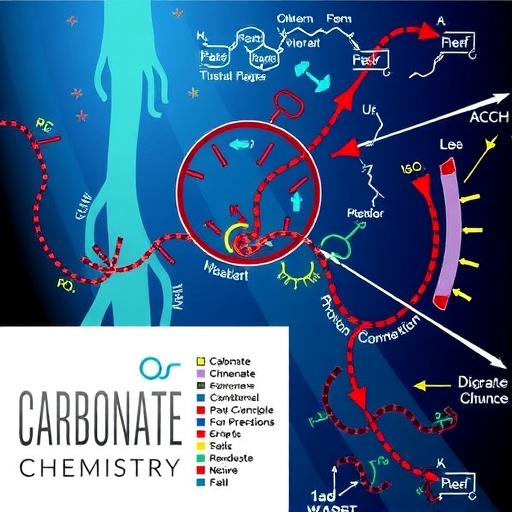
In an extraordinary breakthrough that intertwines marine biology, biochemistry, and materials science, researchers have unveiled the pivotal role of proton channels in regulating vesicular carbonate chemistry within the mineralizing cells of marine calcifiers. This pioneering study elucidates an intricate cellular mechanism that governs the formation of calcium carbonate structures, a fundamental process for marine organisms such as corals and mollusks. The discovery not only deepens our understanding of biomineralization but also sparks new avenues for addressing ocean acidification and its impact on marine ecosystems.
Calcification—the biological process by which marine organisms produce calcium carbonate skeletons and shells—has long captivated scientists due to its critical role in marine biodiversity and oceanic carbon cycles. However, the exact cellular and molecular controls underscoring the deposition of mineralized calcium carbonate crystals remained elusive. The recent findings demonstrate how proton channels embedded in vesicular membranes play a decisive role in maintaining carbonate chemistry within cellular compartments where biomineralization is initiated.
Within the mineralizing cells, specialized vesicles serve as microreactors, where calcium and carbonate ions converge, and initial crystalline nuclei form before being transported to the extracellular matrix. The researchers discovered that proton channels actively regulate the pH and carbonate concentration by modulating proton fluxes across these vesicles. This delicate balance of proton movement influences the availability of bicarbonate ions, which subsequently drives efficient calcium carbonate crystallization under physiological conditions.
Using advanced live-cell imaging techniques coupled with electrophysiological assays, the team traced proton currents within vesicles isolated from marine calcifiers. Their data showed a marked proton permeability that directly affects the intravesicular pH—a critical determinant in carbonate ion equilibrium. By manipulating proton channel activity using specific inhibitors and genetic tools, the researchers confirmed that the disruption of proton flux compromises carbonate chemistry and impairs mineralization, thus establishing a causal relationship.
This proton channel-mediated control mechanism provides a fascinating glimpse into how marine organisms fine-tune their biomineralization processes in response to environmental fluctuations. Given that these proton channels can rapidly respond to changes in ionic concentrations and pH, they offer a dynamic method for maintaining homeostasis within mineralizing vesicles, even under stressful oceanic conditions like acidification triggered by increased atmospheric CO2.
Moreover, the study bridges a crucial gap between cellular physiology and geochemical processes at the marine organism-ocean interface. By delineating the molecular underpinnings of vesicular carbonate chemistry, it opens up promising horizons in the quest to engineer biomimetic materials that replicate the strength and resiliency of marine calcium carbonate structures. Such innovations have potential applications spanning from sustainable construction materials to novel biomedical implants.
From an ecological perspective, the ability of marine calcifiers to maintain robust calcification mechanisms under shifting carbonate chemistry conditions is vital for the preservation of coral reefs, oyster beds, and other bioengineered ecosystems that form marine biodiversity hotspots. The proton channel pathway may represent an evolutionary adaptation that has enabled these species to thrive despite variable seawater carbonate saturation states over geological timescales.
The implications extend beyond biological sciences, as the study highlights a potential molecular target for interventions aimed at buffering the effects of ocean acidification. By understanding how proton channels influence vesicular chemistry, there emerges the possibility of developing strategies to enhance resilience or bioengineering marine organisms capable of sustaining calcification under future ocean scenarios.
Technically, the team employed a blend of molecular genetics, including CRISPR-based gene editing, alongside fluorescent pH-sensitive dyes to monitor vesicular environments in real time. These approaches allowed for unprecedented visualization of proton fluxes and simultaneous tracking of carbonate ion dynamics, offering a multidimensional view of biomineralization in situ.
Furthermore, the integration of computational modeling was critical in predicting how changes in proton channel activity influence carbonate speciation within vesicles. These simulations not only matched experimental observations but also suggested that slight alterations in proton permeability could lead to significant shifts in carbonate precipitation kinetics, emphasizing the tight biochemical control achieved by mineralizing cells.
The study’s authors also highlighted the conservation of proton channel proteins across multiple marine calcifying phyla, suggesting a universal role for these channels in biomineralization. This phylogenetic insight points toward a fundamental evolutionary strategy to optimize mineral formation—a notion that reshapes our understanding of how life on Earth modulates inorganic chemistry for biological ends.
In sum, the revelation that proton channels govern vesicular carbonate chemistry unveils a previously hidden microscopic dimension of marine biomineralization. Such interdisciplinary research continues to redefine the boundaries between biology, chemistry, and environmental science, illustrating the elegance of cellular processes that underpin life’s capacity to engineer complex mineral structures.
As humanity grapples with the dual challenges of climate change and environmental degradation, insights like these offer crucial templates for preserving marine ecosystems and inspire biomimetic innovations that harness nature’s ingenuity. The synergistic fusion of cutting-edge technology and molecular biology presented in this work epitomizes the future of scientific discovery—transformative, integrative, and deeply impactful.
Researchers envision expanding this line of inquiry to explore how environmental stressors—such as temperature spikes and pollutant exposure—modulate proton channel activity, thereby affecting calcification rates in situ. Future studies will likely integrate oceanographic data to predict ecosystem-scale consequences of molecular disruptions in vesicular carbonate chemistry.
Such comprehensive understanding is indispensable for crafting targeted conservation measures and informing policy aimed at mitigating the deleterious effects of anthropogenic activities on vital marine calcifiers. This foundational research sets a new benchmark in marine cell biology and biomineralization studies and paves the way for novel interdisciplinary collaborations aimed at safeguarding oceanic health.
In summation, the elucidation of proton channel function in mineralizing cells marks a paradigm shift in the science of biomineralization, integrating cellular biophysics, marine ecology, and materials chemistry into a cohesive explanatory framework. As the mysteries of ocean life continue to unfold, this discovery underscores the profound complexity and adaptability encoded within even the smallest cellular compartments, with wide-reaching implications for the future of marine scientific research and environmental resilience.
Subject of Research: Proton channel regulation of vesicular carbonate chemistry in marine calcifying cells
Article Title: Proton channels govern vesicular carbonate chemistry in mineralizing cells of a marine calcifier
Article References:
Jonusaite, S., Przibylla-Diop, C., Musinszki, M. et al. Proton channels govern vesicular carbonate chemistry in mineralizing cells of a marine calcifier. Nat Commun (2026). https://doi.org/10.1038/s41467-026-70837-x
Image Credits: AI Generated


