

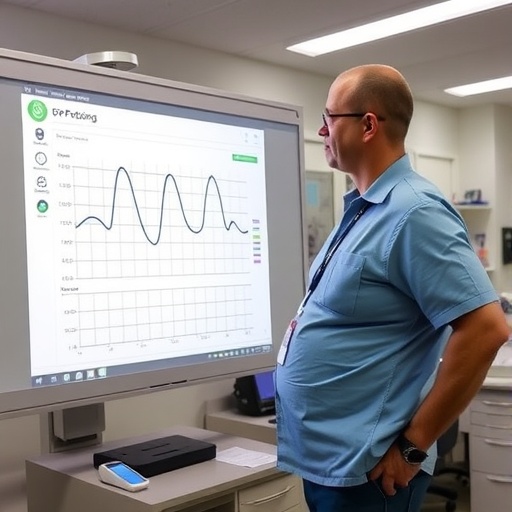
In a groundbreaking advancement poised to reshape clinical obesity management, researchers have introduced a novel biomarker-centric framework that revolutionizes patient monitoring and intervention timing. This paradigm shift leverages continuous protein monitoring (CPM) embedded within established care pathways, promising to enhance precision in case detection, optimize therapeutic decision-making, and fortify long-term remission benchmarks. By integrating nuanced biological signals alongside traditional anthropometric measures, this innovative approach provides a dynamic window into patient trajectories—creating an unprecedented opportunity to preempt disease progression and personalize care.
Historically, obesity care has been hampered by episodic assessments tethered to clinic schedules, often resulting in reactive rather than proactive interventions. The newly proposed model disrupts this episodic pattern by introducing the waist-to-height ratio (WtHR) ≥0.5 as a frontline criterion to flag individuals at potential risk. Sequentially, continuous monitoring of specific proteins adds a temporal dimension, distinguishing those with stable clinical profiles from individuals exhibiting active physiological drift—a critical insight that conventional metrics frequently fail to capture. This stratification recalibrates surveillance efforts, streamlining patient cohorts into those necessitating intensified monitoring versus those suitable for maintained standard care.
One of the transformative implications of this approach lies in its capacitation of clinic workflows toward evidence-driven rather than appointment-driven management. The reliance on real-time biomarker data mitigates the variability born from arbitrary visit timings and regional heterogeneity in practice patterns. Consequently, clinical teams can deploy focused resources towards patients presenting with early signals of deterioration, enabling interventions tailored to emergent biological states rather than fixed temporal markers. This pivot away from rigid scheduling holds the potential to harmonize care delivery and reduce disparities across healthcare settings.
The robustness of remission definitions stands to benefit substantially from this framework. Traditional criteria emphasizing functional restoration often lack objective verification, relying heavily on intermittent clinical judgement. The persistent stability of low-variance biomarkers offers an auditable, quantitative signature of disease control over an extended period. This molecular steadiness not only corroborates therapeutic success but also equips clinicians and payers with transparent evidence to guide decisions regarding therapy de-escalation and resource allocation. Such clarity enhances trust and accountability within patient-provider-payer triads.
This continuous data stream transforms the clinical narrative from reactive “damage control” to proactive course correction. Patients experience a paradigm shift, moving away from passivity or delayed recognition of worsening conditions, toward engagement with real-time insights that signal emerging risks well before conventional thresholds are breached. This shift fosters patient empowerment and adherence by involving individuals more intimately in their health status and progression trajectory.
At a systems level, the integration of CPM enables sophisticated capacity planning aligned with fluctuating patient risk profiles. Clinics can better anticipate demand for specialized interventions, allocate staffing, and optimize appointment availability based on dynamic risk stratifications. Furthermore, by embedding these biomarker signals into iterative learning-health system loops, clinical protocols and predictive algorithms can be continually refined using accumulating real-world data, thereby enhancing the overall precision and efficacy of obesity care pathways.
The scientific insight driving this paradigm centers on the temporal dimension of obesity progression—captured by sensitive protein biomarkers reflecting metabolic perturbations before overt anthropometric or clinical deterioration becomes evident. This temporal bridging capability addresses a long-standing gap: the lag between early metabolic shifts and subsequent clinical manifestations. By capturing this early window, interventions can be timed to intercept pathogenic trajectories at their inception, potentially halting or reversing disease development more effectively.
Integration with the European Association for the Study of Obesity (EASO) targets ensures that this model both complements established guidelines and advances them by embedding a mechanistic biomarker layer. This harmonization strengthens clinical acceptability and accelerates pathway adoption across diverse healthcare contexts. Additionally, maintaining fidelity to the Lancet Commission’s obesity definition preserves conceptual continuity while expanding operational sophistication.
The promise of CPM extends beyond individual care to population health management. Aggregated biomarker data can facilitate epidemiological surveillance, uncovering emergent trends and regional shifts in obesity risk. This granular data layering enables public health interventions to be targeted with greater specificity, potentially mitigating obesity’s rise with surgical precision at community levels.
Ethical and logistical considerations around continuous monitoring also demand attention. Data governance structures must safeguard patient privacy while enabling secure data sharing that fuels algorithmic learning. Ensuring equitable access to CPM technologies across socioeconomic strata is critical to avoid exacerbating health disparities. Moreover, training and resource support for frontline clinical teams will be paramount to translate biomarker insights into effective care adjustments.
Early pilot programs implementing this framework have demonstrated promising outcomes, with improved risk stratification accuracy and more timely intervention deployment. Patient feedback highlights increased engagement and satisfaction, noting less frustration with arbitrary appointment schedules and more confidence in individualized care plans. Health economic analyses suggest potential cost savings through reduced complications and optimized resource utilization, further bolstering the model’s appeal for widespread adoption.
The longevity and durability of remission characterized by stable biomarker profiles also open new avenues in payer negotiations and reimbursement models. Objective evidence of sustained disease control can enhance dialogue around value-based care contracts and incentivize providers to pursue long-term patient stabilization rather than episodic symptom management.
Critically, the framework’s adaptability allows incorporation of emerging biomarkers and evolving technology platforms. As proteomic discovery advances and sensor technologies miniaturize, the sensitivity and ease of CPM applications are expected to improve, catalyzing a virtuous cycle of innovation and clinical refinement.
In sum, this landmark model bridges the temporal gap between disease initiation and clinical manifestation, leveraging continuous protein-based monitoring to elevate obesity care into an era of precision timing alongside precision biology. Its capacity to individualize care trajectories, stabilize remission, optimize resource allocation, and empower patients heralds a new chapter in the global fight against the obesity epidemic.
With ongoing validation and integration into diverse healthcare infrastructures, this biomarker-enhanced timing layer promises to transform obesity management from episodic checkpoints to a seamless continuum of anticipatory care—imbuing clinicians and patients alike with actionable knowledge to outpace disease progression and reclaim health.
Subject of Research: Obesity care enhancement through continuous protein monitoring and timing integration within the European Association for the Study of Obesity (EASO) pathway.
Article Title: A time bridge for obesity care: protein monitoring adds a timing layer to the EASO pathway while preserving the Lancet Commission definition.
Article References: Nisoli, E., Carruba, M.O. & Valerio, A. A time bridge for obesity care: protein monitoring adds a timing layer to the EASO pathway while preserving the Lancet Commission definition. Int J Obes (2026). https://doi.org/10.1038/s41366-026-02083-6
Image Credits: AI Generated
DOI: 10.1038/s41366-026-02083-6 (Published 04 April 2026)


