
Sunday, December 14, 2025
Science
No Result
View All Result
  • Login
  • HOME
  • SCIENCE NEWS
  • CONTACT US
  • HOME
  • SCIENCE NEWS
  • CONTACT US
No Result
View All Result
Scienmag
No Result
View All Result
Home Science News Technology and Engineering

Preventing counterfeiting by adding dye to liquid crystals to create uncrackable coded tags

August 27, 2024
in Technology and Engineering
Reading Time: 3 mins read
0
Figure 1
67
SHARES
611
VIEWS
Share on FacebookShare on Twitter
ADVERTISEMENT

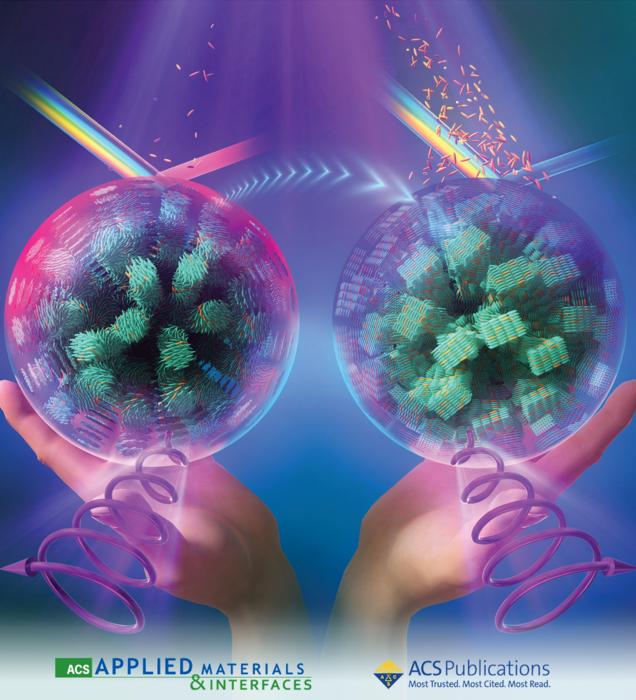
A research group led by Nagoya University has developed an innovative approach to creating anti-counterfeiting labels for high-value goods. Their findings, published in ACS Applied Materials & Interfaces, enhance the security of the currently used cholesteric liquid crystals (CLCs) by adding fluorescent dyes to produce florescent CLCs (FCLCs).  

Figure 1

Credit: ACS Publications

A research group led by Nagoya University has developed an innovative approach to creating anti-counterfeiting labels for high-value goods. Their findings, published in ACS Applied Materials & Interfaces, enhance the security of the currently used cholesteric liquid crystals (CLCs) by adding fluorescent dyes to produce florescent CLCs (FCLCs).  

Using this unique technology, the group created unique labels with almost impossible-to-counterfeit security features. These advanced labels are designed to protect valuable items, important documents, and sensitive products by generating distinctive visual patterns that are difficult to replicate without specialized tools and knowledge. 

To create these specialized tags, scientists mix fluorescent dyes with CLCs, causing the helical structure of the crystals to twist either to the left or right—a property known as chirality. This twisting determines how the crystals reflect light, producing a specific “light signature”. The precise control over this twisting and the resulting light patterns makes these labels almost impossible to counterfeit. 

Under normal light, the FCLCs appear as solid colors with no visible information. However, when viewed through a circular polarizer, hidden features emerge, revealing intricate details that serve as a primary security layer. Additionally, the FCLCs can include components that respond only to ultraviolet light, offering a secondary verification method. 

As Professor Yukikazu Takeoka from Nagoya University explains: “The correct information is revealed only when both decoding tools—left circularly polarized light (CPL) and ultraviolet light—are employed. This dual-layer security significantly enhances the protection offered by existing CLC-based anti-counterfeiting tags.” 

The FCLCs’ unique iridescent colors shift depending on the concentration of chiral dopant and the polarization of the light source, adding another layer of complexity for counterfeiters attempting to replicate the labels. 

By carefully adjusting the concentration of the chiral dopant, the researchers have fine-tuned the material to reverse the direction of circular polarization. This allows the FCLCs to reflect right-handed CPL while absorbing left-handed CPL, further complicating any counterfeiting attempts. 

The development of FCLC particles with both circularly polarized structural color and circularly polarized luminescence marks a significant milestone in the field of anti-counterfeiting. This innovative approach holds tremendous potential for securing high-value goods and protecting sensitive products from forgery. 

In the future, this technology could evolve to include additional security features, such as QR codes that become visible only under polarized light or passwords that appear under UV light. As Jialei He, a member of the research team, said: “This dual-verification system would provide two layers of protection: the structural color visible under polarized light and the fluorescent emission visible under UV light.” 

With these advancements, FCLCs could soon become an integral part of the security protocols for a wide range of industries, offering an unparalleled defense against counterfeiting and ensuring the integrity of high-value products. 


Journal

ACS Applied Materials & Interfaces

DOI

10.1021/acsami.4c08331

Share27Tweet17
Previous Post

Beckman announces 2024 research seed grant awardees

Next Post

KKH study: Exclusive breastfeeding leads to greater weight loss in women with high body mass index as compared to women with normal weight

Related Posts

blank
Technology and Engineering

Revolutionizing Art Education with Generative Adversarial Networks

December 14, 2025
blank
Technology and Engineering

Paramicrosphaeropsis eriobotryae: New Canker Threat to Pomegranates

December 14, 2025
blank
Technology and Engineering

GsMTx4 Protects Neonatal Brain by Blocking Ferroptosis

December 14, 2025
blank
Technology and Engineering

Gauss-Markov Framework Offers Insights into Residuals

December 14, 2025
blank
Technology and Engineering

Brain Imaging Predicts Neonatal Encephalopathy Outcomes

December 14, 2025
blank
Technology and Engineering

Nonparametric Quantile Regression Reveals Atlantic Surfclam Size Variability

December 14, 2025
Next Post
Figure 1: Postnatal weight retained (grammes) by feeding practices among 347 mothers with normal and high BMI at 12 months after childbirth

KKH study: Exclusive breastfeeding leads to greater weight loss in women with high body mass index as compared to women with normal weight

  • Mothers who receive childcare support from maternal grandparents show more parental warmth, finds NTU Singapore study

    Mothers who receive childcare support from maternal grandparents show more parental warmth, finds NTU Singapore study

    27591 shares
    Share 11033 Tweet 6896
  • University of Seville Breaks 120-Year-Old Mystery, Revises a Key Einstein Concept

    998 shares
    Share 399 Tweet 250
  • Bee body mass, pathogens and local climate influence heat tolerance

    653 shares
    Share 261 Tweet 163
  • Researchers record first-ever images and data of a shark experiencing a boat strike

    522 shares
    Share 209 Tweet 131
  • Groundbreaking Clinical Trial Reveals Lubiprostone Enhances Kidney Function

    495 shares
    Share 198 Tweet 124
Science

Embark on a thrilling journey of discovery with Scienmag.com—your ultimate source for cutting-edge breakthroughs. Immerse yourself in a world where curiosity knows no limits and tomorrow’s possibilities become today’s reality!

RECENT NEWS

  • AI Aging Simulation Enhances Nursing Students’ Gerontology Learning
  • F(Q) Gravity: Unified Cosmology Across Branches

  • Exploring Equity and Diversity in Canadian Anesthesiology Residencies
  • Bisphenol Levels in Preterm Neonates: A Cohort Study

Categories

  • Agriculture
  • Anthropology
  • Archaeology
  • Athmospheric
  • Biology
  • Blog
  • Bussines
  • Cancer
  • Chemistry
  • Climate
  • Earth Science
  • Marine
  • Mathematics
  • Medicine
  • Pediatry
  • Policy
  • Psychology & Psychiatry
  • Science Education
  • Social Science
  • Space
  • Technology and Engineering

Subscribe to Blog via Email

Enter your email address to subscribe to this blog and receive notifications of new posts by email.

Join 5,191 other subscribers

© 2025 Scienmag - Science Magazine

Welcome Back!

Login to your account below

Forgotten Password?

Retrieve your password

Please enter your username or email address to reset your password.

Log In
No Result
View All Result
  • HOME
  • SCIENCE NEWS
  • CONTACT US

© 2025 Scienmag - Science Magazine

Discover more from Science

Subscribe now to keep reading and get access to the full archive.

Continue reading