

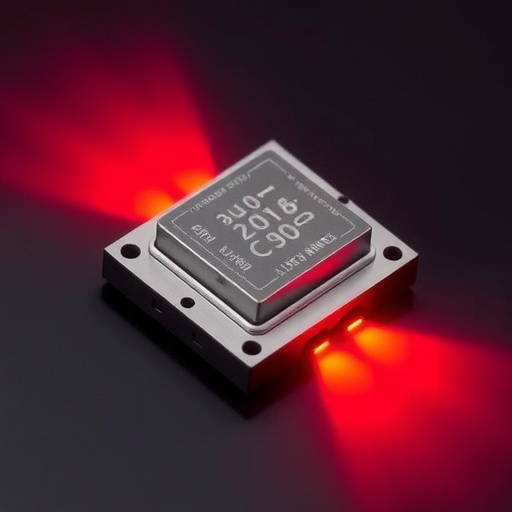
A groundbreaking advancement in the realm of nanoscience and optoelectronics has emerged from the laboratories of Tokyo University of Agriculture and Technology (TUAT), Japan. Researchers from the Department of Applied Physics and Chemical Engineering at TUAT have unveiled a pioneering approach to constructing photodetectors that leverage the extraordinary potential of colloidal quantum dots (QDs). Their study, recently made accessible online and set to appear in the esteemed journal Advanced Optical Materials, marks a pivotal stride toward resolving a longstanding impasse characterizing next-generation photodetector technology.
Colloidal QDs, often described as “giant atoms,” are semiconductor nanocrystals whose electronic and optical properties can be precisely tuned by manipulating their size. This tunability, coupled with their robust light absorption across broad spectral regions, positions QDs as prime candidates for applications spanning from imaging to communication technologies. Despite their promise, a central obstacle has hindered their practical application in photodetectors: the inherently low charge carrier mobility within typical QD solids, primarily caused by spatial and energetic disorder. This disorder disrupts efficient charge transport, consequently limiting the device’s sensitivity and detection capabilities.
In earlier pioneering work published in Nature Communications in 2023, the TUAT team managed to surmount some of these barriers by engineering highly ordered, quasi-two-dimensional quantum dot superlattices (QDSLs). This approach enhanced electron mobility exponentially by forming epitaxially connected QDs arranged in a well-defined lattice. Yet, skepticism persisted regarding the impact of this delocalized charge transport on the quintessential quantum confinement effects that endow QDs with their remarkable optical properties—effects that are instrumental to their performance as light sensors.
The current study pushes frontiers by definitively addressing this challenge at the mesoscopic scale, bridging the gap between material structure and device performance. Under the guidance of Associate Professor Dr. Satria Zulkarnaen Bisri, the team presents compelling evidence that quantum confinement remains intact even as charge carriers move more freely across the superlattice. This finding overturns the previously held notion that enhanced charge mobility necessarily compromises the fundamental optical properties of quantum dots.
Using lead sulfide (PbS) as their material of choice, the researchers fabricated epitaxially connected QDSL photodetectors comprising just a single monolayer, less than 8 nanometers thick. Remarkably, these devices demonstrated responsivity values soaring to 10^5 amperes per watt and detectivity exceeding 10^13 Jones, standing among the highest ever recorded for colloidal QD-based photodetectors functioning in both visible and near-infrared spectra. The planar monolayer configuration underscores the intimate correlation between structural perfection and photodetector sensitivity.
PhD candidate Dadan Suhendar, who spearheaded much of the experimental work, elaborated on the implications of the superlattice’s structural integrity. Their investigation of photodetector response times and light-intensity dependencies reveals that the epitaxially connected PbS QDSLs possess exceptionally low charge trap densities. This insight suggests a direct link between the meticulous assembly of QDs into highly ordered, oriented superlattices and a dramatic reduction in surface defects and interface disorders—factors critical to minimizing recombination losses and boosting device efficiency.
The ramifications of this achievement extend well beyond incremental performance improvements. By reconciling the traditionally conflicting attributes of high electrical conductivity and strong quantum confinement within colloidal QD assemblies, this research heralds a new era for ultrathin, scalable, and exceedingly sensitive light sensors. Potential applications are vast, encompassing advanced imaging systems with unprecedented sensitivity, high-speed optical communication devices, and emergent quantum technologies that demand miniaturized components with unparalleled performance.
Dr. Bisri emphasizes the transformative potential unlocked by this breakthrough, envisioning a future where epitaxially connected QDSLs form the backbone of sensors embedded ubiquitously in everyday technologies. Such photodetectors could feasibly be integrated into wearable devices, environmental monitoring systems, and next-generation digital cameras, all benefiting from the unique combination of exceptional sensitivity, spectral tunability, and compact form factor.
The researchers’ methodological rigor combined state-of-the-art epitaxial synthesis techniques with comprehensive optoelectronic characterization, ensuring that the observed phenomena stem from intrinsic material properties rather than extrinsic artifacts. Their work delineates a clear pathway for the scalable production of high-performance QD superlattices that reconcile theoretical promises with tangible device metrics.
Looking ahead, the team anticipates that this modular monolayer approach will inspire further exploration into multi-layered superlattices and hybrid structures tailored for specific wavelengths and applications. As the global demand for faster, more sensitive photodetection systems accelerates—in fields ranging from biomedical imaging to quantum computing—the foundational knowledge secured by this study paves the way for revolutionary device architectures.
Supported generously by prestigious institutions such as the Iketani Science and Technology Foundation, the Thermal and Electric Energy Technology Foundation, and RIKEN, the study underscores the strategic importance of fundamental research in driving practical technological advances. The pioneering spirit cultivated at Tokyo University of Agriculture and Technology continues to push boundaries, fostering innovations with profound implications for both scientific understanding and industry.
In sum, the epitaxially connected PbS QDSL photodetectors developed by the TUAT team represent not merely an incremental innovation but a paradigm shift in quantum dot optoelectronics. With their versatile, ultrathin configuration and record-breaking performance metrics, these devices illuminate a promising path toward the next generation of high-sensitivity, low-power photonic sensors and quantum-enabled technologies.
Subject of Research: Not applicable
Article Title: High-Performance Photodetectors of Quasi-2-Dimensional Epitaxially-Connected Quantum Dot Superlattices
News Publication Date: March 20, 2026
Web References:
References:
DOI: 10.1002/adom.202503565
Image Credits:
Credit: Dr. Satria Zulkarnaen Bisri, Tokyo University of Agriculture and Technology, Japan
Keywords
Quantum dots, photodetectors, epitaxial connection, quantum confinement, superlattices, lead sulfide, charge carrier mobility, colloidal semiconductors, optoelectronics, nanotechnology, quantum dot solids, ultrathin devices


