

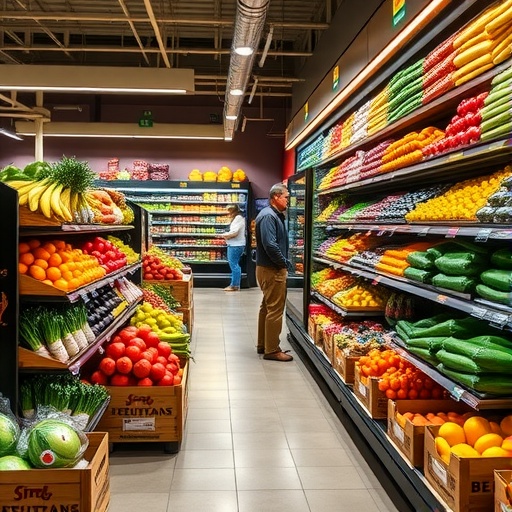
A groundbreaking new study funded by the National Institute for Health and Care Research (NIHR) reveals how strategic placement of fruit and vegetable sections near supermarket entrances significantly elevates consumer purchasing and can lead to improvements in dietary quality, particularly among women. This innovative research, recently published in PLOS Medicine, highlights the profound influence that environmental cues within retail settings have on food choices, providing a potent tool in the battle against poor diet and obesity.
The researchers conducted a comprehensive matched-controlled cluster trial across 36 discount supermarket stores in England, spanning from March 2018 to May 2022. They divided the stores into intervention and control groups, placing fresh fruit and vegetable displays prominently near the store entrances in the intervention sites. Their findings demonstrated a substantial increase—approximately 2,525 additional portions of fruit and vegetables sold per store each week—compared to control stores with standard product layouts. This figure is especially remarkable in the context of nationwide trends showing declining fruit and vegetable purchasing amidst the COVID-19 pandemic and economic challenges.
Central to the study was an emphasis on women aged 18 to 60, due to their pivotal role in shaping household dietary habits. This demographic’s increased engagement with fresh produce when exposed to the intervention corresponded to improved diet quality, underscoring the potential ripple effects of such interventions on family health outcomes. The study’s authors argue that strategic product placement holds not just commercial but profound public health value.
In examining these results, the researchers contextualize the findings within broader public health challenges. Obesity and diet-related diseases remain leading causes of ill health worldwide. In the UK, less than 1% of placement promotions focus on fruit and vegetables. Concurrently, the ‘junk food cycle’—where unhealthy products are cheap, marketable, and readily accessible—dominates retail environments. The study’s findings suggest that breaking this cycle through intervention in store design can create healthier consumer behavior.
The mechanism by which product placement influences purchasing behavior is grounded in cognitive psychology and behavioral economics. Visual salience at points of entry leverages impulse buying tendencies and reduces decision fatigue, steering consumers toward healthier choices even before deeper engagement in the shopping process. The study provides essential empirical backing that environmental nudges in supermarkets can contribute significantly to public health nutrition strategies.
Notably, the increased purchases observed translated into meaningful potential health benefits. Incremental consumption of as little as 50 grams of fruit and vegetables per day—a fraction of a portion (one portion equals 80 grams)—has been associated with a 20% reduction in all-cause mortality. Thus, the intervention’s approximate 2,525 extra weekly portions per store represent a quantifiable step towards reducing diet-related morbidity and mortality at a population level.
Further analysis revealed that the intervention’s impact grew marginally more pronounced after six months, especially for families who primarily shopped at the intervention stores and where women lacked formal post-school educational qualifications. This insight suggests that such environmental modifications could help mitigate dietary inequalities and resonate particularly in socioeconomically disadvantaged communities.
Professor Christina Vogel, lead author and Director of the Centre for Food Policy at City St George’s, University of London, emphasized how placement strategies can help disrupt entrenched patterns of unhealthy eating. She highlights the cost-effectiveness and scalability of such interventions, advocating for policy shifts to mandate produce placement near store entrances across large food retail environments.
Complementing Vogel’s perspective, Professor Adam Briggs, Director of NIHR’s Public Health Research Programme, framed the study as a model of actionable insights gained through retailer engagement. He underscored the urgency of addressing poor diet and health inequalities with practical solutions that influence consumer environments, thus shaping healthier shopping behaviors organically.
Given these compelling findings, the research team strongly advocates for government action extending UK Food (Promotions and Placement) regulations. They recommend mandating the preferential positioning of fresh produce at store entrances and restricting the placement of unhealthy foods at high-visibility supermarket locations such as checkouts and aisle ends, thereby reinforcing healthier choices by design.
This study represents an important advancement in public health nutrition science, highlighting how subtle environmental interventions can shift consumer behavior at scale. Through robust methodology and collaboration across institutions in the UK and Australia, it sets a new precedent for evidence-based policy interventions aimed at ameliorating the global burden of diet-related disease via changes in supermarket environments.
Looking forward, sustained efforts to optimize retail food environments can complement other health campaigns, offering an integrated strategy to promote healthier diets nationwide. As supermarkets play a pivotal role in food access, leveraging their layout and product display practices could be a critical step toward reversing declining trends in fruit and vegetable consumption—the cornerstone of balanced nutrition.
Subject of Research: People
Article Title: Impact of supermarket fruit and vegetable placement on store sales, customer purchasing, diet and household waste: A prospective matched-controlled cluster trial
News Publication Date: 31-Mar-2026
Web References: https://journals.plos.org/plosmedicine/article?id=10.1371/journal.pmed.1004575
Keywords: Foods, Food science, Dietetics, Diets, Nutrition counseling, Health equity, Health disparity, Health care policy


