
Sunday, March 1, 2026
Science
No Result
View All Result
  • Login
  • HOME
  • SCIENCE NEWS
  • CONTACT US
  • HOME
  • SCIENCE NEWS
  • CONTACT US
No Result
View All Result
Scienmag
No Result
View All Result
Home Science News Technology and Engineering

Portable engine powers artificial muscles in assistive devices

July 1, 2024
in Technology and Engineering
Reading Time: 3 mins read
0
Untethered engine for powering artificial muscles in assistive devices
66
SHARES
599
VIEWS
Share on FacebookShare on Twitter
ADVERTISEMENT

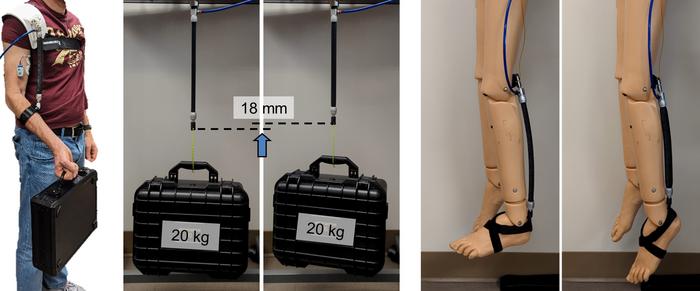
Researchers have developed a lightweight fluidic engine to power muscle-mimicking soft robots for use in assistive devices. What sets the new engine apart is its ability to generate significant force without being tethered to an external power source.

Untethered engine for powering artificial muscles in assistive devices

Credit: Antonio Di Lallo, NC State University

Researchers have developed a lightweight fluidic engine to power muscle-mimicking soft robots for use in assistive devices. What sets the new engine apart is its ability to generate significant force without being tethered to an external power source.

“Soft robots that are powered by fluid engines – such as hydraulic or pneumatic action – can be used to mimic the behavior of muscle in ways that rigid robots cannot,” says Hao Su, corresponding author of a paper on the work and an associate professor of mechanical and aerospace engineering at North Carolina State University. “This makes these robots particularly attractive for use in assistive devices that improve people’s ability to move their upper or lower limbs.”

However, most fluid engines are physically connected to an external power source, such as a large air compressor. That significantly limits their utility. And previous fluid engines that were not tethered to external power sources were not able to generate much force, which also limited their utility.

“Our work here addresses both of those challenges,” Su says. “Our fluidic engine is not tethered to an external source but can still generate up to 580 Newtons of force.”

The new engine works by pumping oil into and out of a chamber in a soft robot, causing the soft robot to act as an artificial muscle that is flexing and relaxing. The fluidic engine’s pump is driven by a battery-powered high-torque motor that allows it to generate significant pressure, enabling the artificial muscle to exert significant force. Video of the untethered engine can be found at https://www.youtube.com/watch?v=csVBpZIS_is.

In proof-of-concept testing, the researchers not only assessed the amount of force the new engine can generate, but how efficiently the engine converts electrical power into fluidic power.

“We found that we were able to generate an unprecedented amount of force for an untethered engine, while still keeping the weight of the fluidic engine low,” says Antonio Di Lallo, first author of the paper and a postdoctoral researcher at NC State. “And the maximum efficiency of our fluidic engine is higher than previous portable, untethered engines.”

The paper, “Untethered Fluidic Engine for High-Force Soft Wearable Robots,” is published open access in the journal Advanced Intelligent Systems. The paper was co-authored by Shuangyue Yu, a former postdoctoral researcher at NC State; Jie Yin, an associate professor of mechanical and aerospace engineering at NC State; Jonathon Slightam of Sandia National Laboratories; and Grace Gu of the University of California, Berkeley.

This work was done with support from the National Science Foundation under grants 2026622 and 1944655; the National Institute on Disability, Independent Living, and Rehabilitation Research, under grant 90DPGE0011; and Amazon Robotics.


Journal

Advanced Intelligent Systems

DOI

10.1002/aisy.202400171

Method of Research

Experimental study

Subject of Research

Not applicable

Article Title

Untethered Fluidic Engine for High-Force Soft Wearable Robots

Article Publication Date

13-Jun-2024

COI Statement

none

Share26Tweet17
Previous Post

Immunotherapy in colorectal cancer

Next Post

Advanced DeepLabv3+ algorithm enhances safflower filament harvesting with high accuracy

Related Posts

blank
Technology and Engineering

Sub-1V Reconfigurable Gires-Tournois Resonators Enable Full-Color Monopixels

March 1, 2026
blank
Technology and Engineering

Ultra-Efficient, Vibrant Red Micro-LED Breakthrough

March 1, 2026
blank
Technology and Engineering

Graphene Microtube Resonators Enable Polarization-Sensitive Optics

March 1, 2026
blank
Technology and Engineering

Synchronizing Complex Spatio-Temporal Laser Dynamics

March 1, 2026
blank
Technology and Engineering

Tunable Green Light Source Integrated on Silicon Nitride

March 1, 2026
blank
Technology and Engineering

Stretchable 3D Perovskite Compound Eye Arrays

March 1, 2026
Next Post
Fig.3

Advanced DeepLabv3+ algorithm enhances safflower filament harvesting with high accuracy

  • Mothers who receive childcare support from maternal grandparents show more parental warmth, finds NTU Singapore study

    Mothers who receive childcare support from maternal grandparents show more parental warmth, finds NTU Singapore study

    27618 shares
    Share 11044 Tweet 6902
  • University of Seville Breaks 120-Year-Old Mystery, Revises a Key Einstein Concept

    1022 shares
    Share 409 Tweet 256
  • Bee body mass, pathogens and local climate influence heat tolerance

    665 shares
    Share 266 Tweet 166
  • Researchers record first-ever images and data of a shark experiencing a boat strike

    532 shares
    Share 213 Tweet 133
  • Groundbreaking Clinical Trial Reveals Lubiprostone Enhances Kidney Function

    518 shares
    Share 207 Tweet 130
Science

Embark on a thrilling journey of discovery with Scienmag.com—your ultimate source for cutting-edge breakthroughs. Immerse yourself in a world where curiosity knows no limits and tomorrow’s possibilities become today’s reality!

RECENT NEWS

  • Geriatric Surgery Outcomes: Mortality and Hospital Stay Factors
  • Risk Factors for Elderly Bacteraemia Deaths Revealed
  • Sub-1V Reconfigurable Gires-Tournois Resonators Enable Full-Color Monopixels
  • Ultra-Efficient, Vibrant Red Micro-LED Breakthrough

Categories

  • Agriculture
  • Anthropology
  • Archaeology
  • Athmospheric
  • Biology
  • Biotechnology
  • Blog
  • Bussines
  • Cancer
  • Chemistry
  • Climate
  • Earth Science
  • Editorial Policy
  • Marine
  • Mathematics
  • Medicine
  • Pediatry
  • Policy
  • Psychology & Psychiatry
  • Science Education
  • Social Science
  • Space
  • Technology and Engineering

Subscribe to Blog via Email

Enter your email address to subscribe to this blog and receive notifications of new posts by email.

Join 5,190 other subscribers

© 2025 Scienmag - Science Magazine

Welcome Back!

Login to your account below

Forgotten Password?

Retrieve your password

Please enter your username or email address to reset your password.

Log In
No Result
View All Result
  • HOME
  • SCIENCE NEWS
  • CONTACT US

© 2025 Scienmag - Science Magazine

Discover more from Science

Subscribe now to keep reading and get access to the full archive.

Continue reading