

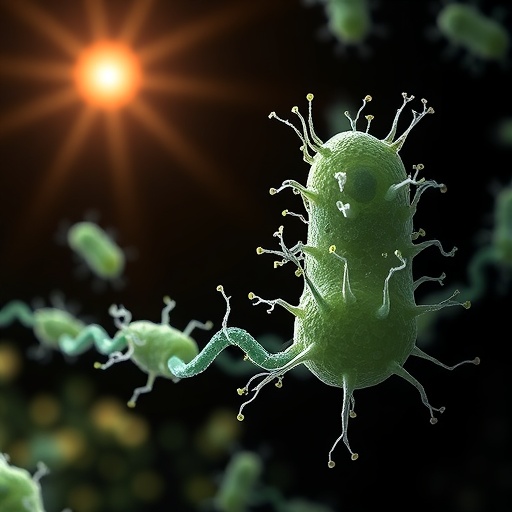
In a groundbreaking new study published in Nature Communications, researchers have unveiled a remarkable evolutionary phenomenon within the bacterial order Caulobacterales, shedding light on the extensive potential for phototrophy alongside a striking trend of lifecycle simplification. This research opens new vistas in microbial ecology and evolutionary biology by demonstrating how diverse bacterial species have adapted sophisticated metabolic strategies while concurrently streamlining their developmental pathways to thrive in a variety of ecological niches.
The family of bacteria known as Caulobacterales has long been recognized for its distinctive dimorphic lifecycle, traditionally characterized by a complex alternation between motile swarmer cells and sessile stalked cells. Such dimorphism enables these organisms to effectively colonize and exploit fluctuating environments, particularly aquatic habitats where nutrient availability and light conditions often vary widely. However, the new study reveals that this developmental complexity is not universal within the order and that many Caulobacterales have independently undergone reductions in lifecycle stages, a process that appears to be deeply intertwined with their metabolic evolution.
Central to the study’s findings is the surprising prevalence of phototrophic capabilities across a broad range of Caulobacterales species. Phototrophy—the ability to harness light energy for metabolic processes—is conventionally associated with specific microbial groups such as cyanobacteria or purple bacteria. However, the researchers’ extensive genomic analyses uncovered genetic signatures indicative of phototrophic machinery across multiple lineages within Caulobacterales, suggesting a widespread, previously underappreciated capacity for light-driven energy acquisition.
This discovery challenges the traditional view that Caulobacterales are principally chemoheterotrophs reliant on organic substrates for growth. Instead, the data suggest a remarkable metabolic versatility, with many species capable of supplementing their energy budget through phototrophy. This capability likely confers significant adaptive advantages in oligotrophic (nutrient-poor) aquatic environments, where light availability can be more predictable than organic nutrient sources.
The authors combined comparative genomics, metagenomic surveys, and detailed phylogenetic reconstructions to build an evolutionary framework showing that phototrophic genes have either been retained from ancestral lineages or independently acquired through horizontal gene transfer events. These findings paint a complex picture of evolutionary convergence, where diverse Caulobacterales lineages arrive at similar metabolic strategies despite divergent evolutionary histories.
Concomitant with this phototrophic potential, the study highlights a pervasive trend toward convergent reduction in lifecycle complexity within Caulobacterales. Many species have lost one or more early developmental stages, particularly the motile swarmer cell, effectively simplifying their lifecycle. This reduction appears to be an adaptive response, perhaps facilitating a more energy-efficient existence in stable or light-rich microhabitats where motile dispersal provides less of a selective advantage.
Intriguingly, this simplification of the lifecycle often coincides phylogenetically with the acquisition or retention of phototrophic capabilities, supporting the hypothesis that exploiting light as an energy source enables these bacteria to forego energetically expensive developmental stages. By reducing the complexity of their lifecycle, these bacteria may allocate more resources toward phototrophy, enhancing survival and proliferation in highly competitive or resource-limited ecosystems.
The implications of this study extend beyond microbial evolutionary biology, with potential impacts on our understanding of aquatic ecology and biogeochemical cycles. Caulobacterales are abundant in freshwater and marine ecosystems, where they play crucial roles in nutrient cycling and microbial food webs. Uncovering their phototrophic potential suggests that these bacteria may contribute to primary production more significantly than previously recognized, influencing carbon fixation and energy flow in aquatic environments.
Moreover, the findings underscore the importance of integrating genomic and ecological data to unravel hidden metabolic traits and evolutionary trajectories in microbial life. As phototrophy emerges as a widespread strategy within Caulobacterales, the conceptual boundaries of microbial functional groups are being redrawn, spotlighting the dynamic interplay between genome evolution and ecological adaptation.
The research team employed cutting-edge sequencing technologies and bioinformatics pipelines to analyze hundreds of Caulobacterales genomes sourced from diverse ecological settings worldwide. This comprehensive dataset allowed for robust statistical assessments of gene distribution, evolutionary lineage divergence, and trait correlation, providing compelling evidence for the convergent patterns observed.
One fascinating aspect revealed by the phylogenetic analyses is the mosaic nature of phototrophic gene clusters, which exhibit various degrees of conservation and rearrangement. This genetic fluidity hints at an evolutionary landscape marked by recurrent gene shuffling and modular adaptation, enabling rapid ecological diversification in response to environmental pressures.
Additionally, the study delves into the biochemical mechanisms underlying Caulobacterales phototrophy. Many phototrophic Caulobacterales possess genes encoding for rhodopsins—light-driven proton pumps—or bacteriochlorophyll biosynthetic pathways. These systems facilitate photophosphorylation, allowing bacteria to efficiently convert light into usable chemical energy. The coexistence of these systems within the same order indicates a versatile toolkit for light utilization, reflecting the evolutionary experimentation and innovation present in bacterial lineages.
From an evolutionary perspective, the convergent reduction in development coupled with metabolic innovation parallels phenomena observed in other microbial groups undergoing niche adaptation. By streamlining complex life stages and harnessing new energy sources, organisms maximize fitness in changing environments—a principle echoed in the Caulobacterales narrative uncovered by this study.
The broader scientific community will likely find these insights valuable for microbial ecology, environmental microbiology, and biotechnology. Understanding Caulobacterales’ phototrophic mechanisms could inspire novel approaches for harnessing bacterial systems in bioenergy or bioremediation, capitalizing on their ability to efficiently exploit light in diverse habitats.
Crucially, this study exemplifies the power of integrative, multidisciplinary research in decoding the evolutionary puzzles of microbial life. By combining genomics, phylogenetics, ecology, and biochemistry, the authors have crafted a nuanced story of adaptation, metabolic ingenuity, and developmental simplification that challenges existing paradigms and invites further exploration.
Future research stemming from these findings may involve experimental validation of phototrophic activity in cultured isolates, ecological surveys to quantify their contributions to primary production in situ, and genetic investigations to decipher regulatory networks controlling lifecycle transitions and phototrophic gene expression.
In sum, this revelation about the widespread potential for phototrophy coupled with convergent lifecycle simplification in Caulobacterales enriches our understanding of microbial evolution and ecology. It underscores the adaptability and innovation inherent in microbial communities and highlights a fascinating interplay between metabolic strategy and developmental complexity that shapes the survival and diversification of bacteria in our planet’s aquatic biospheres.
Subject of Research: Evolutionary adaptations in the bacterial order Caulobacterales, focusing on phototrophic potential and lifecycle complexity reduction.
Article Title: Widespread potential for phototrophy and convergent reduction of lifecycle complexity in the dimorphic order Caulobacterales.
Article References:
Hallgren, J., Dharamshi, J.E., Rodríguez-Gijón, A. et al. Widespread potential for phototrophy and convergent reduction of lifecycle complexity in the dimorphic order Caulobacterales. Nat Commun 16, 11003 (2025). https://doi.org/10.1038/s41467-025-65642-x
Image Credits: AI Generated


