

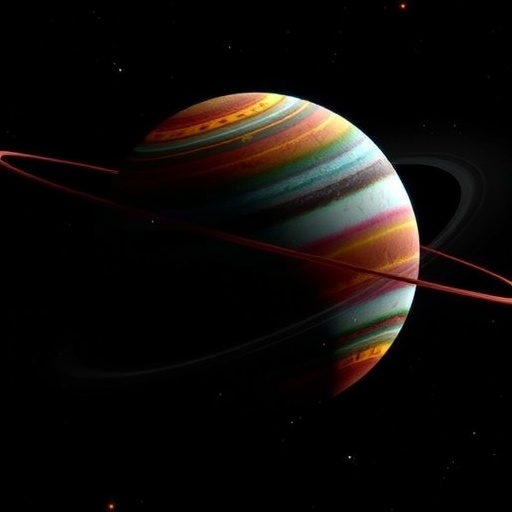
In a groundbreaking advancement for planetary science, an international team of astronomers, spearheaded by PhD candidate Paola Tiranti from Northumbria University, has successfully charted the first-ever three-dimensional map of Uranus’s upper atmosphere. This milestone discovery unveils not only the intricate ways in which the planet’s unique magnetic field sculpts its luminous auroras but also reveals the dynamic thermospheric characteristics and energy flows high above the distant ice giant’s cloud tops. The insights gleaned from this study mark a substantial leap forward in understanding Uranus’s atmospheric processes, an achievement realized through the exceptional observational capabilities of the James Webb Space Telescope (JWST).
Employing the Near-Infrared Spectrograph on the JWST, a marvel of modern space technology operated jointly by NASA, ESA, and CSA, Dr. Tiranti and her colleagues embarked on nearly 15 hours of continuous observation, capturing Uranus over one full rotation. This prolonged, detailed scrutiny allowed the team to detect faint emissions from ionized molecules extending up to 5,000 kilometers above the planet’s cloud deck. These emissions provide critical data, illuminating the vertical distribution of temperature and ion density within Uranus’s ionosphere and offering unprecedented clarity on the spatial structure of auroral phenomena.
Auroras on Uranus arise when charged particles become entrapped by the planet’s magnetic field and energize the upper atmospheric layers, resulting in vibrant light shows. However, unlike Earth’s relatively symmetrically aligned magnetic field, Uranus’s magnetic dipole is dramatically tilted about 60 degrees relative to its rotation axis and is offset from the planetary center. This peculiar geometry induces complex auroral patterns that sweep across the planet’s atmosphere irregularly, differentiating Uranus’s magnetosphere from any other known in the Solar System.
The team’s temperature mapping indicates a pronounced thermal peak between 3,000 and 4,000 kilometers above Uranus’s cloud tops, a region where ion densities fall off notably, with maximum ion concentrations recorded nearer to 1,000 kilometers altitude. This stratification challenges prior assumptions about Uranus’s ionospheric layers, highlighting the nuanced interplay between solar energy input, magnetospheric interactions, and atmospheric cooling processes. The detailed thermal gradients mapped contribute crucial constraints to models that simulate ice giant atmospheric physics.
This investigation further confirmed a perplexing long-term trend: Uranus’s upper atmosphere continues to cool. The mean temperature derived from JWST data is approximately 426 kelvins, roughly 150 degrees Celsius, a significant reduction from measurements obtained by ground-based telescopic surveys and previous spacecraft missions dating back several decades. This continued decline poses fundamental questions about the energy budget, heat sources, and radiative mechanisms operating in the planet’s exosphere, particularly as Uranus receives minimal solar irradiance due to its distance from the Sun.
By resolving the vertical structure of Uranus’s ionosphere with exquisite sensitivity, the research team unveiled a distinctive double auroral band configuration corresponding with the planet’s magnetic poles. Intriguingly, between these bright auroral bands lies a pronounced depletion zone with reduced emission intensity and lowered ion densities. This dip is hypothesized to stem from magnetic field lines channeling charged particles in a manner that suppresses auroral excitation in those regions. Similar phenomena have been documented in Jupiter’s magnetosphere, suggesting commonalities in magnetosphere-ionosphere coupling processes across different gas and ice giants.
The implications of understanding energy transport and magnetic topology in Uranus’s upper atmosphere extend far beyond the ice giant itself. Ice giants like Uranus serve as natural laboratories for studying the complex physics that govern upper atmospheric dynamics under conditions of low solar input coupled with strong, asymmetric magnetospheric forces. This understanding is critical not only for planetary science but also for extrapolating atmospheric models to exoplanets, particularly those in the Neptune-Uranus mass range that populate the census of known extrasolar worlds.
The comprehensive three-dimensional visualization of Uranus’s ionosphere achieved with JWST provides a much-needed framework to interpret the interactions between charged particles, magnetic fields, and atmospheric constituents at altitudes that are otherwise inaccessible. By tracing how auroral energy ascends through the planet’s atmosphere, the study elucidates mechanisms of heating, ionization, and cooling that reshape our understanding of how giant planet atmospheres maintain energy balance across extended timescales.
Paola Tiranti emphasized the revolutionary nature of the findings, noting that “this is the first occasion to perceive Uranus’s upper atmosphere volumetrically, exposing how energy percolates upward and how the planet’s lopsided magnetic field vigorously modulates auroral morphology.” The research thus represents a pivotal advancement in remote sensing of planetary ionospheres, made possible by JWST’s unparalleled spectroscopic capabilities in the near-infrared range.
These observations form part of JWST General Observer program 5073, led by Dr. Henrik Melin of Northumbria University, which leveraged the telescope’s Integral Field Unit to gather spectro-imaging data critical to constructing the three-dimensional maps. This mission underscores the synergy between state-of-the-art instrumentation and focused scientific inquiry in unravelling the enduring mysteries of the Solar System’s least explored giant.
The sustained cooling trend in Uranus’s thermosphere discovered by the study remains an intriguing enigma—one likely representative of energy dissipation and atmospheric circulation phenomena linked to the planet’s unique axial tilt and seasonal variations. Understanding this thermodynamic behavior is vital to deciphering the atmospheric evolution of ice giant worlds and their comparators in the galactic exoplanetary population.
In sum, the work led by Paola Tiranti and her international collaborators harnesses JWST’s transformative observational prowess to unveil a detailed molecular and thermal fingerprint of the hidden reaches of Uranus’s upper atmospheric environment. This breakthrough provides foundational knowledge pivotal for comparative planetary atmospheres, magnetospheric physics, and the characterization of distant exoplanets, heralding a new epoch in the exploration of ice giant planets.
Subject of Research:
Article Title: JWST Discovers the Vertical Structure of Uranus’ Ionosphere
News Publication Date: 19-Feb-2026
Web References:
– James Webb Space Telescope General Observer Programme 5073: https://www.stsci.edu/jwst/science-execution/program-information?id=5073
References:
– Geophysical Research Letters, DOI: 10.1029/2025GL119304
Image Credits: Northumbria University/Barry Pells
Keywords
Uranus, auroras, ionosphere, James Webb Space Telescope, magnetic field, ice giants, thermosphere, upper atmosphere, planetary magnetosphere, Near-Infrared Spectrograph, auroral morphology, planetary cooling


