

A groundbreaking study recently published in the Journal of Exposure Science and Environmental Epidemiology has drawn profound attention to the intricate web connecting environmental contaminants and childhood cancer incidence. Spearheaded by researchers Binczewski, Morimoto, Wiemels, and their colleagues, the investigation scrutinizes the spatial relationships between residential locations at birth, exposure to per- and polyfluoroalkyl substances (PFAS) in public water systems, and the occurrence of childhood cancers across Southern California from 2000 to 2019. This comprehensive temporal and geographic analysis presents a compelling narrative on how early-life environmental conditions might predispose vulnerable populations to potentially fatal diseases.
PFAS chemicals, often dubbed “forever chemicals” due to their persistence in the environment and human body, have attracted global regulatory scrutiny for years. These synthetic compounds have been notoriously incorporated into various consumer products for their resistance to heat, water, and oil. However, their presence in public water supplies has instigated urgent health investigations. The researchers utilized a blend of epidemiological data and geospatial technologies, enabling a robust examination of exposure intensity according to residential proximity to PFAS-contaminated water sources at the time of birth—a critical developmental window with lifelong health implications.
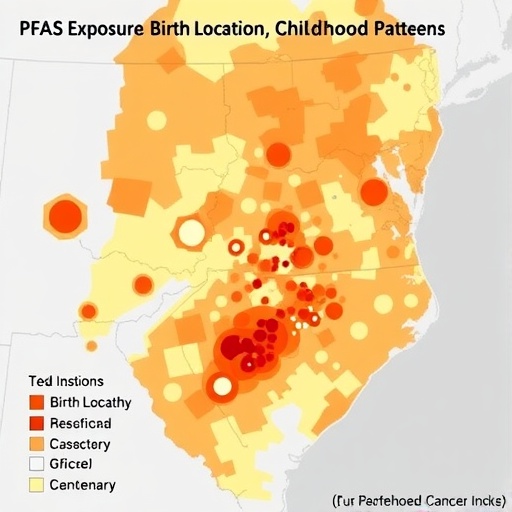
The study’s novelty lies in its integration of spatial analytic methodologies to unravel patterns of childhood cancer incidence against a backdrop of environmental exposure gradients. By mapping birth addresses alongside PFAS concentration data, the team identified high-risk areas where young children faced disproportionate exposure. Crucially, these regions exhibited statistically significant elevations in various childhood cancers when compared to less contaminated neighborhoods. This granular spatial approach provides not just correlation but compelling evidence suggestive of environmental causality, expanding upon prior work that mainly relied on broader population statistics without specific residential histories.
Among the spectrum of cancers assessed, hematological malignancies such as leukemia emerged as prominently associated with PFAS exposure. Leukemia, a cancer of blood-forming tissues, is often linked to genetic and environmental factors during early development. The researchers hypothesize that PFAS might disrupt normal cellular signaling pathways and immunological functions during critical prenatal and early postnatal immune system maturation, thus increasing cancer susceptibility. Furthermore, the study highlights the potential for PFAS exposure to compound other risk factors prevalent in socioeconomically disadvantaged areas, underscoring environmental justice concerns.
Technically, the study employed complex exposure estimation models that combined historical PFAS contamination records, water quality monitoring data, and residential geocoding. These models also accounted for water consumption variations among populations and dynamic changes in water treatment practices over nearly two decades. Advanced statistical analyses, including spatial clustering and regression adjustment for confounders like socioeconomic status, enabled enhanced precision in isolating the influence of PFAS from other environmental and demographic variables. This rigor ensures a high degree of confidence in the observed associations and mitigates common biases encountered in environmental epidemiology.
The implications of this investigation extend far beyond Southern California. Given that PFAS contamination is a national and global issue affecting millions of water systems, the methodology and findings set a precedent for future surveillance and public health interventions worldwide. Communities with known PFAS pollution can adopt similar spatial analytic frameworks to identify other vulnerable populations and extrapolate cancer risk profiles with spatial specificity. Moreover, the study’s longitudinal design permits evaluation of trends over time, thereby aiding policymakers in assessing the efficacy of regulatory measures aimed at reducing PFAS exposure.
One fascinating facet of the research pertains to how the spatial distribution of PFAS correlates with infrastructure and industrial patterns. Many contamination hotspots mirrored locales with concentrated military bases, firefighting training sites, and chemical manufacturing facilities where PFAS use is historically prevalent. The alignment of these industrial and military landscapes with residential areas places entire neighborhoods, especially those born into these zones, at heightened risk. This spatial co-location thus frames an urgent call for targeted remediation efforts that encompass both environmental cleanup and public health screening protocols.
In synthesizing the study’s findings, it becomes evident that environmental toxicants like PFAS must be factored intimately into childhood cancer etiology discourse. While genetic predisposition undeniably plays a role, the intersection with pervasive chemical exposures introduces modifiable risk elements. This paradigm shift foregrounds the need for multi-disciplinary collaboration among toxicologists, epidemiologists, urban planners, and community advocates to orchestrate effective strategies for prevention, early detection, and equitable health outcomes.
The researchers’ use of geographic information systems (GIS) technology exemplifies the growing potency of digital tools in environmental health research. GIS enabled precise spatial overlays of individual-level birth data with chemical distribution maps, allowing for nuanced risk stratification rarely achievable through traditional epidemiology alone. This innovative approach paves the way for real-time monitoring platforms that could dynamically inform public health officials of emerging hazards, facilitating rapid response to contamination events that jeopardize child health.
Moreover, the persistence and bioaccumulation characteristics of PFAS raise compounded concerns about lifelong exposure repercussions. Prenatal and early childhood exposures may trigger epigenetic modifications—heritable changes in gene expression without altering DNA sequences—that predispose individuals not only to cancers but also to immune dysregulation, endocrine disruption, and other chronic diseases. This study acts as a clarion call for intensified research into the molecular mechanisms by which PFAS exert carcinogenic influence during vulnerable developmental windows.
Policy implications from this research echo loudly. Targeted mitigation strategies must prioritize water system decontamination, stricter regulatory standards for acceptable PFAS levels, and proactive community health surveillance focusing on at-risk birth cohorts. Public education campaigns are also paramount to raise awareness among expectant families about environmental exposures and potential risks. Legislative momentum inspired by such spatial epidemiological evidence can catalyze comprehensive reforms safeguarding future generations from preventable environmental carcinogens.
This seminal work also invites reflection on environmental equity and the socio-political dimensions of chemical exposures. The disproportionate concentration of PFAS-related cancer risks within marginalized communities highlights systemic inequalities in environmental protections. Addressing these disparities demands environmental justice frameworks embedded in health policy design, ensuring affected populations have agency in mitigation efforts and remediation funding. Collective societal responsibility should drive initiatives that rectify historic neglect and prevent perpetuation of hazardous exposure cycles.
In closing, the study by Binczewski and colleagues marks a significant advancement in understanding how the nexus of geography, environmental toxicology, and epidemiology coalesce to influence childhood cancer patterns. Their meticulous spatial analysis over two decades vividly illustrates the tangible human health consequences of industrial chemical legacies infiltrating public water supplies. As global environmental contamination challenges mount, this pioneering research offers a robust blueprint for harnessing spatial data science methodologies in unraveling complex exposure-disease relationships, ultimately fostering healthier communities worldwide.
As science continuously evolves, studies like this galvanize the intersection of technology and epidemiology in addressing pressing public health crises. The blend of cutting-edge spatial analytical tools with environmental chemistry insights accentuates emerging pathways for cancer prevention that extend beyond traditional realms. With persistent advocacy and interdisciplinary solutions, there is hope that the haunting shadow of PFAS and its contribution to childhood cancer can be diminished, transforming exposure hotspots into zones of resilience and health.
Subject of Research: Spatial Analysis of Residential Location at Birth, PFAS Exposure in Public Water, and Childhood Cancers
Article Title: Spatial analysis of residential location at birth, PFAS in public water, and childhood cancers in Southern California (2000–2019)
Article References:
Binczewski, N.R., Morimoto, L.M., Wiemels, J.L. et al. Spatial analysis of residential location at birth, PFAS in public water, and childhood cancers in Southern California (2000–2019). J Expo Sci Environ Epidemiol (2026). https://doi.org/10.1038/s41370-026-00850-1
Image Credits: AI Generated
DOI: 05 March 2026


