

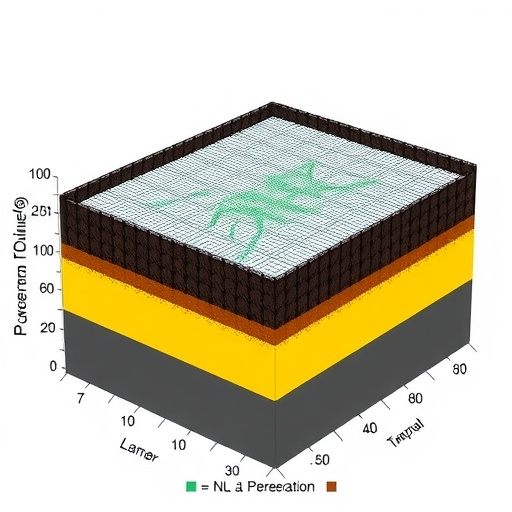
In the evolving field of underground reservoir engineering, understanding the intricate permeability dynamics of materials used in coal mine environments is paramount. Recent groundbreaking research by Rong, Ren, Wang, and their colleagues illuminates these complexities through an innovative study of double porous media material combinations, offering pivotal insights into permeability characteristics that could reshape mine safety and resource management. Published in Environmental Earth Sciences, this investigation addresses both the scientific and pragmatic challenges posed by the multi-scale porous structures typically found in coal mine underground reservoirs, bringing a new understanding that could vastly influence future mining and geological engineering practices.
Underground coal reservoirs are notably complex systems characterized by porous media exhibiting dual porosity — a phenomenon where two distinct pore networks coexist and interact. Traditional models often simplify these interactions or neglect the coupled permeability between the fissures and the matrix materials. However, this new study embarks on a detailed exploration of double porous media, emphasizing the material combinations that influence the flow paths and storage capabilities of gases and fluids in subsurface environments. This offers a leap forward in predicting how hydrocarbons, gases, and water migrate through underground coal seams.
The research methodology integrates advanced numerical simulations with empirical permeability testing, aiming to demystify how variations in pore size distribution and interconnectedness within composite materials affect overall permeability. By simulating the flow in dual porous structures—which consists primarily of a macro-porous network interspersed with micro-porous matrices—the team achieved a nuanced picture of flow behavior, surpassing the predictive accuracy of conventional single-porosity models. This robustness facilitates enhanced control over reservoir engineering strategies in complex settings.
Central to the findings is the identification of synergistic effects arising from the combination of materials exhibiting markedly different pore structures. When these materials are combined in a double porous medium, fluid flow does not merely sum up linearly; rather, it undergoes a complex interaction dominated by pressure differentials and permeability thresholds within each phase of the porous framework. This dynamic intricacy directly affects the permeability coefficient, a fundamental parameter governing the efficiency of resource extraction and gas drainage in underground coal mines.
Furthermore, the study elaborates on how external stresses, such as overburden pressure and mining-induced strain, modulate these permeability characteristics. The double porous media respond anisotropically to such stressors due to the heterogeneous distribution of pore structures. These stress-permeability relationships have immediate practical implications, highlighting avenues to engineer reservoirs that maintain permeability even under mechanical disturbance, thereby mitigating risks associated with ground subsidence or gas outbursts.
By dissecting the dual permeable networks, the paper also addresses the phenomenon of preferential flow paths. These arise from the interconnected macro-pores that facilitate rapid fluid transmission, contrasted with the slower, diffusion-dominated transport through micro-pores. The balance and transition between advective and diffusive transport regimes in such composite media underpin many operational challenges in underground reservoir management, including the optimization of gas drainage systems and water inflow control.
In expanding on these insights, the research sheds light on the significance of porosity ratios and spatial arrangement of constituent materials in dictating permeability thresholds. These parameters influence how fluids navigate the interstitial spaces within the porous structure, affecting volumetric flow rates and residence times, both critical in designing efficient extraction or injection protocols. Enhanced control over these processes may lead to improved recovery rates and reduced environmental impact.
Technologically, the study leverages imaging techniques combined with computational fluid dynamics, creating a multi-disciplinary framework that corroborates theoretical forecasts with experimental validations. Such a comprehensive approach underscores the evolving role of simulation-driven design in subterranean engineering, pushing the boundaries of material science and reservoir physics integration. As a result, the research not only clarifies the fundamental science but also translates it into actionable engineering solutions.
Moreover, the research pioneers new perspectives on how permeability heterogeneity within double porous media can be harnessed to tailor underground reservoir capacities. By systematically adjusting the layering and mixing of materials with distinct porosity characteristics, it becomes possible to construct reservoirs with predetermined flow properties. This concept opens a novel frontier in reservoir customization, potentially enabling site-specific design strategies for coal mine environments.
Addressing environmental sustainability, the study indirectly propels forward the safer management of mine methane—a potent greenhouse gas trapped within coal formations. Better understanding and control of permeability within double porous media can enhance the efficiency of methane capture and drainage systems, lowering emissions and improving safety. This integration of environmental objectives with engineering advances typifies the multidisciplinary nature of modern subsurface research.
The implications of this research resonate beyond coal mining, extending into other geological applications such as carbon sequestration, groundwater management, and hydrocarbon recovery. Double porous media are ubiquitous in many sedimentary formations, and insights garnered through this investigation could inform a wide spectrum of industries reliant on accurate permeability characterization. Thus, the study stands as a bridge connecting fundamental geosciences with applied engineering disciplines.
Importantly, the authors emphasize the need for continued research along these lines, proposing future experiments to refine permeability models under dynamic field conditions. Real-world mining operations present variability far exceeding laboratory setups, and advancing field-applicable methodologies will be crucial for validating and optimizing the concepts introduced. This roadmap invites a broader scientific collaboration focused on bridging theory and practice.
In conclusion, the work by Rong and collaborators represents a significant leap in understanding the permeability behavior of double porous media in underground coal mines. By intricately dissecting the interactions within dual pore networks, the study provides a foundational framework for enhanced reservoir design, operational efficiency, and environmental management. As the global demand for coal and associated gases remains substantial, this research not only advances academic knowledge but also equips engineers with new tools to address the pressing challenges of underground resource extraction.
The advancement in permeability characterization as demonstrated sets the stage for more resilient and sustainable mining operations, underscoring the essential role of interdisciplinary research that fuses geology, material science, and fluid mechanics. As mining ventures delve deeper and environments grow more complex, such studies become indispensable for safe, economical, and environmentally sensitive resource exploitation.
This paper’s detailed analysis and innovative methodologies will doubtlessly influence academia and industry, prompting re-evaluations of current practices and inspiring novel approaches to underground reservoir engineering. The prospect of designing reservoirs with bespoke permeability properties driven by double porous media principles could usher in an era of precision extraction technologies firmly rooted in scientific rigor.
As with many pioneering studies, the challenge now lies in scaling these findings and integrating them into real-world systems. Nonetheless, the path charted by this work promises to transform coal mine reservoir management, enhance methane capture strategies, and broaden our understanding of subsurface fluid dynamics at a fundamental level, marking a new epoch in environmental earth sciences and engineering innovation.
Subject of Research: Permeability characteristics of double porous media material combination in underground coal mine reservoirs.
Article Title: Permeability characteristics of double porous media material combination in coal mine underground reservoirs.
Article References:
Rong, T., Ren, X., Wang, L. et al. Permeability characteristics of double porous media material combination in coal mine underground reservoirs. Environ Earth Sci 84, 705 (2025). https://doi.org/10.1007/s12665-025-12683-6
Image Credits: AI Generated


