

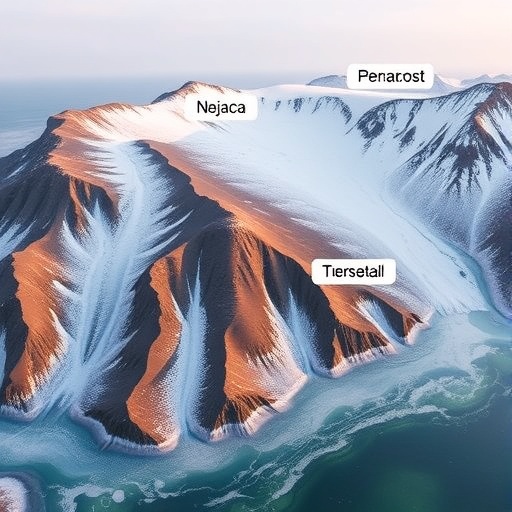
As Arctic and sub-Arctic regions continue to warm at unprecedented rates, the response of permafrost landscapes emerges as a critical interface shaping local and global climate trajectories. A groundbreaking study published by Kokelj, Wolfe, Weiss, and colleagues in Nature Communications reveals how the heterogeneity of permafrost landsystems fundamentally governs the regional variability in climate change impacts on northern environments. This research provides fresh insights into the complex interplay between geomorphology, hydrology, and biogeochemistry in permafrost zones, challenging prior assumptions of uniform thaw consequences and introducing nuanced perspectives essential for climate adaptation strategies.
Permafrost, defined as ground that remains frozen for at least two consecutive years, underpins vast tracts of the Northern Hemisphere, storing approximately 1,500 billion metric tons of organic carbon—nearly twice the carbon currently in the atmosphere. As warming temperatures trigger thawing, this massive carbon reservoir risks release into the atmosphere in the form of methane and carbon dioxide, potent greenhouse gases that could substantially accelerate global warming. However, the spatial and temporal heterogeneity of permafrost degradation has remained poorly understood, complicating prognostications and mitigation efforts.
The authors emphasize that broad climatic warming is but one driver; underlying permafrost landsystem characteristics—complex amalgams of soil composition, ice content, hydrology, and geomorphological configuration—control how thaw unfolds and what ecological and atmospheric consequences ensue. These landsystems are formed by millennia of glacial and sedimentary processes and vary sharply across landscapes, defining distinct permafrost states ranging from continuous icy permafrost to sporadic, ice-poor zones. Each landsystem exhibits unique vulnerability thresholds and feedback mechanisms in response to warming.
In continuous permafrost zones with high ground ice content, the study highlights how thermal erosion leads to abrupt thaw processes such as thermokarst formation—land surface subsidence and collapse into wetlands or water bodies. These features destabilize carbon stores and reshape hydrological flow paths, leading to increased methane emissions from anaerobic microbial degradation in newly formed thermokarst lakes. Moreover, the retreat of ice-rich permafrost modifies vegetation patterns, further influencing carbon cycling dynamics through changes in photosynthesis and respiration balances.
Contrastingly, in discontinuous or sporadic permafrost zones characterized by low ice content, thaw often occurs more gradually via top-down processes. Here, gradual active layer deepening results in enhanced drainage, oxidation of previously frozen organic matter, and higher carbon dioxide fluxes instead of methane. These regions consequently display different greenhouse gas signatures and ecosystem responses. The article elaborates on the vital importance of delineating these contrasting pathways to refine climate models and remote sensing interpretation of permafrost thaw landscapes.
The research integrates high-resolution remote sensing data, extensive field measurements, and modeling approaches to map permafrost landsystem distribution across large swaths of the Arctic. This integrative methodology enables identification of hotspots where warming is likely to drive disproportionate thaw and carbon release, aiding policymakers and communities in prioritizing monitoring and intervention. Additionally, the study stresses the need for incorporating landsystem heterogeneity into Earth system models to avert oversimplified projections that risk underestimating future climate feedbacks.
An innovative aspect of the paper is its interdisciplinary approach marrying geomorphology with microbial ecology, hydrology, and atmospheric science. By parsing the interplay between permafrost physical properties and biogeochemical processes, the authors untangle the mechanisms behind observed variability in greenhouse gas emissions from northern landscapes. For instance, they reveal how soil texture and moisture influence microbial community composition and metabolic pathways, thereby controlling whether carbon is emitted as methane or carbon dioxide following thaw.
Beyond carbon dynamics, the authors trace how permafrost degradation affects northern hydrological networks, triggering shifts in river discharge, groundwater flow, and sediment transport. These changes have profound implications for aquatic ecosystems, freshwater availability, and indigenous livelihoods dependent on stable water resources. The study discusses how abrupt thaw events may amplify local hazards such as landslides, infrastructure damage, and altered wildfire regimes, underscoring the multifaceted risks posed by permafrost thaw.
The paper also situates findings within the broader context of climate feedback loops. For example, as thaw-generated wetlands expand, increased methane emissions may intensify warming, further accelerating permafrost degradation in a positive feedback cycle. Conversely, regrowth of vegetation in some landsystems may partially offset carbon losses, illustrating the complex balancing forces at play. These nuanced insights are pivotal for designing adaptation measures that leverage natural resilience where feasible while mitigating vulnerabilities.
Importantly, the authors call attention to the socio-economic dimensions of permafrost thaw impacts. Northern indigenous populations, whose cultural heritage and subsistence economies are closely tied to permafrost landscapes, face significant disruptions from changing terrain and ecosystem services. The study advocates for inclusive research and decision-making frameworks that integrate traditional knowledge with scientific expertise to foster adaptive capacity among vulnerable communities.
Long-term monitoring emerges as a central recommendation. Given the dynamic nature of permafrost systems, continuous observation using satellite platforms, ground sensors, and citizen science initiatives is essential to detect early signals of destabilization and assess intervention efficacy. The research outlines priorities for enhancing observational networks, including leveraging novel technologies such as unmanned aerial vehicles and soil moisture sensors to improve spatial and temporal resolution.
From a policy perspective, this study’s granular understanding of permafrost landsystem variability provides a powerful tool for tailoring climate mitigation and adaptation strategies at regional scales. It advocates for integrating permafrost considerations into national and international climate agendas, emphasizing the urgency of restraining global temperature rise to minimize irreversible losses in northern environments. Furthermore, proactive infrastructure planning informed by landsystem mapping can reduce economic costs associated with thaw-induced damage.
In conclusion, the work of Kokelj and colleagues marks a paradigm shift by moving beyond coarse assessments of average permafrost thaw to recognize the critical role of underlying landsystem diversity in shaping environmental outcomes. By illuminating the mechanisms that drive regional differences in thaw trajectories and feedbacks, this research enriches the scientific foundation necessary to confront the multifaceted challenges of a warming Arctic. Its implications resonate deeply across climate science, ecology, hydrology, and socio-economic realms, serving as a clarion call for coordinated action.
The paper’s compelling combination of field data, remote sensing, and modeling exemplifies the power of interdisciplinary collaboration in tackling complex environmental problems. As the Arctic continues to transform in the coming decades, such integrative studies will be indispensable for enhancing predictive capacity and informing sustainable stewardship of permafrost landscapes. Ultimately, this research underscores that nuanced spatial understanding is critical to anticipate and mitigate the cascading impacts of climate change on northern environments and the global system.
Subject of Research: Permafrost Landsystems and Regional Variability in Climate Change Effects in Northern Environments
Article Title: Permafrost Landsystems Define Regional Variability in Climate Change Effects on Northern Environments
Article References:
Kokelj, S.V., Wolfe, S.A., Weiss, N. et al. Permafrost landsystems define regional variability in climate change effects on northern environments. Nat Commun (2026). https://doi.org/10.1038/s41467-026-71216-2
Image Credits: AI Generated


