

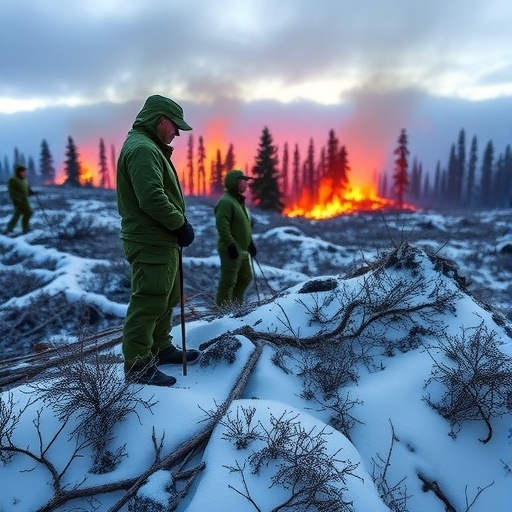
In a groundbreaking study, researchers have underscored the pressing implications of permafrost thawing and wildfire carbon emissions in the context of climate change. As global temperatures rise, these phenomena are projected to release a significant amount of stored carbon, which could further exacerbate the warming trend and hinder global efforts to meet the Paris Agreement’s temperature targets. This work, led by an interdisciplinary team that includes prominent experts Schädel, Gasser, and Rogers, highlights an urgent need for enhanced climate action to mitigate these risks.
Permafrost, which is permanently frozen ground, acts as a carbon sink, securely trapping vast amounts of organic matter. As climate change progresses, areas of permafrost around the globe are experiencing unprecedented thawing. What was once a stable reservoir of carbon dioxide and methane is now at risk, and the potential implications of its release into the atmosphere cannot be understated. The study suggests that the rapid rate of permafrost thawing could significantly increase emissions of these potent greenhouse gases, contributing to a feedback loop that accelerates climate warming.
In addition to permafrost thawing, wildfires have emerged as a critical factor in carbon emissions discussions. The changing climate conditions are making landscapes more susceptible to wildfires, which are becoming increasingly frequent and intense. These fires not only obliterate vegetation but also release carbon dioxide stored within trees and soil back into the atmosphere. The synergistic relationship between wildfires and permafrost thawing poses a dual threat that could derail collective efforts to combat climate change if not adequately addressed.
Enhancing our efforts to mitigate these emissions is essential to uphold the Paris Agreement’s goals. The targets set under this international treaty are designed to limit global temperature rise to well below 2 degrees Celsius above pre-industrial levels, with an aspirational goal of keeping the increase to 1.5 degrees Celsius. However, if current trends continue unchecked, the combined impacts of permafrost and wildfires could threaten the feasibility of achieving these targets.
The research team conducted an extensive analysis that synthesizes existing data on carbon emissions from both permafrost and wildfires. By employing cutting-edge modeling techniques, they were able to project future emissions scenarios under varying climate conditions. The results were alarming—if the current trajectory persists, carbon emissions from these sources could surpass the thresholds necessary to maintain safe levels of atmospheric greenhouse gases.
The findings emphasize the interconnectedness of different climate components and the cascading effects that can arise from one area’s degradation. With permafrost acting as a crucial component of the global carbon cycle, its destabilization, coupled with the increasing frequency of wildfires, paints a grim picture for future climate stability. Addressing this multifaceted challenge requires not only recognition of the problem but also immediate and substantial policy responses at local, national, and international levels.
Researchers advocate for a two-pronged approach in responding to these threats. First, strong measures need to be implemented to reduce greenhouse gas emissions. Transitioning to renewable energy sources, increasing energy efficiency, and adopting sustainable land-use practices can mitigate further warming and provide pathways for adaptation. Secondly, it is imperative to invest in research and monitoring systems that improve our understanding of the dynamics of carbon release from permafrost and wildfires.
In highlighting these challenges, the study also brings attention to the importance of global collaboration. Climate change is a borderless crisis, and its solutions must be equitably shared across nations. Funding initiatives, technology transfers, and joint research projects can help to build resilience against the effects of climate change in vulnerable regions, particularly those most affected by permafrost thawing and increasing wildfire occurrences.
The implications of delaying action are grave. The more carbon that is released from permafrost and wildfires, the lower the chance of stabilizing global temperatures. In light of this, the accountability of both governmental and non-governmental organizations becomes paramount in ensuring that stringent climate action is prioritized. Each year that passes without addressing the escalating risks posed by these phenomena diminishes the prospects for maintaining a habitable planet for future generations.
The urgency of reducing emissions is further compounded by the challenges posed by natural disasters that ensue due to climate change. As more areas witness catastrophic events like wildfires, floods, and extreme weather, the cost of inaction continues to mount. The researchers emphasize that for every ton of carbon that could be mitigated now, not only are emissions reduced, but the long-term costs associated with repairing climate-induced damage are also lowered.
As the world continues to grapple with the realities of climate change, the outcomes of this study serve as a clarion call for action. Comprehensive strategies that encompass both local and global efforts must be prioritized if humanity is to navigate the complexities of a changing climate. Drawing on the knowledge gleaned from this research provides a roadmap for policymakers, environmental groups, and communities alike to adapt and thrive in this new climate era.
The study concludes that while the perils associated with permafrost thawing and wildfires are daunting, they also present a unique opportunity for innovation and leadership in climate resilience. By embracing sustainable practices and investing in technological advancements, society can harness the lessons learned to create a more viable future, ultimately influencing global approaches to climate action as the stakes continue to grow.
In summary, Schädel, Gasser, and Rogers’ research presents an intricate tapestry of challenges and solutions surrounding permafrost and wildfire emissions. As the scientific community continues to unveil the implications of these phenomena, awareness and actionable steps are vital for fostering a sustainable path forward. The time to act is now, ensuring that future generations inherit a planet that thrives in harmony with its climate ecosystem.
Subject of Research: Permafrost thawing and wildfire carbon emissions and their impact on climate change.
Article Title: Permafrost and wildfire carbon emissions indicate need for additional action to keep Paris Agreement temperature goals within reach.
Article References:
Schädel, C., Gasser, T., Rogers, B.M. et al. Permafrost and wildfire carbon emissions indicate need for additional action to keep Paris Agreement temperature goals within reach.
Commun Earth Environ (2026). https://doi.org/10.1038/s43247-026-03189-5
Image Credits: AI Generated
DOI: 10.1038/s43247-026-03189-5
Keywords: Permafrost, wildfire, carbon emissions, climate change, Paris Agreement, greenhouse gases, global warming, environmental policy, sustainable practices, climate resilience.


