

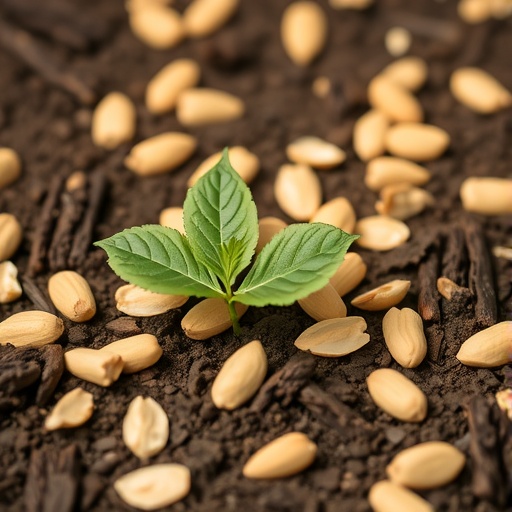
In a landmark six-year field investigation spanning major tobacco-growing regions across China, researchers have uncovered compelling evidence that the application of biochar derived from peanut shells can profoundly enhance soil health and agricultural output. This pioneering study delves deep into the multifaceted effects of biochar amendments, revealing transformative changes in soil chemistry, microbiological communities, and ultimately, crop quality—reshaping the future of sustainable agriculture.
Soil ecosystems are inherently complex and dynamic, with microorganisms playing an indispensable role in nutrient cycling, organic matter decomposition, and overall soil fertility. However, conventional agricultural paradigms characterized by intensive fertilization regimes and continuous monoculture cropping have significantly undermined these natural microbial symbioses. Degraded soil microbial diversity and disrupted interactions have been linked to declining soil productivity and crop resilience, posing a critical challenge to global food security efforts.
The latest research, published in the esteemed journal Biochar, addresses this challenge by evaluating the long-term ramifications of repeated biochar integration into agricultural soils under authentic field conditions. By focusing on peanut shell biochar, a byproduct of agricultural waste valorization, the study offers an innovative pathway to augment soil quality while minimizing environmental footprint. This approach not only recycles organic residues but also potentially mitigates greenhouse gas emissions through biochar’s carbon sequestration properties.
Detailed soil analyses revealed that biochar amendments induced significant enhancements in fundamental soil physicochemical parameters. Soil pH levels were elevated towards neutrality in acidic soils, fostering a more hospitable environment for nutrient uptake by plants. Organic matter concentrations surged, contributing to improved soil structure and water retention capabilities. Furthermore, crucial macronutrients—nitrogen, phosphorus, and potassium—showed increased bioavailability, essential for optimal plant metabolic functions and growth.
Beyond soil chemistry, the study provides groundbreaking insights into the shifts within the soil microbial consortia. Although overall microbial diversity remained largely unchanged, taxa-specific changes were pronounced, particularly among bacterial communities. The Firmicutes phylum experienced noteworthy enrichment, with the Bacilli class constituting about 70% of these beneficial bacterial populations. These organisms are renowned for their plant-growth-promoting attributes, including nitrogen fixation, phosphate solubilization, and synthesis of phytohormones, as well as biocontrol against plant pathogens.
Network analysis of microbial interactions uncovered that biochar application substantially increased the complexity and stability of bacterial co-occurrence networks. This enhanced network resilience suggests improved ecosystem robustness, enabling soils to better withstand environmental stresses. Intriguingly, fungal networks exhibited a decline in complexity, indicating a possible selective inhibition or displacement in favor of bacterial-driven processes, which might realign nutrient cycling pathways towards more efficient bacterial mediation.
An especially striking aspect of this research lies in its linkage between microbial ecosystem shifts and tangible improvements in crop quality. Using advanced statistical modeling, the team demonstrated that enhanced bacterial communities contributed indirectly yet significantly to the accumulation of soluble sugars in tobacco leaves. Since soluble sugar content is a major determinant of flavor and commercial value in tobacco, this finding underscores biochar’s potential to elevate crop marketability alongside yield.
Mechanistically, biochar acts both as a nutrient reservoir and a physical habitat within soil matrices. Its porous structure provides refuge and microenvironments conducive to microbial colonization and activity, fostering beneficial microbiomes. Moreover, the presence of labile carbon fractions within biochar may serve as substrates, stimulating microbial metabolism and the production of enzymes integral to nutrient mineralization and mobilization.
Notwithstanding these promising outcomes, the study highlights that biochar’s effects are not universally beneficial across all soil types. In alkaline soils, for example, biochar application paradoxically diminished phosphorus availability, revealing the necessity for nuanced and site-specific soil management protocols. Such variability underscores the complexity of soil-biochar interactions and the imperative for tailored amendment strategies to maximize agronomic gains.
Beyond its immediate agronomic implications, the research advocates for biochar’s integration within circular economy frameworks. By converting peanut shell waste into a value-added soil amendment, this approach elegantly addresses waste management challenges while contributing to sustainable agricultural intensification. The dual advantage of enhancing soil function and reducing environmental pollution positions peanut shell biochar as a potent agent for agroecological transition.
Importantly, this comprehensive field study addresses prior knowledge gaps that often plague short-term or greenhouse-based biochar research. Its real-world setting across diverse agroclimatic zones lends robustness to the conclusions and paves the way for scalable, regionally adapted biochar deployment. Such empirical evidence is critical for informing policy frameworks and incentivizing farmer adoption of biochar amendments globally.
As agriculture grapples with the dual pressures of feeding a growing population and mitigating environmental degradation, innovative soil enhancement techniques like biochar application become indispensable. This research exemplifies how biochar’s multifunctional roles—as a soil amendment, microbial habitat, and waste valorization tool—can converge to foster resilient, productive, and sustainable cropping systems.
Engagement from multidisciplinary stakeholders, including soil scientists, agronomists, microbial ecologists, and policymakers, will be essential to translate these scientific insights into widespread practical applications. Further exploration into biochar feedstocks, production methods, and long-term ecosystem effects will undoubtedly enrich our understanding and optimize biochar utilization.
In conclusion, the study compellingly positions peanut shell biochar as an effective, eco-friendly strategy to rejuvenate soil fertility, stabilize beneficial bacterial networks, and enhance crop quality within China’s tobacco-producing landscapes. Its success underscores a promising avenue towards sustainable agriculture, circular economy implementation, and global food security resilience.
Subject of Research: Long-term impact of peanut shell biochar on soil fertility and microbial community dynamics in agricultural soils.
Article Title: Long-term peanut shell biochar application improves soil fertility and bacterial network stability across tobacco-growing regions in China.
News Publication Date: 27-Feb-2026
Web References:
- Journal Biochar: https://link.springer.com/journal/42773
- Article DOI: http://dx.doi.org/10.1007/s42773-026-00576-1
References:
Liao, Z., Li, P., Cai, X., et al. Long-term peanut shell biochar application improves soil fertility and bacterial network stability across tobacco-growing regions in China. Biochar 8, 63 (2026).
Image Credits: Zhuzhu Liao, Peiyan Li, Xianjie Cai, Zhongke Sun, Huilin Feng, Zhihong Huang, Yaowei Wei, Quanyu Yin, Guoshun Liu, Chengwei Li, Yu Shi & Tianbao Ren
Keywords: biochar, soil fertility, microbial communities, Firmicutes, Bacilli, peanut shell, tobacco cultivation, sustainable agriculture, soil microbiome, nutrient cycling, bacterial networks, crop quality, soil amendment


