

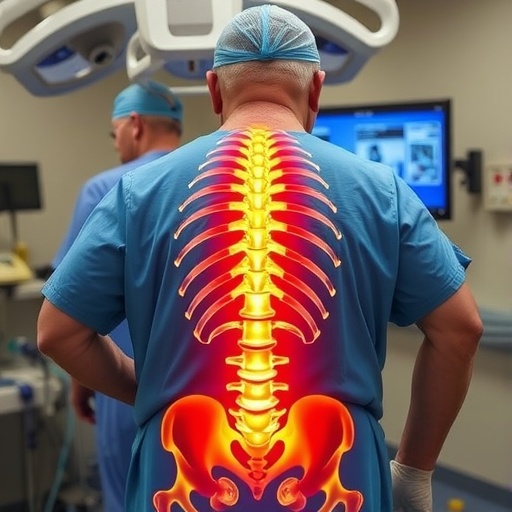
SCOTTSDALE, Ariz. — March 31, 2026 — In a significant milestone for spinal health interventions, the HonorHealth Research Institute has pioneered a groundbreaking procedure utilizing a novel lumbar spine disc repair technology known as the PerQdisc. This innovative therapy, performed for the first time in Arizona and only the second occasion across the United States, offers patients immediate pain relief while preserving the complete range of motion in the lumbar region—a therapeutic advance that addresses the longstanding limitations of conventional spinal surgeries.
The PerQdisc system targets a critical issue in spinal degenerative disease: the damage and depressurization of the intervertebral discs caused by leakage of the nucleus pulposus, the gelatinous core that cushions spinal vertebrae. Much like a deflating tire, when the annulus fibrosus—the tough outer ring of the disc—is torn, the internal jelly leaks, reducing pressure and destabilizing the disc. This structural failure leads to chronic pain and functional impairment, a condition traditionally managed by more invasive surgical techniques like spinal fusion, which restricts movement, or total disc replacement, which requires extensive surgery.
What distinguishes the PerQdisc procedure is its minimally invasive nature and its ability to maintain disc integrity and spinal mobility. Unlike existing treatments, which either immobilize the affected spinal segment or completely replace the disc, the PerQdisc substitutes only the nucleus pulposus. The concept is elegantly simple yet technically demanding: surgeons remove the degenerated jelly-like material through a small incision and then implant a tiny silicone-filled balloon designed to re-pressurize the disc. This novel approach reestablishes the biomechanical function of the disc, offloading stress from nerve roots and restoring normal disc height and mechanical support.
Luis Tumialan, M.D., a neurosurgeon and biomedical engineer affiliated with ASU School of Medicine and the HonorHealth Research Institute’s Neuroscience Research Division, emphasized the rationale behind this intervention. “If loss of the nucleus pulposus essentially deflates the disc causing pain, the logical solution is to restore the pressure, thereby alleviating symptoms,” Dr. Tumialan explains. The PerQdisc achieves this by replicating the natural disc’s hydraulic cushioning system, harnessing silicone’s elastic properties to mimic the physiologic forces within the disc space.
Currently, the use of PerQdisc is focused on the lower lumbar levels—specifically between vertebrae L2-L3, L3-L4, and L4-L5—areas that bear significant mechanical loads and are most susceptible to degenerative disc disease in the adult population. The procedure involves accessing the disc space through a small 6mm metallic cannula, a technique that minimizes tissue disruption and reduces operative time. The surgeon extracts the compromised nucleus material and replaces it with the silicone balloon, a process that can be completed in a single outpatient visit, allowing patients to return home and resume normal activities promptly.
The simplicity and efficiency of the PerQdisc implantation invite questions about its novelty and the technological advances that have only recently made it possible. Dr. Tumialan notes that although spinal surgeons have envisioned such a disc-preserving repair for decades, it was not until now that materials science and biomedical engineering converged to yield a viable implant and delivery method. The company behind this breakthrough, Spinal Stabilization Technologies, headquartered in San Antonio, Texas, has fine-tuned the silicone prosthesis and the procedural instrumentation over several years, resulting in a robust, biocompatible solution for nucleus substitution.
Demographically, the PerQdisc intervention is tailored for individuals in their prime adult years, roughly between the ages of 25 and 50. This age range corresponds to early- to mid-stage disc degeneration where the annulus remains sufficiently intact to retain the implant and prevent extrusion. Patients younger than 25 typically exhibit minimal wear, while those over 50 tend to manifest advanced degenerative changes and structural compromise that preclude the use of this less-invasive restorative procedure.
Dr. Tumialan underscores the importance of early intervention, emphasizing that degenerative disc disease is a progressive condition often overlooked until symptoms become severe. “Our goal is to arrest degeneration at a stage when traditional approaches would offer little relief, capturing patients ‘in the window’ where meaningful repair can be performed,” he remarks. This paradigm shift challenges the conventional “wait and worsen” management strategy, offering a proactive solution to halt or reverse disc damage before extensive surgical intervention becomes necessary.
The first recipient of the PerQdisc treatment at HonorHealth was a middle-aged woman from Los Angeles, whose debilitating back pain was adversely affecting her quality of life and personal plans, including an impending marriage. Chronic lower back pain is frequently an underestimated contributor to psychological distress, including depression, which further complicates patient outcomes. For this patient, understanding the biomechanical principles underlying the PerQdisc’s function, aided by her engineering background, fostered her confidence and acceptance of the novel procedure.
The patient’s successful treatment occurred under the umbrella of the DISCPAIN1 clinical trial, which systematically evaluates the safety and efficacy of the PerQdisc system. Follow-up assessments have shown remarkable improvement in pain reduction and functional restoration, with the patient resuming normal activities and experiencing renewed optimism. This case not only validates the clinical potential of the technology but also exemplifies a broader impact on patient well-being beyond mere symptom management.
The significance of the PerQdisc innovation extends beyond individual patient benefits; it represents a paradigm shift in the management of degenerative spinal disorders. By preserving the spine’s natural kinematics, it mitigates secondary complications often associated with fusion surgeries such as adjacent segment disease and loss of spinal flexibility. This minimally invasive, motion-preserving technology aligns with modern principles of regenerative and restorative medicine, emphasizing functional recovery and quality of life enhancements.
Looking ahead, ongoing clinical trials at HonorHealth Research Institute are poised to refine patient selection criteria, optimize surgical protocols, and evaluate long-term outcomes. As the technology matures and adoption increases, it may herald a new era in orthopedic and neurosurgical spine care, transforming the therapeutic landscape for millions suffering from chronic low back pain worldwide.
For those interested in participating in clinical studies or seeking more information on the PerQdisc system and related innovations, HonorHealth Research Institute provides accessible channels for inquiry and enrollment.
Subject of Research: People
Article Title: Innovation in Lumbar Spine Disc Repair: The Advent of PerQdisc Technology
News Publication Date: March 31, 2026
Web References: https://www.honorhealth.com/company/research-institute
Keywords: Biomedical engineering, lumbar spine, intervertebral disc, degenerative disc disease, PerQdisc, spine surgery, minimally invasive procedure, pain relief, motion preservation, randomized controlled trial, clinical trial


