

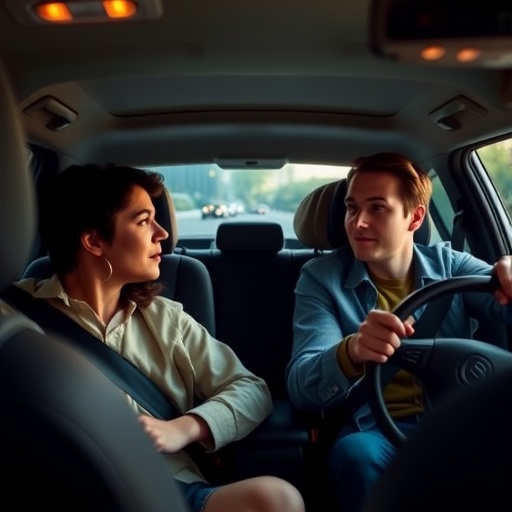
In a groundbreaking study set to shape the discourse surrounding driving safety and behavioral psychology, researchers Liu, Yu, and Zhu have explored the complex dynamics at play when individuals are confronted with the varying influences of passengers and social norms during driving scenarios. Their findings, presented in a virtual environment, shine a light on the psychological aspects that contribute to risky driving behavior, offering invaluable insights that could inform both preventative measures and policy formulation.
Driving has become an integral part of modern life, but with the convenience it provides comes the darker specter of risky behavior behind the wheel. Factors contributing to these behaviors are multifaceted, yet passenger presence and societal expectations play a pivotal role. The researchers adeptly utilized state-of-the-art virtual reality technology to simulate realistic driving conditions, which allowed them to observe participant behaviors more accurately than traditional observational methods could.
One of the most significant findings from this study is that the number of passengers in a vehicle drastically alters the decision-making process of the driver. As more passengers enter a vehicle, a social dynamic emerges that can either heighten or mitigate risky behaviors. Drivers with one or two friends may feel emboldened to take more risks, often engaging in behaviors they ordinarily would avoid when alone. This appears to be largely influenced by perceived social approval or disapproval.
The impact of injunctive norms, which are the perceived expectations of others regarding acceptable behavior, was also critical in this research. The study showed that drivers are often influenced by what they believe their passengers expect of them. For instance, if drivers think their friends expect them to drive recklessly for a thrill, they may very well comply, mirroring behaviors that can lead to dangerous driving. Understanding these social pressures can be vital for researchers and policymakers aiming to reduce road accidents.
The researchers also delved into the intricacies of self-regulation and impulse control, revealing how social situations can weaken these critical psychological faculties. The presence of peers can create a form of social facilitation, where individuals are more likely to engage in high-risk activities under the watchful eyes of friends. This finding prompts a reconsideration of how we educate new drivers about the importance of resisting peer pressure and the ramifications of succumbing to it.
Safety campaigns often focus on instructing drivers to avoid distractions, but this research suggests that the context of the driving situation—a passenger-filled vehicle—can be equally detrimental. It emphasizes that teaching young drivers about the dynamics of social influence may be as crucial as traditional lessons on safe driving practices. A comprehensive approach to driver education that includes these elements may help in cultivating safer driving environments.
Virtual reality has historically been limited to specific training scenarios in driving education. However, Liu, Yu, and Zhu successfully leveraged this technology to replicate not only the driving experience but also the accompanying social interactions. This innovation opens the door to conducting further studies in varied environments, potentially leading to even deeper insights into risk behavior under various conditions.
The study raises critical questions about responsibility and accountability in shared driving situations. When multiple individuals are present, who can be deemed responsible for risky behaviors? This ambiguity becomes increasingly pertinent as more complex social interactions occur within a shared vehicle space. The implications of the findings may extend beyond just individual driver behavior; they could influence legislative approaches to car insurance and liability in cases of accidents involving multiple passengers.
Moreover, cultural differences in how social norms influence driving behaviors present another area worthy of study. The researchers urge that future investigations consider how societal expectations vary across different cultures, potentially adjusting how educational programs and public services address risky driving behaviors.
In conclusion, the pivotal work of Liu, Yu, and Zhu illustrates the profound influence that passengers and social norms exert on driving behavior. The adoption of advanced technology, such as virtual reality, provides a robust framework for understanding these influences, paving the way for innovative educational strategies and policy reforms aimed at reducing the incidence of risky driving. As society grapples with the implications of these findings, a renewed focus on the social aspect of driving safety may drastically reshape our approach to this critical public health issue.
The insights garnered from this research usher in a new era of understanding in road safety psychology and highlight the necessity of considering the social dynamics at play whenever individuals take to the road. The interconnectedness of social environments and individual behavior calls for a collaborative effort in crafting targeted interventions aimed at promoting safer driving, embodying a collective responsibility that transcends personal choice.
Subject of Research: The impact of the number of passengers and injunctive norms on risky driving behaviors.
Article Title: The impact of number of passengers and injunctive norms on risky driving behaviors in a virtual environment.
Article References:
Liu, J., Yu, B. & Zhu, L. The impact of number of passengers and injunctive norms on risky driving behaviors in a virtual environment.
Discov Psychol (2025). https://doi.org/10.1007/s44202-025-00575-6
Image Credits: AI Generated
DOI: 10.1007/s44202-025-00575-6
Keywords: risky driving behavior, social norms, passenger influence, virtual reality, driving safety, psychology.


