

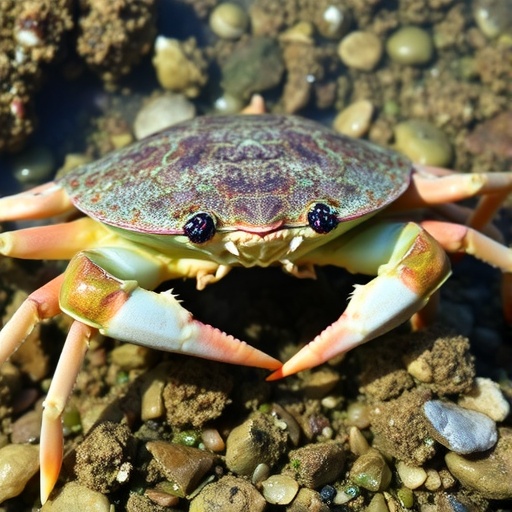
In a groundbreaking study published in the journal Ecology, researchers from William & Mary’s Batten School of Coastal & Marine Sciences and Virginia Institute of Marine Science (VIMS) have uncovered an unexpected ecological service provided by oysters that could revolutionize our understanding of disease control in marine environments. Their research demonstrates that oysters, known for their water-filtering capabilities, can actively reduce the transmission of a lethal parasite affecting juvenile blue crabs, Chesapeake Bay’s economically and ecologically valuable species.
Traditionally, oysters have been celebrated for their ability to cleanse their aquatic habitats by filtering out algae, sediments, and excess nutrients, thereby improving water clarity and quality. However, this new research reveals that oysters also play a crucial role in mitigating disease spread by removing infectious agents from the water column. The parasite Hematodinium perezi, a dinoflagellate known for causing debilitating infections in juvenile blue crabs, is significantly less likely to infect crabs located near actively filtering oysters.
Field experiments conducted on Virginia’s Eastern Shore involved deploying juvenile blue crabs in cages either near live oysters, empty oyster shells, or in environments devoid of oyster presence altogether. Remarkably, juvenile crabs adjacent to live oysters exhibited about a one-third reduction in infection rates, a testament to the filtering efficiency of active oyster populations. The reduction was not observed in cages with empty shells, underscoring the importance of the oysters’ biological activity in pathogen removal rather than simply physical habitat structure.
To investigate the mechanisms behind this protective effect, the team conducted controlled laboratory experiments in VIMS’ Seawater Research Lab. Here, oysters exposed to dinospores — the infectious developmental stage of Hematodinium perezi — rapidly cleared these motile, free-swimming parasites from the water, removing over 60% within just one hour. This filtration rate mirrors the oysters’ known capacity to eliminate planktonic particles, highlighting their pivotal role in pathogen suppression.
Interestingly, although the researchers noticed a trend of reduced mortality among crabs housed near live oysters, they urge caution in ascribing causality solely to the presence of oysters. The complex interplay of environmental variables and host-parasite interactions suggests that the observed survival advantage may result from multiple synergistic factors. Nevertheless, the implications of lowered infection risk and possibly enhanced survival have vital consequences for fisheries management and coastal health.
The study also illuminated unexpected disease dynamics linked to crab size. Contrary to initial assumptions that the smallest juveniles would be most vulnerable to infections, larger juvenile crabs showed higher incidence rates over time. This finding has profound implications for population ecology and fishery sustainability since adult crabs, harvested heavily by the fishery (up to 40% annually), rely on a recruitment pool of juveniles that must survive and mature to maintain population stability.
By integrating field ecology, laboratory experimentation, and sophisticated mathematical modeling, the interdisciplinary team is forging new pathways to predict how oyster filtration can influence host-parasite relationships on a broader ecological scale. The National Science Foundation-funded project combines biological insights with advanced applied mathematics to simulate disease dynamics and assess potential outcomes of oyster restoration initiatives under varying environmental conditions.
This modeling framework is particularly crucial as coastal waters face increasing temperatures due to climate change, which intensifies parasite transmission and host susceptibility during warm summer months. Understanding when and where oysters can most effectively suppress pathogens could inform targeted restoration and management strategies, enhancing both ecosystem resilience and commercial fisheries.
William & Mary’s Jeffrey Shields, the study’s principal investigator, notes that despite restoration efforts, current oyster populations remain drastically reduced compared to historical baselines. This reduction translates into diminished filtration capacity and, consequently, the loss of an essential ecological service — pathogen removal. Through mathematical models, the team hopes to evaluate whether scaling up oyster populations could meaningfully impact disease prevalence and promote healthier marine ecosystems.
Lead author Xuqing Chen, Ph.D. ’25, now a postdoctoral researcher in France, emphasizes the broader significance of this research by calling attention to understudied marine disease dynamics. The complexity of marine ecosystems and the often-overlooked role of microbial and parasitic interactions impose profound challenges that, if unraveled, could greatly benefit fisheries and biodiversity conservation.
The discovery that oysters can filter out deadly parasite spores from coastal waters expands their ecological value beyond mere habitat providers and water purifiers. It positions them on the frontline of natural disease mitigation strategies, reinforcing the urgency of robust oyster restoration programs within the Chesapeake Bay and similar ecosystems globally.
Future research will likely focus on refining models of filtration-dependent disease control and validating these predictions across different temporal and spatial scales. This will be crucial for integrating scientific findings into practical fisheries management policies, potentially transforming how marine diseases are approached and controlled in wild populations.
The full manuscript detailing these findings and methodologies is accessible through the Ecology journal website, providing a comprehensive resource for ecologists, marine biologists, and environmental managers eager to apply these innovative insights to real-world conservation challenges.
Subject of Research: Animals
Article Title: Filter feeding by oysters reduces disease transmission in a marine host–parasite system
News Publication Date: 17-Jan-2026
Web References: https://esajournals.onlinelibrary.wiley.com/doi/10.1002/ecy.70281
References: Shields, J., Chen, X., et al. (2026). Filter feeding by oysters reduces disease transmission in a marine host–parasite system. Ecology. DOI: 10.1002/ecy.70281
Image Credits: Lyndsey Smith
Keywords: Species interaction, Crustaceans, Shellfish, Marine biology, Parasitology


